Quick Answer
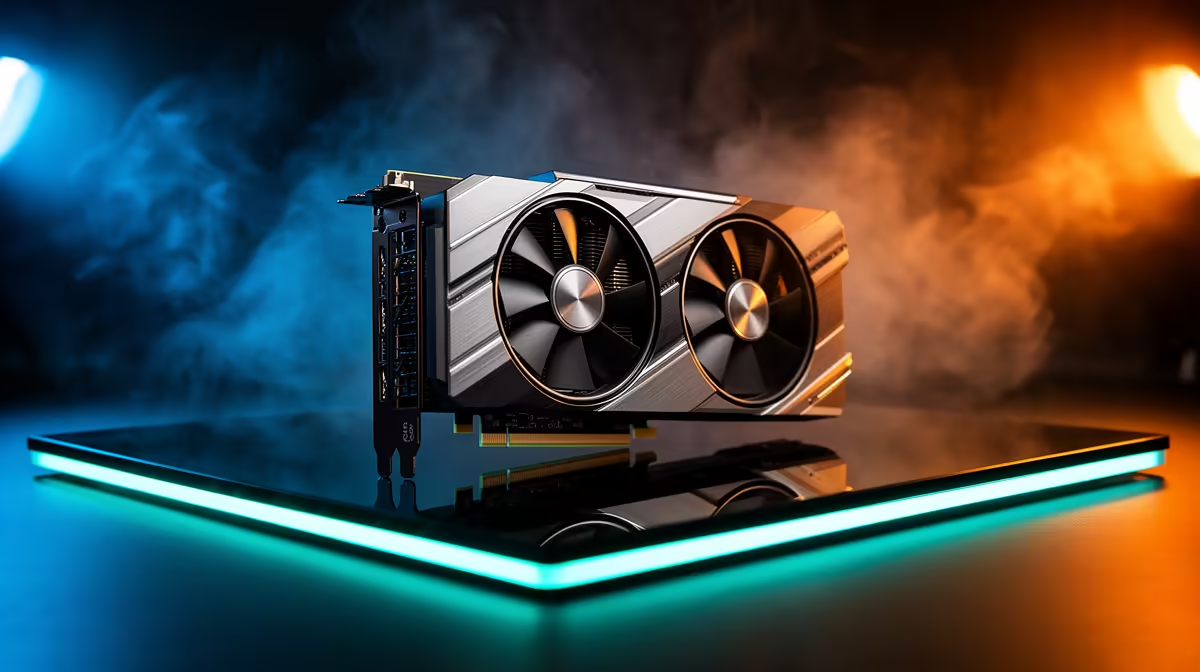
A GPU bottleneck at 1080p means the graphics card is the limiting factor on frame rate, with the GPU at near 100% utilisation while the CPU waits. This is the ideal operating state; the problem is when the GPU is the wrong tier for the resolution, delivering less than 60 fps at target settings despite running at full load.
Understanding GPU vs CPU Bottlenecks at 1080p 🎮
At 1080p, the GPU handles a lower pixel volume than at higher resolutions, giving the CPU a larger relative contribution to frame production. Esports titles at 1080p 144 Hz or 240 Hz can become CPU-bottlenecked on mid-range GPUs because the GPU finishes frames faster than the CPU can prepare draw calls. This is why high-refresh 1080p gaming often benefits from a faster CPU as much as a faster GPU.
For graphically demanding single-player games, the GPU remains the bottleneck even at 1080p because these games are GPU-heavy by design. Cyberpunk 2077 and Hogwarts Legacy are GPU-bound at 1080p High on any current GPU from the RTX 5060 tier upward.
To identify your actual constraint, run HWiNFO64 during gaming. GPU at 99% with CPU at 50% means the GPU is the limit. CPU cores near 100% with GPU at 70% means the CPU is your bottleneck.
What Causes a GPU to Struggle at 1080p 🔧
Insufficient VRAM causes stutters rather than a smooth bottleneck. When the frame buffer is exhausted, the GPU pages assets to slower system RAM, producing frame time spikes. This is why 8GB is the minimum VRAM floor for current-gen gaming.
Running an older GPU architecture with modern games creates genuine bottlenecks at 1080p. A GTX 1060 6GB lacks the shader throughput to process modern game engines at 60 fps in demanding titles. Upgrading to an RTX 5060-class card in the R8,000 to R12,000 range resolves this completely.
Thermal throttling is a hidden cause. A GPU that overheats reduces its clock speed to stay within temperature limits, appearing as a bottleneck when the hardware should be capable. Cleaning the cooler and repasting the GPU often resolves this without any hardware upgrade.
Pairing Your GPU With the Right CPU at 1080p 💡
For 1080p at 60 fps targets, a Ryzen 5 5600 paired with an RTX 5060 is a balanced combination. For 1080p 144 Hz targets, a faster CPU helps: a Ryzen 7 7700X or Core i7-13700 gives the GPU enough pre-processed frames to sustain high refresh rates in competitive titles.
Avoid large CPU mismatches in either direction. A fast RTX 5080 with a Ryzen 5 3600 will be CPU-bottlenecked. An RTX 5060 with a Core i9-14900K is CPU overkill, wasting money better spent on a GPU tier upgrade.
Check Your Bottleneck With a Free Tool Before Upgrading ⚡
Download HWiNFO64 and run it in sensors-only mode alongside your game. Monitor both GPU Core Load and CPU Total Thread Usage simultaneously during a 10-minute gaming session. This definitively identifies which component is limiting your frame rate before you spend a rand on hardware.
FAQ
Will a GPU upgrade always fix low FPS at 1080p?
Only if the GPU is the actual bottleneck. If your CPU cores are maxed while the GPU is underutilised, a GPU upgrade will not improve frame rates. Always identify the bottleneck with a monitoring tool first.
Does a GPU running at 100% utilisation damage the card?
No. A GPU at 100% utilisation during gaming is operating exactly as designed. The only risk is if the card overheats due to poor cooling, which is a separate issue from utilisation percentage.
Can DLSS resolve a GPU bottleneck at 1080p without new hardware?
Yes. DLSS Quality mode at 1080p renders internally at roughly 720p and reconstructs a sharp output image, boosting performance by 30 to 50% in supported titles. This is the most cost-effective way to address a GPU bottleneck without any hardware upgrade.
GPU bottlenecked and ready to upgrade?
Evetech stocks mid-range and high-end graphics cards that remove 1080p bottlenecks. Browse the graphics card category to find the right tier for your CPU pairing and frame rate targets.