Quick Answer
A quality 360mm AIO radiator keeps a Ryzen 9 9950X under 80 to 85 degrees Celsius during sustained Cinebench R24 all-core workloads at stock clocks, and an Intel Core Ultra 9 285K under 85 to 90 degrees Celsius at PL1 (253W). For gaming-only workloads where CPU utilisation is moderate, CPU temperatures on 360mm AIOs typically stay in the 60 to 75 degree Celsius range even for flagship CPUs.
Temperature Targets by CPU Tier with a 360mm AIO 🌡️
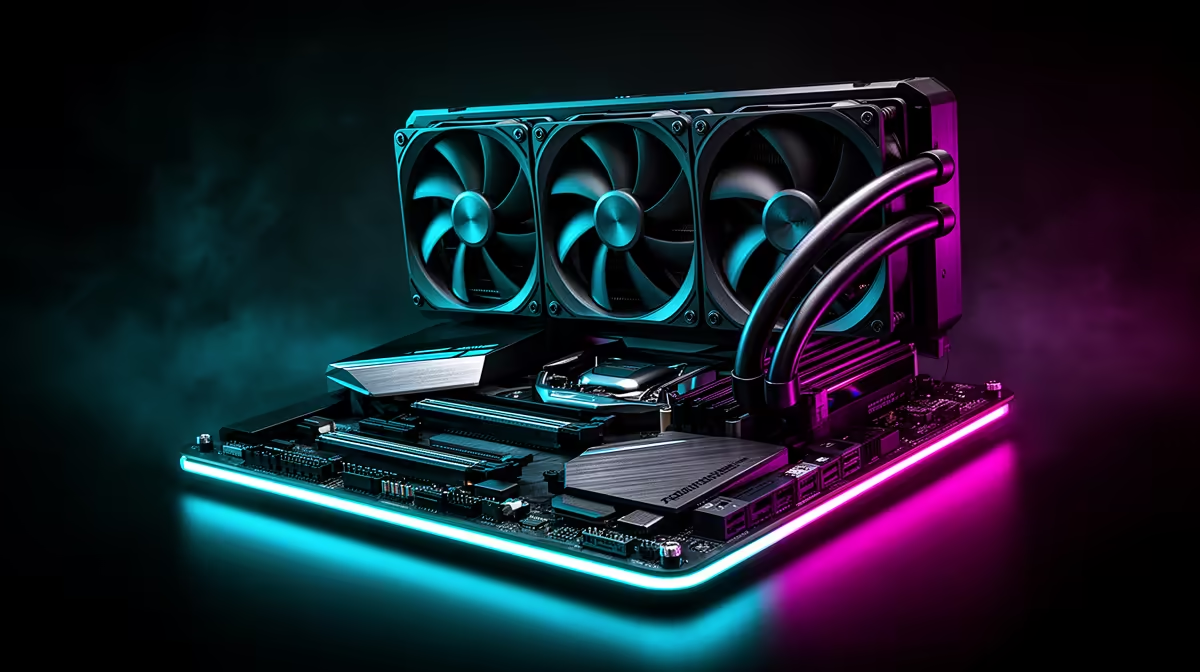
A 360mm radiator with three good 120mm fans provides roughly 350 to 400W of sustainable cooling capacity, depending on fan speed and ambient temperature. The Ryzen 7 9700X at 65W TDP stays comfortably below 65 degrees Celsius during gaming and under 70 degrees during sustained all-core workloads. The Ryzen 9 9900X at 120W stock TDP sits between 70 and 78 degrees during Cinebench. The Ryzen 9 9950X at 170W TDP pushes the 360mm radiator meaningfully, landing at 80 to 86 degrees under full render load, still within AMD's 95-degree Celsius safe operating limit.
How Ambient Temperature in SA Affects AIO Performance 🌞
Cooling headroom is always relative to ambient. A 360mm AIO keeping a CPU at 75 degrees Celsius in a 22-degree ambient room will show 83 degrees in a 30-degree ambient room under identical load, because the delta-T remains roughly constant. South African builders in coastal cities like Durban or inland in Pretoria during summer should factor 28 to 32 degree ambient into their temperature planning rather than the 20 to 22 degree figures used in international reviews. A 360mm radiator that looks borderline in summer ambient conditions can be supplemented with better case airflow, particularly by ensuring the front radiator pulls cool air from outside the case.
Overclocking and Power Limits Beyond 360mm Capacity 🔧
Pushing a Ryzen 9 9950X with PBO2 and extended power limits can raise sustained all-core power draw from 170W to 230W or more. At 230W in a warm SA ambient environment, CPU temperatures regularly touch 90 degrees Celsius. This is not dangerous but means the CPU's boost algorithm frequently thermal-throttles, negating some overclock gains. Builders who plan to run extended power limits on flagship CPUs in warm SA rooms should either improve case airflow substantially or budget for a 420mm radiator at R3,000 to R5,000 if their case supports it.
Use Your AIO Software to Log Peak CPU Temps During Gaming ⚡
Run NZXT CAM, Corsair iCUE, or HWiNFO64 during your most CPU-heavy game for 30 minutes and log peak temperatures. If peaks stay under 85 degrees Celsius consistently, your 360mm AIO is well-matched. If you regularly see 88 to 92 degrees in gaming, investigate case airflow improvements before assuming the AIO is undersized.
FAQ
Is a 360mm AIO worth the extra cost over a 240mm for a Ryzen 9 9900X?
Yes for South African builds where ambient temperatures are higher than international reviews assume. A 360mm AIO on a 9900X in a 30-degree ambient room delivers the same temperatures a 240mm provides in a 22-degree room, making the larger radiator a practical necessity in warm climate gaming setups.
Will a 360mm AIO handle an Intel Core Ultra 9 285K comfortably?
For gaming workloads, yes. For sustained all-core compute with the full 253W PL2 power limit active, the 360mm radiator keeps the 285K operational but often near its thermal limit in warm ambient conditions. Reducing PL2 to 200W in BIOS typically keeps the 285K under 85 degrees on 360mm without significant gaming performance loss.
How does a 360mm AIO compare to a premium air cooler for gaming?
In gaming (60 to 80W sustained CPU load), a premium dual-tower air cooler and a 360mm AIO deliver nearly identical temperatures within two to four degrees Celsius. The 360mm AIO advantage becomes clear only under sustained all-core loads exceeding 120W, making it most valuable for creator or overclock builds.
Shopping for a 360mm AIO to keep your CPU cool through South African summers?
Evetech stocks a full range of 240mm and 360mm all-in-one coolers with local warranty and nationwide delivery.