Quick Answer
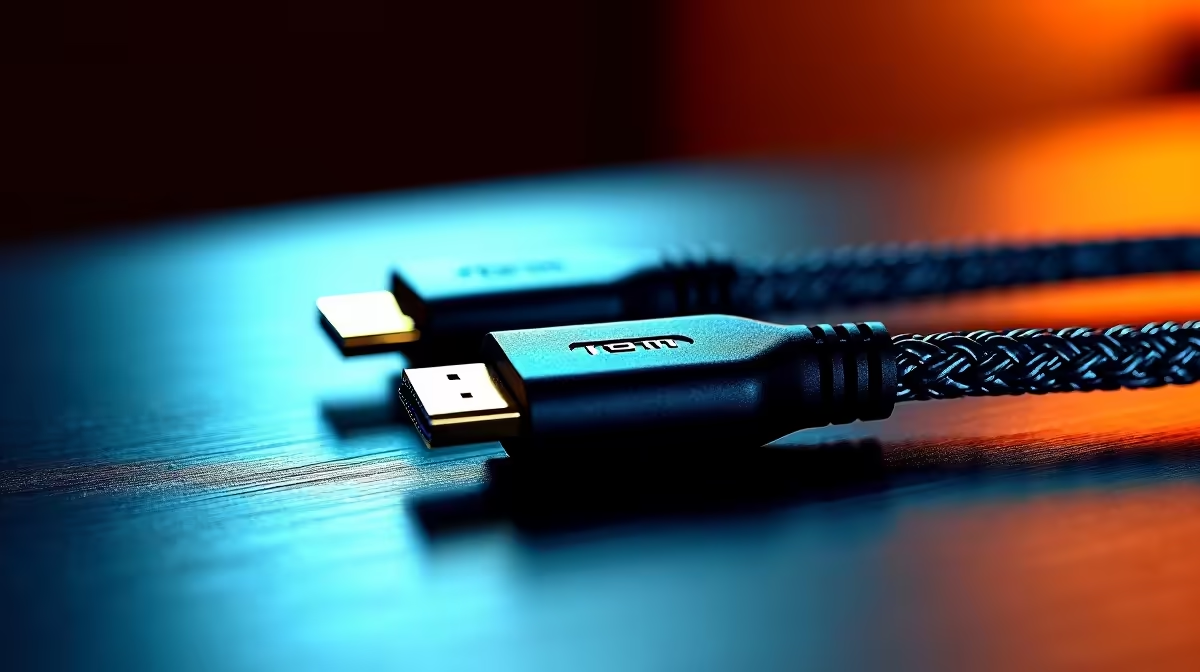
For 4K at 60Hz you need an HDMI 2.0 cable, rated at 18Gbps. An HDMI 1.4 cable will cap you at 4K 30Hz, and HDMI 2.1 cables work but are overkill for 60Hz. Any length up to 5m in a passive HDMI 2.0 cable is safe for full-bandwidth 4K 60Hz delivery.
HDMI Version Guide for 4K Displays 🖥️
HDMI cables and ports are version-stamped by their maximum bandwidth. HDMI 1.4 tops out at 10.2Gbps, which is enough for 4K at 24 or 30Hz but falls short of the roughly 17.8Gbps a 4K 60Hz 4:4:4 signal requires. HDMI 2.0 raises the ceiling to 18Gbps, clearing that threshold and adding support for HDR10, HLG, and Dolby Vision. HDMI 2.1 jumps to 48Gbps, which is needed for 4K 120Hz or 8K content. For a 4K 60Hz TV or monitor used with a PS5, Xbox Series S, or a mid-range RTX 5060 gaming PC, HDMI 2.0 is the precise match: you are not underpowered and you are not paying a premium for bandwidth you will never use. Budget around R120 to R280 for a certified HDMI 2.0 cable stocked locally.
TV vs Monitor: Does the Cable Choice Differ? 📺
The cable type is the same for both, but the port labelling can differ. On TVs, HDMI 2.0 ports are often marked as "HDMI 2.0" or "eARC" (the eARC port on modern TVs is always HDMI 2.0 or 2.1). On monitors, the port is usually labelled plainly as "HDMI" but the spec sheet confirms the version. Where a monitor has both DisplayPort and HDMI 2.0, DisplayPort 1.4 carries 4K 60Hz equally well and is slightly more common on PC graphics cards including Nvidia's RTX 50-series. For consoles that only output over HDMI, a certified HDMI 2.0 cable is the only option.
Cable Length and Its Effect on 4K Signal Quality 📏
Passive HDMI 2.0 cables are rated for up to 5m at full 18Gbps bandwidth. Beyond that, conductor resistance and capacitance cause signal attenuation that can introduce visual artefacts or blank screens. If your setup needs more than 5m, step up to an active HDMI 2.0 cable, which incorporates a signal repeater chip (typically powered by the HDMI port itself). Active cables in the 7m to 15m range are available locally at around R350 to R700. For most South African setups with the source within 3m of the display, a standard passive HDMI 2.0 cable at R150 to R250 is the right call.
Match Cable and Port Versions Precisely ⚡
If you have a 4K HDR TV but connect it via HDMI 1.4 by mistake, your device may fall back to 4K 30Hz or disable HDR entirely without warning. Check your cable's packaging for an '18Gbps' or 'HDMI 2.0' marking before seating it, and confirm the TV's HDMI port is set to Enhanced or HDMI 2.0 mode in the settings menu.
FAQ
Can I use an HDMI 2.1 cable on an HDMI 2.0 TV or monitor?
Yes. HDMI 2.1 cables are backward-compatible and will work in HDMI 2.0 ports at HDMI 2.0 speeds. You simply will not gain any 2.1 features (4K 120Hz, VRR, ALLM) unless both your cable and display support them.
What if my gaming PC only has DisplayPort on the GPU?
You can use a DisplayPort to HDMI 2.0 adapter or a DP-to-HDMI 2.0 cable to connect to your 4K display at 60Hz. Confirm the adapter or cable is rated for 18Gbps, as cheap adapters often default to HDMI 1.4 speeds.
Does it matter whether I buy a branded or unbranded HDMI 2.0 cable?
What matters is that the cable is certified or tested at 18Gbps. Evetech stocks cables from verified suppliers. Unbranded cables from bulk retailers sometimes carry HDMI 2.0 labelling without meeting the full spec, causing intermittent 4K issues.
Need the right cable for your 4K screen?
Evetech stocks a range of certified HDMI 2.0 cables suitable for TVs, gaming monitors, and console setups, with nationwide delivery across South Africa.