Quick Answer
A liquid cooler earns its premium price tag in a high-end gaming build when it delivers lower peak temps, sustained boost clock maintenance, quieter operation under load, and a longer service life. These factors directly affect gaming performance and system longevity, making the R1,000 to R2,000 price gap between mid-range and premium units a worthwhile investment on builds costing R25,000 or more.
Sustained Boost Clocks Under Gaming Load 🎮
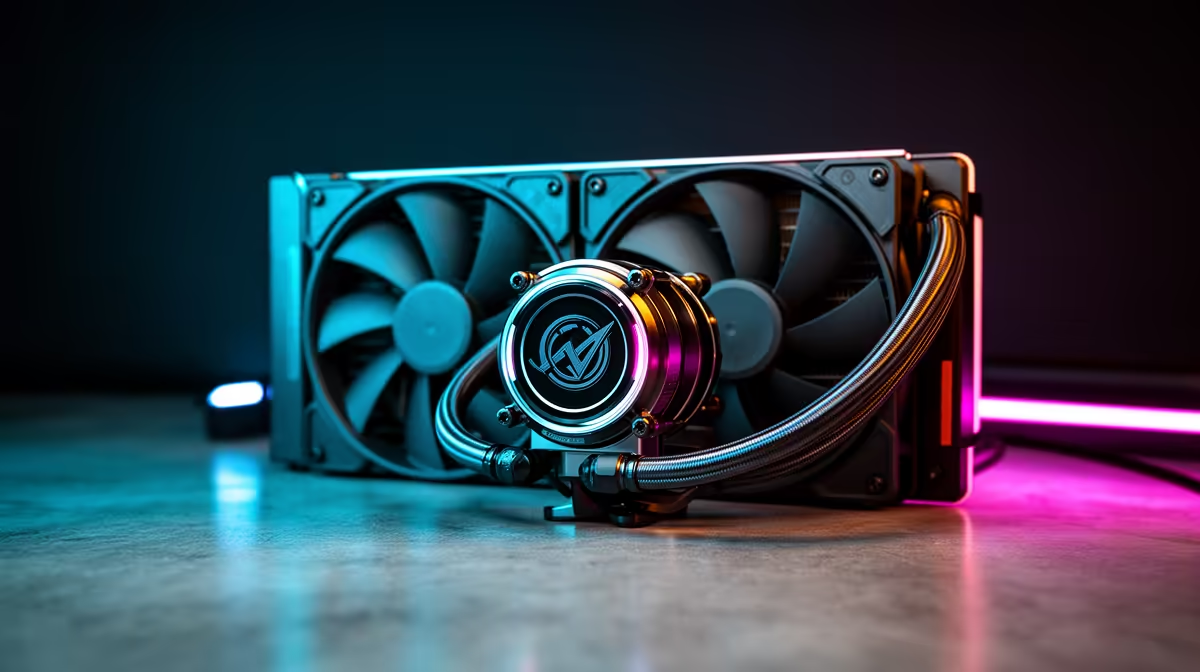
Modern gaming CPUs like the Ryzen 7 9800X3D and Core i9-14900K aggressively boost to their maximum frequencies only when thermal headroom allows. A premium 360mm AIO with a thick radiator and strong pump can keep a Ryzen 7 9800X3D below 75 degrees Celsius under extended gaming sessions, letting it maintain its full 5.2 GHz boost consistently. A cheaper cooler that allows temps to climb above 90 degrees triggers thermal throttling, clipping those boost frequencies and costing real fps in CPU-sensitive titles. The delta between a well-cooled and a thermally limited Ryzen 7 9800X3D can reach 8 to 12 fps in games like CS2 and Rainbow Six Siege.
Noise Levels During Long Gaming Sessions 🔊
Premium AIOs invest heavily in fan engineering. Higher-quality bearings, optimised blade profiles, and better motor controllers allow a premium 360mm unit to cool a 170W CPU at fan speeds below 1,200 RPM, compared to a budget unit that might need 1,800 RPM or more to achieve the same result. In a South African gaming setup where the PC sits close to the monitor and headset, fan noise becomes fatiguing across a four-hour session. Spending R3,500 to R5,000 on a quality AIO rather than R1,800 on a budget option pays off in daily comfort.
Build Longevity and Warranty Value 🔧
High-end gaming builds in South Africa represent a significant outlay, often R20,000 to R40,000 once GPU, CPU, and platform costs are included. A premium AIO with a robust pump, quality tubing, and local warranty coverage (typically two to three years) protects that investment far better than a budget cooler with an uncertain service life. Pump failures on cheap AIOs can cause catastrophic CPU damage if coolant leaks onto the motherboard. Premium units from established brands with local distributor support mitigate this risk substantially.
Test Cooler Temps Before Long Gaming Sessions ⚡
Run a 10-minute stress test in HWiNFO64 immediately after installing a new AIO to confirm temps are within spec before committing to long gaming sessions. A freshly mounted premium AIO on a Ryzen 7 9800X3D should not exceed 80 degrees Celsius under full synthetic load.
FAQ
Is a premium AIO worth it on a build already using a fast GPU like an RTX 5080?
Yes. A high-end GPU pushes more heat into the case, raising ambient temps inside the chassis. A premium AIO with better fan performance handles elevated ambient temps more gracefully, maintaining CPU thermals even when the GPU is generating significant heat nearby.
At what CPU TDP does a premium AIO become mandatory?
CPUs with a sustained power limit above 150W, such as the Core i9-14900KS or Ryzen 9 9950X, genuinely need a premium 360mm AIO or better. At that thermal output, a mid-range cooler will either throttle the CPU or run fans at intrusive RPMs.
Do premium AIOs come with better thermal paste applied at the factory?
Many do, but results vary. Some premium units ship with high-conductivity paste pre-applied to a consistent standard, while others use generic compounds. Checking reviews or reapplying with a quality aftermarket paste like Thermal Grizzly Kryonaut is worthwhile on a flagship build.
Fitting a top-tier CPU into your build?
Browse premium liquid coolers at Evetech to find the right match for your socket, case, and thermal targets.