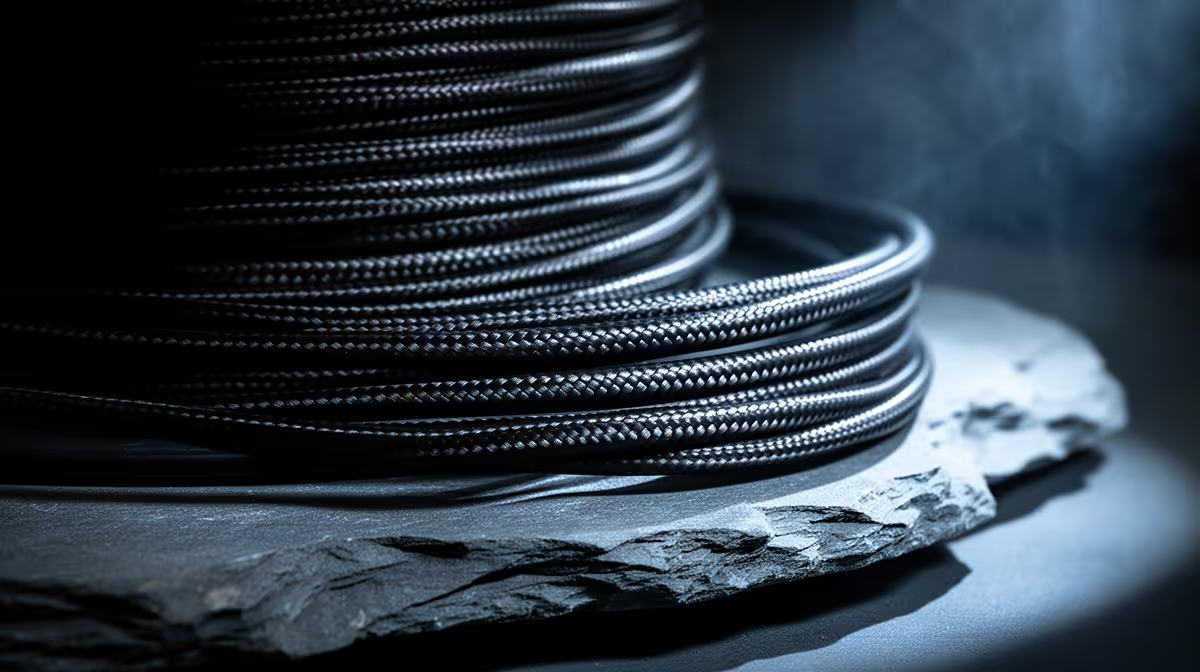
Leave a spool of nylon on the bench overnight in a Durban summer and you can hear the result the next morning: a faint crackle and tiny steam pops at the nozzle, followed by stringy, brittle prints that snap under light load. Of all the common 3D printing materials, nylon and its carbon-fibre blend PA-CF absorb airborne moisture faster than almost anything else you can feed a printer, and they do it within hours, not days.
Quick Answer
Nylon and PA-CF are the fastest moisture absorbers in everyday 3D printing. A dry spool can reach a problem level of around 0.75 percent water content in roughly 2 to 8 hours of open exposure, and visible defects start near 0.5 percent. Drying PA-CF at 70 to 90C for several hours in a dedicated filament dryer before every session is non-negotiable, especially on the humid SA coast.
Why nylon drinks water so quickly
Hygroscopic simply means a material pulls moisture out of the surrounding air. Nylon (technically a polyamide, hence PA6, PA12 and PA-CF) has polar amide groups along its molecular chain that bond readily with water. PLA and PETG are mildly hygroscopic and forgive a sloppy storage habit; nylon does not.
Lab testing on nylon filament has shown that even a relatively dry spool reaches a moisture content that produces visible print artifacts within 2 to 8 hours of sitting in normal room air above about 50 percent relative humidity. By comparison, the same spool sealed in a vacuum bag with desiccant gained only a couple of grams of water across a full month. The takeaway is blunt: with nylon, the clock starts the moment you break the seal.
What wet nylon actually does to a print
When water-laden filament hits the hot end, the trapped moisture flashes to steam inside the melt zone. That steam disrupts the smooth flow of plastic and leaves you with a stack of compounding faults:
- Audible popping or crackling at the nozzle as steam escapes.
- Rough, hairy surfaces with heavy stringing between travel moves.
- Bubbling and inconsistent extrusion that ruins dimensional accuracy.
- A dramatic loss of layer adhesion, so the finished part is weak and brittle exactly where nylon is supposed to be tough.
The cruel part is that nylon is chosen precisely for strength, heat resistance and durability. Print it wet and you throw away the only reasons you reached for it.
PA-CF makes the stakes higher
Carbon-fibre-reinforced nylon raises the engineering ceiling, adding stiffness and dimensional stability for functional brackets, jigs and drone parts. It is also more expensive per spool, so a failed PA-CF print wastes more money than a failed PLA one. The carbon content does not change the hygroscopic behaviour of the nylon base, which means PA-CF needs the same disciplined drying as plain nylon, just with even less tolerance for mistakes.
Drying temperatures and times that work
Drying is not the same as printing hot. The goal is to drive moisture out of the spool without softening or annealing the plastic. Published recipes cluster in a clear band:
- PA-CF low-warp blends: roughly 70C for 4 to 6 hours.
- General PA-CF: 80 to 90C is widely cited.
- Some nylon blends (eSUN PA-CF among them): a longer 12-hour cycle near 80C for a thoroughly soaked spool.
A practical rule for coastal SA: if a nylon or PA-CF spool has been open for more than 8 hours in a room above 50 percent humidity, dry it before printing regardless of whether you see symptoms yet. A dedicated filament dryer that holds a steady temperature is far more reliable than a kitchen oven, which tends to overshoot and can deform a spool. Browsing the well-reviewed gear in the accessories best sellers is a sensible way to size up a dryer and a few sealed dry boxes in one go.
Why Durban and the coast change the maths
Inland centres like Joburg and Pretoria sit at altitude with drier air for much of the year, so a spool there survives a little longer in the open. The coastal belt is a different climate entirely. Durban routinely sits at high relative humidity, and Cape Town and the Garden Route swing humid for long stretches. In those conditions a spool absorbs moisture noticeably faster, which moves a filament dryer from nice-to-have to essential for anyone serious about printing nylon. If you are building or upgrading a printer setup to handle engineering filaments, the current 3D printer range is the place to confirm which models pair well with high-temperature materials and enclosed chambers.
A simple workflow that keeps nylon honest
- Store every nylon and PA-CF spool in a sealed box with fresh desiccant, never on an open shelf.
- Dry the spool in a filament dryer before a session using the temperature band above.
- Keep the spool inside a heated dry box that feeds the printer during long prints, so it does not reabsorb mid-job.
- Recharge or replace desiccant regularly, since spent desiccant is no protection at all.
Treat drying as a fixed step in the routine rather than an emergency fix and the difference in surface finish and part strength is immediate.
Frequently Asked Questions
How quickly does nylon filament absorb enough moisture to cause problems?
Testing shows a relatively dry nylon spool can reach a defect-causing moisture level within roughly 2 to 8 hours of open exposure in normal room air above 50 percent humidity. On the humid SA coast the faster end of that range is realistic, which is why open-shelf storage is a bad idea for nylon.
What temperature should I dry PA-CF at?
Most recipes land between 70 and 90C. Low-warp PA-CF blends often dry well at around 70C for 4 to 6 hours, while general PA-CF is commonly dried at 80 to 90C, and badly soaked spools may need a 12-hour cycle. Always check the spool manufacturer's guidance first.
Can I use a kitchen oven instead of a filament dryer?
It is risky. Household ovens struggle to hold a low, steady temperature and frequently overshoot, which can warp or fuse a spool. A dedicated filament dryer maintains a precise temperature and is the safer, more repeatable choice for nylon and PA-CF.
How do I know if my nylon is wet without testing equipment?
Listen and look. Popping or crackling at the nozzle, steam, heavy stringing, rough surfaces and weak, brittle layers are the classic signs of wet nylon. If you see or hear any of these, stop and dry the spool before continuing.
Does PLA need the same treatment as nylon?
No. PLA is only mildly hygroscopic and tolerates short open exposure far better. Nylon and PA-CF are in a different league, absorbing moisture fast enough that they need active drying and sealed storage as standard practice rather than an occasional rescue step.
Printing engineering parts means respecting the filament before it ever reaches the nozzle. Pair a high-temperature-ready machine from the 3D printer range with proper drying and sealed storage, and nylon will finally deliver the strength you bought it for.