Quick Answer
In compact PC cases, shortened tubing prevents kinking and coolant flow restriction that degrades thermal performance, while precise radiator fitment ensures the radiator does not foul against drive bays, power supplies, or GPU backplates. Getting either wrong in a small case can raise CPU temperatures by 5 to 15 degrees Celsius or prevent assembly entirely.
Why Tubing Length Is Critical in Small Cases 🔧
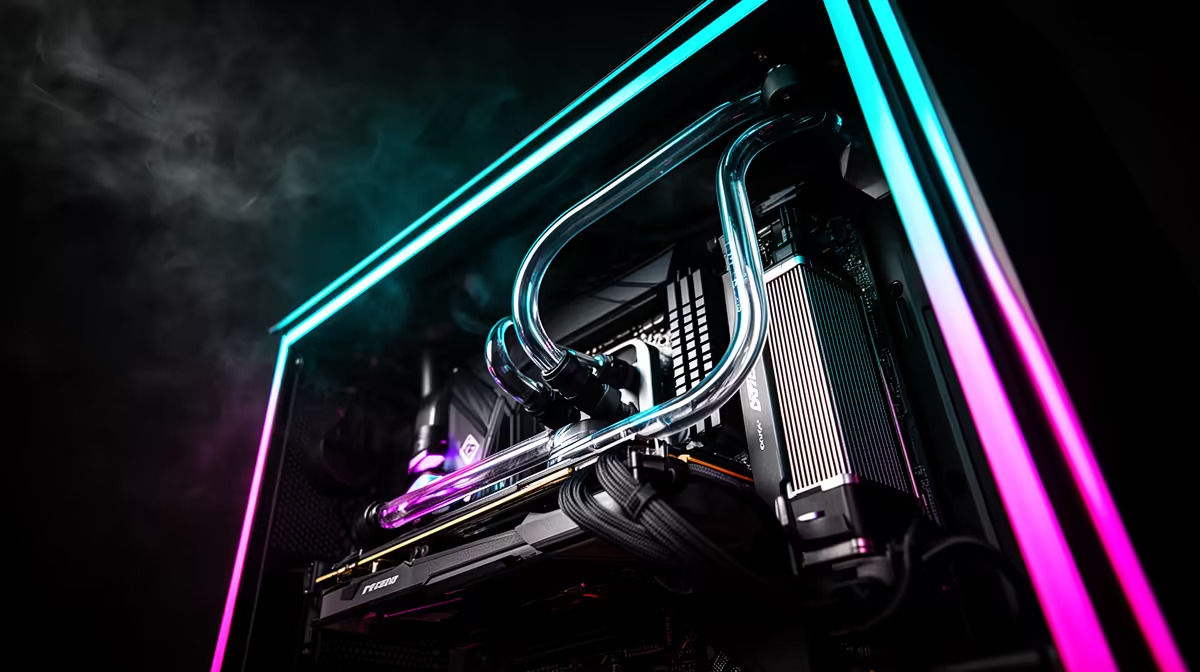
AIO coolers designed for full-tower cases ship with tubing lengths of 380mm to 450mm, which creates slack loops that kink easily in the tight corners of a compact mid-tower or ITX case. Kinked tubing narrows the internal diameter, restricts coolant flow, forces the pump to work harder, and delivers less coolant to the radiator. AIO units designed for compact cases use flexible reinforced hoses that route cleanly through 240mm compact builds without kinking. When building in an ITX case or compact mid-tower under 400mm in height, prioritise AIOs with tubing lengths between 320mm and 380mm.
Radiator Fitment Conflicts to Check Before Buying 🖥️
Compact cases present three common fitment conflicts. First, front-mounted radiators may conflict with long GPUs extending into the front of the case; verify your GPU length leaves adequate clearance for both the radiator and fans. Second, top-mounted radiators in compact cases often conflict with tall RAM heatspreaders; measure clearance from the top of your tallest RAM stick to the case's top panel. Third, the power supply in many compact cases mounts in a position limiting front-radiator depth to 25mm, excluding thicker performance radiators. Cross-referencing your specific case's radiator clearance specifications with the AIO's radiator dimensions is essential before purchasing.
ITX and Compact Mid-Tower AIO Recommendations 💰
For SA builders working with compact cases, the practical maximum is usually a 240mm AIO, with some larger compact mid-towers accepting 280mm or even 360mm front mounts. Deepcool, Corsair, and NZXT offer compact-optimised 240mm AIOs with shorter tubing priced between R1,200 and R2,500 locally at Evetech. These manage CPUs up to around 125 watts TDP effectively, covering chips like the Ryzen 7 7700X and Core i7-14700K. For CPUs above 150 watts TDP in a compact case, consider applying BIOS power limits to bring heat output within what the restricted radiator size can manage.
Route Tubing Away From Fan Blades Before Final Assembly ⚡
AIO tubing contacting a spinning fan blade creates a ticking or grinding noise and can damage both the tubing and the fan. Before closing the case, spin each fan by hand and verify at least 10mm clearance between tubing and all fan blades at every point along the route. This check takes two minutes and avoids a complete disassembly later.
FAQ
Can I shorten AIO tubing myself if it is too long for my compact case?
No. AIO tubing is sealed and factory-crimped; cutting and rejoining it voids the warranty and risks coolant leaks. If tubing is too long, coil any excess in a gentle curve away from components. Purchasing an AIO designed for compact cases is the better solution.
What is the maximum radiator size that fits in most compact mid-tower cases?
Most compact mid-towers in the 380mm to 430mm height range support a 240mm front or top radiator. Some larger compact cases accommodate a 280mm front radiator. Only a handful of compact cases accept 360mm radiators, typically at the larger end of the compact classification.
Does a shorter radiator in a compact case hurt cooling performance significantly?
For CPUs under 125 watts TDP, a 240mm AIO in a compact case cools effectively. The performance gap relative to a 360mm unit on the same chip is 6 to 10 degrees Celsius under sustained load, still keeping a Ryzen 7 7700X well below throttle thresholds in a properly ventilated compact case.
Building a compact PC that needs the right-sized AIO?
Evetech stocks AIO coolers across 240mm, 280mm, and 360mm sizes with compact-case-friendly tubing options. Browse the cooling category on the Evetech site to find your fit.