Quick Answer
X870E is the cleaner premium AM5 choice for MMO and live-service games if you want newer board features; X670E is still valid when it is priced clearly lower. With the same Ryzen CPU and GPU, gaming FPS should be effectively the same. The decision is about I/O, BIOS maturity, USB, storage layout, WiFi, and board quality across broad SA bands around R4,500-R12,000+.
What Actually Changes
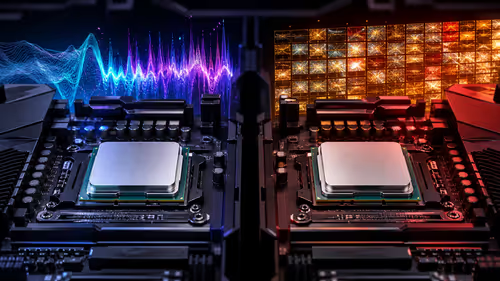
Both chipsets target high-end AM5 builds. X870E boards more often arrive with refreshed layouts and newer USB feature sets, while X670E can offer strong PCIe 5.0 support and premium VRMs at a better price. Compare MSI MAG X870E Tomahawk WiFi, ASUS ROG Strix X870E-E, ASUS TUF X670E-Plus WiFi, and Gigabyte X670E Aorus class boards.
Where SA Buyers Should Spend First
Use X870E for a new premium AM5 build with multiple fast drives, strong networking, and heavy connectivity needs. Use X670E when the board has the ports you need and the saving improves GPU, memory, or storage. SA players on shared fibre, fixed LTE, or home WiFi should not blame the PC for every ping spike.
Specs To Check Before Checkout
Count M.2 slots, check lane sharing, USB-C, WiFi, BIOS flashback, VRM cooling, and case front-panel support. For MMO and live-service games, support long-session stability, patch storage, CPU headroom, and quiet cooling; the board should fit the parts list without wasting money on unused ports.
FAQ
Will this reduce lag in MMOs?
Usually no. With the same CPU, GPU, RAM, and settings, X870E and X670E should produce similar gaming results.
What should I check for live-service games?
Check storage slots, USB needs, BIOS tools, WiFi, and warranty support. Those details matter more than chipset name once both run the chosen Ryzen CPU.
Is the premium option worth it for long sessions?
Choose X870E for a new premium AM5 build with heavy connectivity needs. Choose X670E when a strong board is discounted enough to improve another part.
Buying Tip
Map every drive, USB device, GPU, and front-panel connector before choosing between X870E and X670E. The better board fits the build cleanly.