Quick Answer
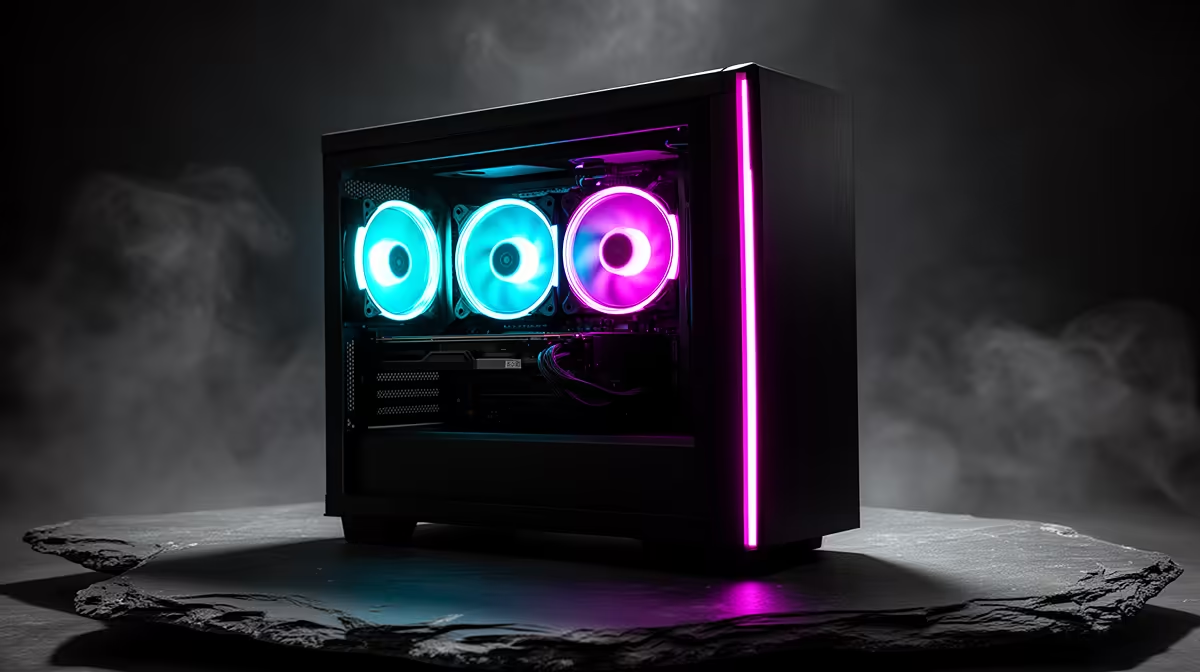
A case with preinstalled ARGB fans saves money in almost every scenario where you would have bought those fans separately. Three matched 120mm ARGB fans purchased individually run R750 to R1,350 at retail.
The Actual Rand Maths Behind the Claim 💰
Let us work through a real comparison. A mid-tower ATX case with no preinstalled fans at a quality level suitable for a gaming build costs roughly R700 to R1,000. The same case chassis from the same brand with three 120mm ARGB fans preinstalled typically retails for R1,100 to R1,600.
When Preinstalled Fans Do Not Save Money 🔧
The bundled fans calculation inverts in two scenarios. First, if you specifically want premium performance fans from Noctua, be quiet! Dark Wing, or Lian Li UNI Fan, which cost R400 to R600 per unit, the preinstalled fans in the bundled case are a different (lower-performing) product and you will be replacing them anyway. In this case, buying a fan-free case at R700 to R1,000 and adding three premium fans is both cheaper and gives you the fans you actually want. Second, if you only need two fans (front intake only, no rear) because the case already has a rear fan position and you plan to use a top exhaust AIO instead of an additional case fan, buying a case with three fans means paying for one fan you will likely unplug or leave unused.
Matching the Purchase to Your Build Plan 🖥️
The clearest saving scenario is a first-time builder assembling a R12,000 to R18,000 gaming PC who wants ARGB lighting, has no existing fans to reuse, and is not committed to a specific premium fan brand. In this scenario, a case bundling three to four 120mm ARGB fans in the R1,100 to R1,600 range from DeepCool, Phanteks, or Corsair saves R400 to R700 and eliminates three purchasing decisions. For experienced builders with a preferred fan brand or partially reused components from a previous build, the value of the bundled case diminishes proportionally with how many of the included fans you would actually use.
Check the Fan Hub Connector Standard Before Committing ⚡
Preinstalled fans connected through a proprietary hub connector may not work with fans from other brands, locking you into buying from the same manufacturer for any future fan additions. Confirm whether the case hub uses standard 4-pin PWM and 3-pin ARGB connectors or a daisy-chain proprietary system. Standard connectors mean full flexibility; proprietary connectors mean ecosystem commitment. This detail is almost always in the case manual rather than the retail listing.
FAQ
Do preinstalled case fans affect the case resale value?
Minimally. In the SA second-hand PC market, bundled case fans add slight value over a fan-free case of the same model, but the resale premium is typically well below the retail cost of the fans themselves. Cases are bought and sold primarily on brand, model, and condition rather than fan count.
Are preinstalled fans the same quality as separately sold fans from the same brand?
Often not quite. Fans bundled with cases are frequently a slightly lower specification than the same brand's retail fan lineup, with lower static pressure or less RGB resolution. They perform adequately for gaming but may fall behind the brand's dedicated fan products in noise and airflow measurements. For a build where thermals and acoustics are critical, evaluating the specific preinstalled fan model matters.
Can I replace preinstalled ARGB fans with aftermarket fans without losing lighting control?
Yes, as long as the replacement fans use standard 3-pin ARGB connectors that connect directly to the motherboard's addressable header. If the case hub uses proprietary connectors for lighting and you bypass it, you lose the integrated hub control but gain full motherboard software control through the standard header. The fan PWM speed control is unaffected either way.
Want to see which cases deliver the best rand value?
Browse mid-tower ATX cases at Evetech with preinstalled ARGB fans across the full price range, from budget to premium, and compare what you get for each tier.