Quick Answer
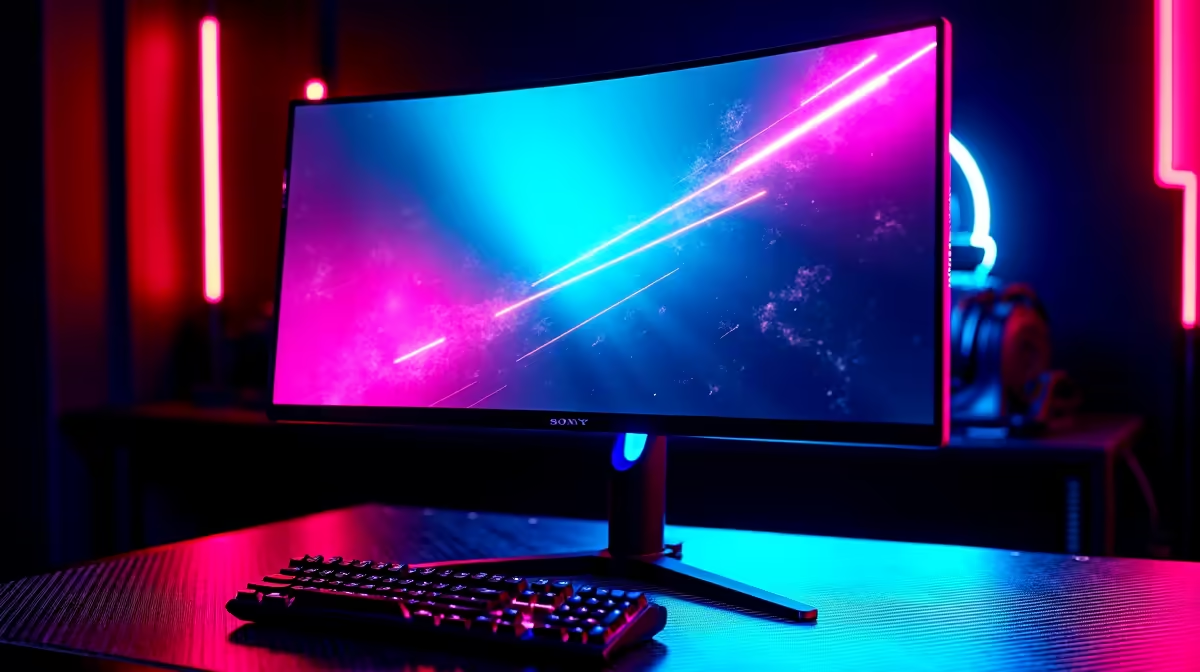
The best 24-inch 1080p IPS gaming monitors in South Africa in 2026 sit in the R2,500 to R5,000 range and deliver excellent colour accuracy, 144Hz to 180Hz refresh rates, and fast response times that suit both competitive gaming and everyday use. Top picks include panels from LG, AOC, and MSI - all widely stocked in SA.
The 24-inch 1080p sweet spot has not gone anywhere in 2026. For competitive FPS gaming - Valorant, CS2, Apex Legends, Warzone - a 24-inch 1080p IPS panel at 144Hz or higher remains the most popular choice among SA gamers, and for good reason. The pixel density at 1080p on a 24-inch panel is comfortable for gaming distances, IPS panels deliver colour and viewing angles that VA and TN panels cannot match, and the price point makes this category accessible without a painful compromise on specs.
Why IPS at 1080p and 24 Inches Still Makes Sense
IPS (In-Plane Switching) technology has been the panel type of choice for gamers who want balanced performance across colour accuracy, contrast, and response time since fast IPS panels became mainstream. Modern IPS panels achieve 1ms grey-to-grey response times that eliminate most visible ghosting at 144Hz, something that older IPS technology struggled with. The colour accuracy and wide viewing angles also make IPS panels usable beyond gaming - they work well for students and professionals who use the same monitor for content consumption, creative work, and gaming.
At 1080p on a 24-inch screen, you get a pixel density of approximately 92 PPI. This is comfortable at 50-80cm viewing distance, which is standard for desk setups. Moving to 1440p at 24 inches (approximately 122 PPI) is noticeably sharper but demands a more powerful GPU to drive at high frame rates, which increases the total system cost significantly.
Top 24-inch 1080p IPS Gaming Monitors Available in SA in 2026
The LG 24GN650-B (or its 2026 refresh) is consistently the value benchmark in this category. It offers a 165Hz IPS panel with 1ms response time, FreeSync Premium, and G-Sync compatibility at a price point that regularly drops below R3,000 during promotions in SA. Colours are accurate out of the box and the stand - while basic - is functional.
The AOC 24G2SP competes directly with the LG at a similar price point and slightly higher 165Hz refresh rate. AOC monitors are well-supported and widely available in SA, and the 24G2SP is one of the best-valued IPS gaming monitors you can buy at under R3,000. Build quality is solid and the included stand offers height adjustment, which the LG does not at the same price.
For those willing to stretch to R4,000 to R5,000, the MSI Optix G244F and Asus TUF Gaming VG249QM offer 240Hz refresh rates on IPS panels at 1080p. At 240Hz, the monitor becomes the limiting factor less often, and the extra smoothness is genuinely noticeable in competitive FPS titles where frame rate headroom matters.
What Settings to Look for Beyond Resolution and Refresh Rate
FreeSync Premium or G-Sync compatibility should be on your shortlist for any gaming monitor - variable refresh rate eliminates screen tearing and reduces stutter without requiring a matching GPU brand. All modern monitors in this segment support FreeSync Premium and most work with G-Sync Compatible mode on NVIDIA cards.
HDR claims at 1080p should be taken with a large dose of scepticism. Most monitors in this price range carry VESA DisplayHDR 400 certification at best, which delivers a slightly brighter image but nothing close to true HDR. Do not pay a premium for HDR at this price point - it is largely marketing. Panel brightness of 250 to 350 nits is adequate for indoor gaming environments, which is standard across this category.
Frequently Asked Questions
Q: Is 1080p still worth buying in 2026 for gaming? A: Yes, for competitive gaming at high refresh rates. At 1080p, mid-range GPUs like the RTX 4060 and RX 7600 can sustain 144fps or higher in demanding titles, which is not always possible at 1440p on the same hardware. For esports titles like Valorant and CS2, 1080p at 240Hz is a perfectly valid competitive choice.
Q: What is the difference between IPS and VA for gaming? A: IPS panels offer better colour accuracy, wider viewing angles, and faster pixel response times, making them better for competitive gaming and general use. VA panels offer higher contrast ratios (better blacks) but slower response times that can cause ghosting in fast-moving scenes. For competitive gaming, IPS is the stronger choice.
Q: Do I need G-Sync or FreeSync for a 144Hz monitor? A: Variable refresh rate (VRR) technology like FreeSync or G-Sync Compatible is highly recommended. It eliminates screen tearing when your frame rate drops below your monitor's refresh rate and reduces stutter, which is noticeable in open-world games and demanding titles.
Q: What cable do I need for 144Hz at 1080p? A: DisplayPort 1.2 or HDMI 2.0 can both drive 1080p at 144Hz without issue. For 240Hz at 1080p, DisplayPort 1.2 or higher is recommended as some HDMI implementations limit bandwidth. Use the cable that came with your monitor and check the spec sheet if in doubt.
Ready to Find Your Perfect Match? Browse gaming PC deals and complete monitor-ready rigs at Evetech, shipped across South Africa.