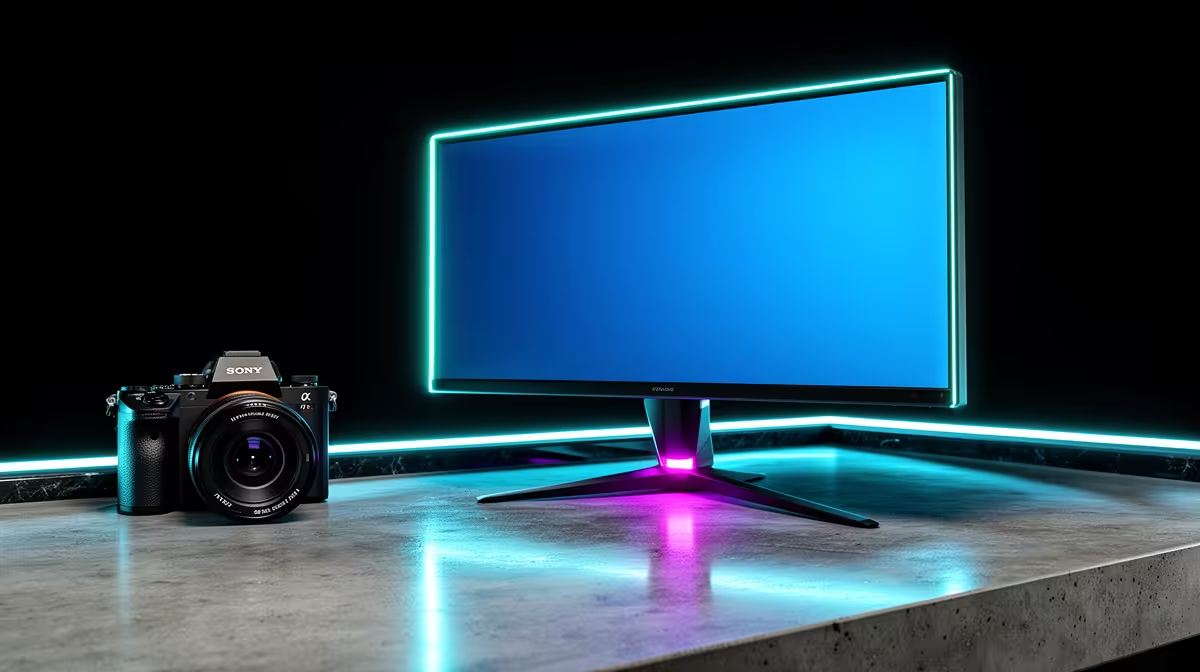
You’ve lined up the perfect shot in Apex Legends. You pull the trigger… but your target ghosts, leaving you staring at a wall. That split-second blur, that frustrating lag between your mouse click and the action on screen, isn't always your internet connection. Often, the culprit is your monitor's response time. For South African gamers aiming for the top, finding the best response time gaming monitor isn't a luxury; it's essential for a competitive edge.
Why a Low Response Time is Your Secret Weapon 🎯
So, what exactly is response time? Measured in milliseconds (ms), it’s the time it takes for a pixel on your screen to change from one colour to another (usually grey-to-grey, or GtG). A lower number is better. A monitor with a 1ms response time updates its pixels far quicker than one with 5ms.
This speed directly impacts motion clarity. In fast-paced games, a slow response time creates motion blur or "ghosting," where you see a faint trail behind moving objects. This visual noise makes it harder to track opponents, aim accurately, and react instantly. Upgrading to a fast display is one of the most significant improvements you can make to your entire gaming experience, affecting everything from casual play to esports-level competition. The difference is immediately noticeable across all kinds of PC monitors.
Response Time and Refresh Rate: The Ultimate Tag Team
It's easy to confuse response time with refresh rate (measured in Hertz, or Hz), but they work together.
- Refresh Rate (Hz): This is how many times your monitor updates the image on the screen per second. A 144Hz monitor can display up to 144 frames per second (FPS).
- Response Time (ms): This is how quickly the pixels can actually change to show those new frames.
Think of it like this: a high refresh rate is useless if your pixels are too slow to keep up. You'll have a high frame rate, but the image will be a blurry mess. The goal is to pair a high refresh rate (144Hz or higher) with a low response time (ideally 1ms GtG) to get a crystal-clear and buttery-smooth picture. This combination ensures the gaming monitor response time is perfectly synchronised with your GPU's output.
Choosing the Best Response Time Gaming Monitor for Your Setup
Finding the right monitor involves balancing speed with other crucial features. For pure competitive performance, a 1080p or 1440p monitor often hits the sweet spot, allowing your graphics card to push higher frame rates. However, if you're also a content creator or love cinematic single-player games, the stunning detail of 5K and 4K monitors might be worth the investment.
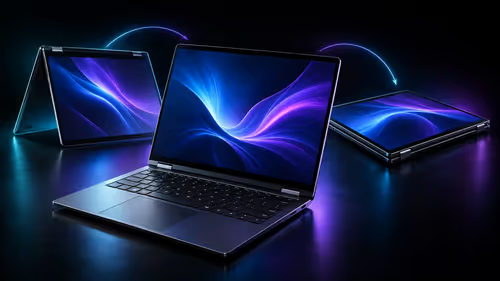
Immersion is another key factor. Many South African gamers are opting for curved monitors that wrap the action around their field of view, making games feel more engaging and expansive. And for those who frequent LANs or need a second screen for their laptop, a modern portable monitor offers incredible flexibility without sacrificing performance.
Pro Tip: Taming Overdrive 🔧
Most gaming monitors have an 'Overdrive' or 'Response Time' setting in their menu. While 'Fastest' looks good on paper, it can cause 'inverse ghosting' (a bright trail). For the best results, set it to 'Fast' or 'Medium'. This often provides the best balance between speed and visual clarity. Test it in a fast-paced game to see what works for you!
Don't Forget the Finishing Touches ✨
Your setup doesn't end with the panel. A high-quality monitor arm can free up desk space and help you achieve perfect ergonomics for those long gaming sessions. Ensuring you have the right cables (like a certified DisplayPort 1.4 cable) is also critical to unlock your monitor's full refresh rate and features. Investing in the right monitor accessories protects your purchase and optimises your entire battle station.
Ultimately, securing the best response time gaming monitor is about removing a bottleneck between you and your in-game performance. It ensures what you see is a true, real-time representation of the game world, giving you the information you need to react faster than the competition. Ready to see the difference for yourself? You can browse a massive selection of all gaming monitors to find the perfect fit for your rig and budget.
Ready to Eliminate Ghosting for Good?
A slow monitor is a bottleneck on your skill. To get that true competitive edge, you need a display that can keep up. Explore our massive range of gaming monitors and find the perfect panel to dominate the server.