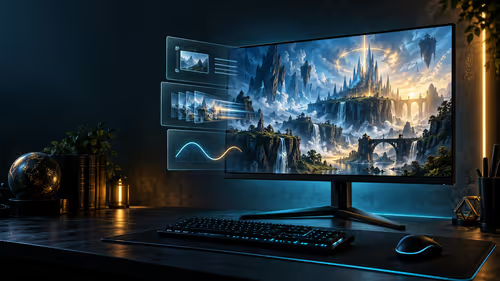
You’re lining up the perfect shot in Apex Legends, the final circle is closing in… and bam! Your screen rips in half. That jarring, ugly tear ruins your immersion and costs you the match. For South African gamers, this frustration is all too real. The fix is adaptive sync, but that brings its own massive question: in the epic battle of FreeSync vs G-Sync, which technology is the right choice for your rig and your wallet?
What Is Adaptive Sync and Why Should You Care?
Before diving into the FreeSync vs G-Sync showdown, let's quickly cover the basics. Your graphics card (GPU) renders frames at a variable rate, while your monitor refreshes its image at a fixed rate (e.g., 144Hz). When these two are out of sync, you get visual artefacts like screen tearing (seeing parts of multiple frames at once) or stuttering.
Adaptive sync technology forces your monitor to refresh only when your GPU has a new frame ready. The result? Buttery-smooth, tear-free gameplay that feels incredibly responsive. ✨ Both AMD's FreeSync and NVIDIA's G-Sync aim to solve this problem, but they go about it in very different ways.
Team Green's Fortress: Understanding NVIDIA G-Sync
G-Sync is NVIDIA's proprietary solution. To earn the G-Sync badge, a monitor must have a special hardware module built into it that communicates directly with your NVIDIA GeForce GPU.
This hardware-first approach has some major benefits:
- Peak Performance: The dedicated scaler ensures a flawless, consistent experience across the monitor's entire refresh rate range, from the lowest to the highest.
- Strict Certification: NVIDIA has a rigorous testing process. If you buy a G-Sync or G-Sync Ultimate monitor, you're guaranteed a premium, tear-free experience with excellent colour calibration and minimal input lag.
The catch? That hardware module costs money, making G-Sync monitors the more expensive option. They are often found in the most premium 5K and 4K monitors where visual fidelity is paramount.
Team Red's Open Standard: AMD FreeSync Explained
FreeSync is AMD's answer, and its biggest strength is that it's an open standard built on top of the VESA Adaptive-Sync protocol. This means any monitor manufacturer can implement it without paying licensing fees or buying proprietary hardware.
This leads to two key advantages for South African gamers:
- Affordability: The lack of a required hardware module makes FreeSync monitors significantly cheaper. You can find this tech in everything from budget-friendly screens to high-end displays.
- Wider Selection: Because it's an open standard, there's a massive variety of PC monitors with FreeSync available.
However, the quality can vary. To fix this, AMD introduced tiers:
- FreeSync: The basic standard.
- FreeSync Premium: Guarantees at least a 120Hz refresh rate at 1080p and includes Low Framerate Compensation (LFC) to keep things smooth when your FPS drops.
- FreeSync Premium Pro: Adds strict HDR (High Dynamic Range) requirements for stunning visuals.
Check Your Compatibility! 🔧
If you have an NVIDIA GPU, don't automatically rule out a FreeSync monitor! Most modern NVIDIA cards can run adaptive sync on FreeSync displays under the "G-Sync Compatible" program. However, performance isn't always guaranteed to be perfect. Always check NVIDIA's official list of G-Sync Compatible monitors before you buy to ensure a smooth experience.
FreeSync vs G-Sync: The Final Verdict for SA Gamers
So, which one is right for you? The choice often comes down to your budget and your GPU.
The Cost Factor
For most gamers in South Africa, budget is a massive consideration. This is where FreeSync shines. You can often find incredible PC monitor deals on FreeSync displays that offer fantastic performance for the price. A G-Sync monitor will almost always command a higher price in ZAR for a similar set of specs.
The Performance Battle
If you're a competitive esports player or a visual enthusiast with a high-end NVIDIA card who demands zero compromise, a true G-Sync monitor is technically superior. The dedicated hardware provides a more consistent, reliable experience. However, a monitor with FreeSync Premium Pro certification gets you 95% of the way there for a fraction of the cost, making it a smarter choice for most. Whether you're looking at immersive curved monitors or even a compact portable monitor for your setup, the technology inside matters.
The Ecosystem
Ultimately, your choice locks you in slightly.
- Have an NVIDIA GPU? You can use G-Sync or a G-Sync Compatible FreeSync monitor.
- Have an AMD GPU? Your only choice is a FreeSync monitor.
The debate between G-Sync vs FreeSync is less about one being definitively "better" and more about which is better for you. Consider your graphics card, your budget, and what kind of games you play. Once you've decided, make sure you have the right monitor accessories like a quality DisplayPort cable to get the most out of your new screen. 🚀
Ready to Banish Screen Tearing for Good? Whether you're Team Green or Team Red, the perfect tear-free monitor is waiting for you. The choice between FreeSync and G-Sync depends on your rig and your budget, but a smoother gaming experience is guaranteed. Explore our huge range of gaming monitors and find the perfect display to dominate the competition.