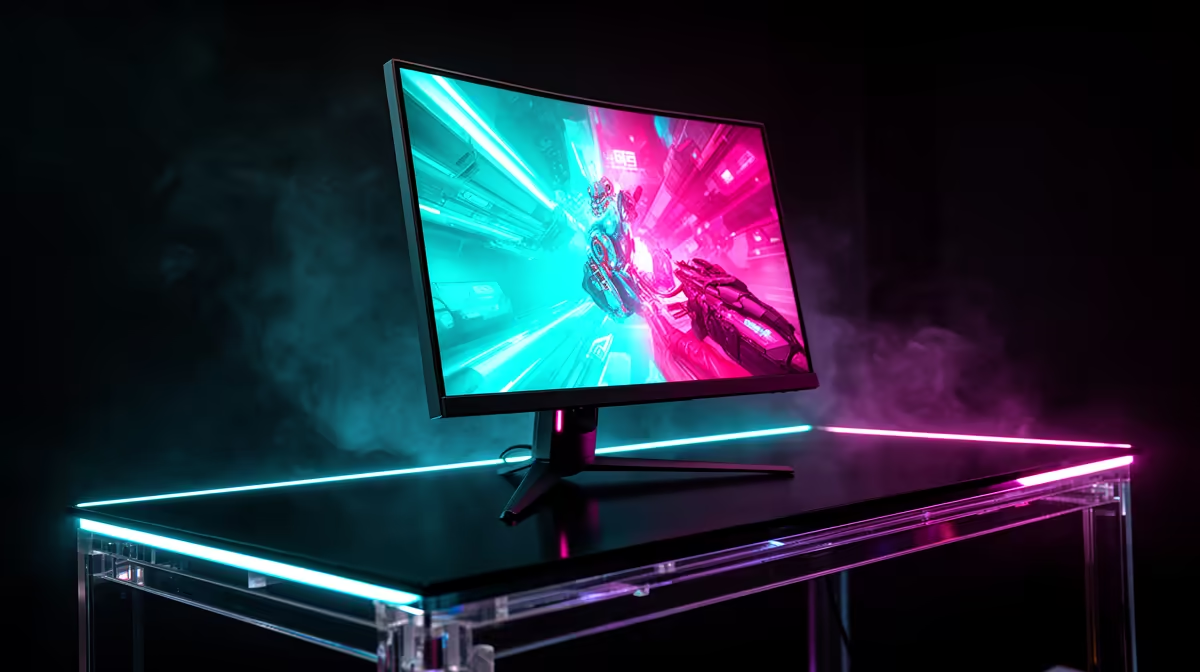
Choosing a new gaming monitor in South Africa feels like a boss battle. You've saved up your hard-earned Rands, and now you face the ultimate choice: OLED vs LCD. One promises mind-blowing colours and perfect blacks, while the other offers battle-tested performance at a sharper price. Which display tech is the right investment for your rig? 🇿🇦
Let's break down the OLED vs LCD gaming monitor debate to help you make the best call for your setup.
Understanding the Core Difference: Pixels & Light
Before we dive into the pros and cons, let's get the basic tech straight. It all comes down to how the screen makes light.
- LCD (Liquid Crystal Display): Think of an LCD monitor as a sophisticated sandwich. It has a backlight (usually LEDs) that is always on. A layer of liquid crystals in front of it acts like tiny shutters, twisting to block or allow light through colour filters to create an image on your screen.
- OLED (Organic Light Emitting Diode): OLED is fundamentally different. Each individual pixel is its own tiny light source. It can turn on to produce brilliant colour or switch off completely to create true, perfect black. There is no backlight.
This single difference is the source of nearly every advantage and disadvantage in the OLED vs LCD for gaming discussion.
OLED Gaming Monitors: The Visual Heavyweight Champion
OLED technology delivers a visual experience that is simply breathtaking. For gamers who prioritise cinematic immersion and image fidelity, it's the current king.
The magic is in the contrast. Because an OLED pixel can turn completely off, you get an "infinite" contrast ratio. Blacks are truly black, not a dark greyish glow like on many LCDs. This makes colours pop dramatically and brings shadowy game environments like the dungeons of Diablo IV or the dark corridors of Alien: Isolation to life. ⚔️
They also boast near-instantaneous pixel response times, virtually eliminating ghosting and motion blur for the cleanest image possible in fast-paced games. Whether you're after an OLED or a top-tier LCD, our full range of gaming monitors has something for every setup.
The main drawbacks? Price and the potential for burn-in (where a static image like a taskbar can leave a permanent ghost). However, modern OLEDs have built-in tech to minimise this risk significantly.
OLED Care Tip 💡
To protect your investment, set your Windows taskbar to auto-hide and use a dark or rotating desktop wallpaper. Avoid leaving static images on screen for hours. These simple habits drastically reduce the risk of burn-in and keep your panel looking pristine for years.
LCD Gaming Monitors: The Versatile & Affordable All-Rounder
Don't count out LCDs; they are the battle-hardened veterans of the monitor world for a reason. For many South African gamers, an LCD is still the smarter choice, offering incredible performance and value.
Their biggest advantage is brightness. LCDs can get significantly brighter than OLEDs, making them ideal for gaming in well-lit rooms. They also come in a massive variety of sizes, resolutions, and price points. This affordability makes high-resolution gaming more accessible, with stunning 5K and 4K monitors often costing less in LCD form.
Furthermore, LCD technology is immune to burn-in, giving you peace of mind for both gaming and productivity. Many gamers also prefer the immersion of curved monitors, a category where LCD technology dominates in variety and availability.
The OLED vs LCD Gaming Monitor Showdown
So, how do they stack up head-to-head on the factors that matter most to gamers?
Contrast & Colour
This is an easy win for OLED. The infinite contrast and per-pixel lighting create a level of depth and vibrancy that LCDs struggle to match, even with advanced tech like Mini-LED backlights.
Speed & Response Time
OLEDs have a natural advantage with sub-1ms response times. However, high-end gaming LCDs (especially TN and fast IPS panels) have become so quick that for most gamers, the difference in motion clarity is almost imperceptible.
Price & Longevity
LCD takes the crown here. You can get a fantastic high-refresh-rate LCD monitor for a fraction of the cost of a comparable OLED. With no burn-in risk, their lifespan is well-established. This makes LCD a safer long-term investment for budget-conscious buyers.
Brightness & Use Case
If you game in a bright room with lots of natural light, an LCD's powerful backlight is a huge plus. If your gaming den is more of a dark cave (perfect for surviving an unexpected outage!), an OLED's perfect blacks will provide a more immersive experience. For those constantly on the move, don't overlook the flexibility of modern portable monitors, which predominantly use reliable LCD tech.
So, Which Monitor Should You Buy?
The best choice in the OLED vs LCD gaming monitor debate depends entirely on you.
- Choose OLED if: You are a visual purist who wants the absolute best image quality for cinematic, story-driven games and have the budget for it.
- Choose LCD if: You want maximum performance-for-your-Rand, play in a bright room, use your monitor for both work and play, or prioritise high refresh rates on a tighter budget.
Ultimately, the best display is one that fits your games, your environment, and your wallet. A great place to start your search is by checking out the best PC monitor deals currently available in South Africa. For a wider selection, you can dive into our complete collection of PC monitors to compare specs and find your perfect screen. ✨
Ready to Upgrade Your View? The OLED vs LCD gaming monitor debate comes down to personal preference and budget. Whether you crave the cinematic perfection of OLED or the bright, reliable performance of LCD, the perfect display is waiting for you. Explore our massive range of monitor deals and find the perfect screen to conquer your world.