


R10,000 Gaming PC Now Costs R25,000: The SA Upgrade Plan
A South African R9,999 gaming PC was estimated at R25,091 eight months later. Current in-stock gaming desktops start from R6,929, so upgrade only the part that limits your games.
Read moreTesting across 11 games found no meaningful advantage between PCIe SSD generations. Checked SSDs start at R1,199, so buy enough capacity and the right interface before chasing peak speed.
A new test put SATA, PCIe 3.0, PCIe 4.0 and PCIe 5.0 SSDs through 11 games. The faster drives won the specification contest, but the games rarely turned that extra sequential throughput into more frames. That matters when local SSD prices reward careful choices about capacity and interface.
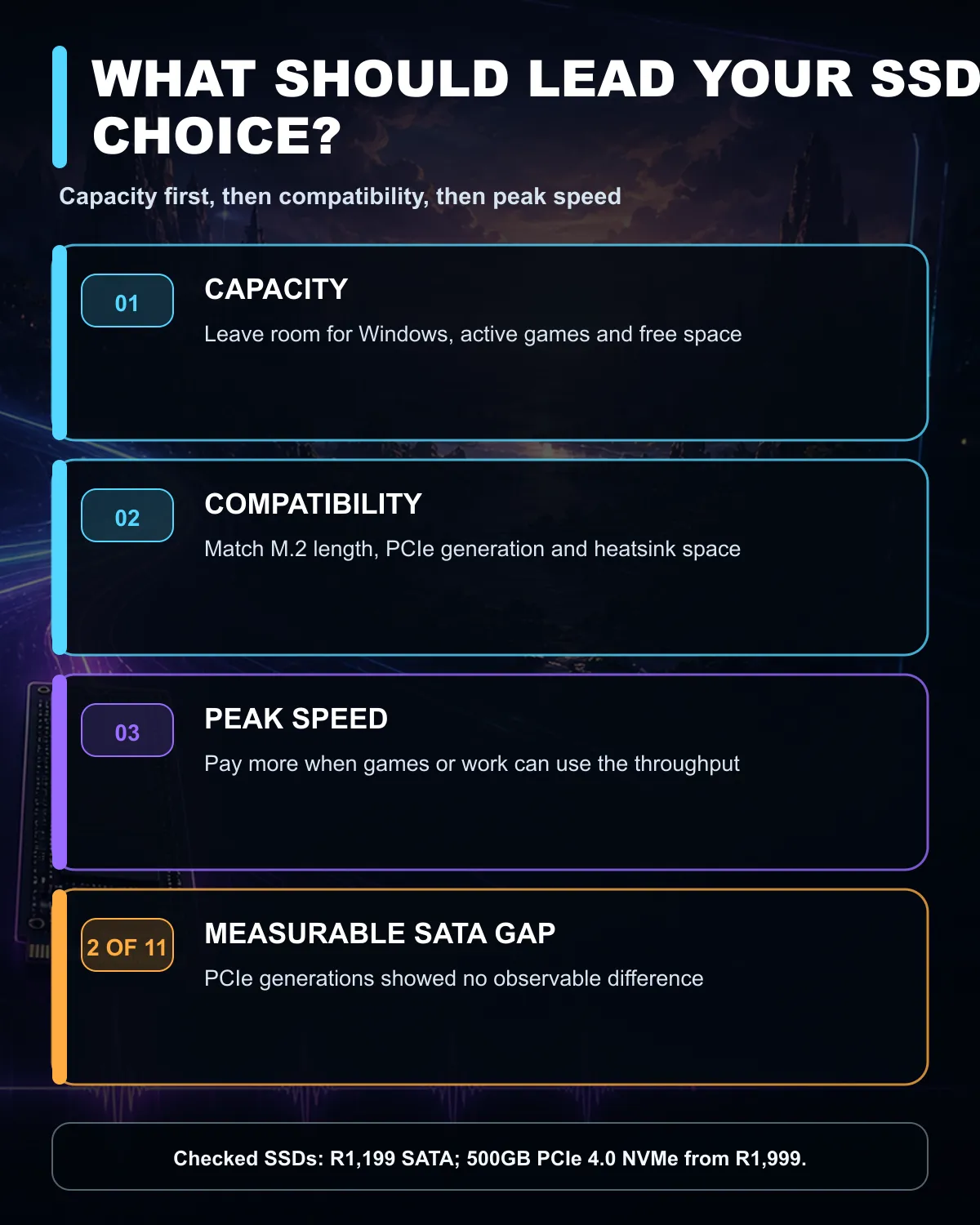
Do not buy a PCIe 5.0 SSD for an assumed frame-rate boost. The test found no observable performance difference between PCIe generations in the covered scenes. The 9 August catalogue check found in-stock SSDs from R1,199 and a 500GB PCIe 4.0 NVMe option at R1,999. Buy enough space, match the motherboard and pay for peak speed only when another workload can use it.
Only two games showed measurable differences between SATA and PCIe storage. Forspoken produced better 1% low frame rates on the PCIe drives. Ratchet & Clank: Rift Apart showed a more complicated result during portal transitions, including better 4K lows on PCIe. Outside that sequence, normal gameplay showed no measurable difference.
The other tested titles did not gain meaningful gameplay performance from faster PCIe drives. The test also found no visible texture or pop-in difference across the storage devices. Some games moved a surprising amount of data, yet the workload still did not separate PCIe 3.0, 4.0 and 5.0 in frame rate.
Loading remains a separate issue. An NVMe drive can load some games faster than SATA, but the gap varies by title and can be small. Moving from a hard drive to any suitable SSD remains the major step. This test did not recommend a mechanical drive for modern games.
Microsoft's DirectStorage gives developers a way to use high-speed NVMe storage for game assets while reducing CPU overhead. Support and implementation matter. A drive cannot force a game engine to issue deeper, larger or more efficient storage requests.
The current catalogue shows why the priority order matters. A checked 256GB SATA SSD was R1,199, a 512GB SATA model was R1,549 and a 500GB PCIe 4.0 NVMe drive was R1,999. Checked 1TB PCIe 4.0 drives started higher, with models around R3,099 and above in the snapshot.
A small premium drive can benchmark beautifully and still create a poor gaming experience when it holds Windows and only two large games. Choose capacity from your actual library, leave free working space and account for the second game you expect to install next month.
Browse the full SSD range to set the capacity budget first. Then compare NVMe SSD options and the PCIe 4.0 NVMe range against the slots your motherboard supports.
M.2 describes the physical form, while NVMe describes the storage protocol. Some M.2 slots support SATA drives, some support PCIe NVMe and some support both. The motherboard manual should name the supported sizes, lanes and generations. It should also state whether using a slot disables a SATA port or shares lanes with another device.
A PCIe 5.0 SSD can work below its maximum speed in an older compatible slot, but paying the Gen 5 premium makes little sense when the motherboard limits it to Gen 4. Check whether the drive includes a heatsink and whether the motherboard already has one. Two heatsinks cannot occupy the same space.
Laptop buyers need another check. Some thin notebooks accept only single-sided drives or a particular M.2 length. Opening the machine may also affect support conditions, so confirm the model's service instructions before ordering.
Large file transfers, video work, development projects, virtual machines and heavy local data tasks can use more storage throughput than most games. A creator who moves hundreds of gigabytes may save real time with a faster drive. A gamer who installs a title once and then plays it for months may gain more from capacity.
Premium storage can also make sense when two drives offer the same capacity at a small price difference and the faster model has the right warranty, endurance and cooling. Judge the complete product rather than a single read-speed figure.
The 11-game test found no observable performance advantage between the tested PCIe generations in the covered gameplay scenes.
No. Forspoken and one Ratchet & Clank portal sequence showed measurable differences, while most tested games delivered comparable performance.
An in-stock 256GB SATA SSD was R1,199 in the 9 August catalogue snapshot.
Confirm the M.2 length, PCIe generation, lane sharing, single- or double-sided fit, heatsink space and operating-system support.
It often is when the larger drive prevents constant uninstalling and the games do not use the extra Gen 5 throughput.
Choosing an SSD for a game library? Set the capacity first, confirm the motherboard slot, then compare current NVMe drives at the speed tier your system can use.
The 11-game test found no observable performance difference between PCIe SSD generations in the tested scenes.
No. Only two of the 11 games showed measurable SATA-versus-PCIe differences, and most delivered comparable gameplay.
The 9 August catalogue snapshot found an in-stock 256GB SATA SSD at R1,199.
A checked in-stock 500GB PCIe 4.0 NVMe SSD was R1,999.
It makes sense for compatible systems, large file work, fast transfers and specific games or applications that use the extra throughput.
Choose capacity from your installed games and free-space target. A larger suitable drive often helps more than a smaller premium-speed model.
A South African R9,999 gaming PC was estimated at R25,091 eight months later. Current in-stock gaming desktops start from R6,929, so upgrade only the part that limits your games.
Read more
The 2026 Zephyrus G16 review tested its RTX 5080 at 135W, below its 160W maximum. Current local G16 listings start at R36,999, so compare exact GPU, power limit and screen.
Read more
How to fix FPS drops after a RTX 5080 build starts with driver cleanup, BIOS checks, and power testing. Work through SA-friendly checks for chipset drivers, display refresh, PCIe seating, frame caps, and game settings before blaming the GPU.

How to fix fps drops after a steam deck upgrade starts by checking power profile, storage, shader cache, and game settings. Test the Steam Deck upgrade step by step so SA players can separate install issues from normal handheld limits. Keep settings notes.

Valorant keyboard choices in SA should match switch feel, layout, latency, key rollover, and desk space. Compare practical setup needs, comfort, reliability, and upgrade room before buying gear for long gaming sessions.
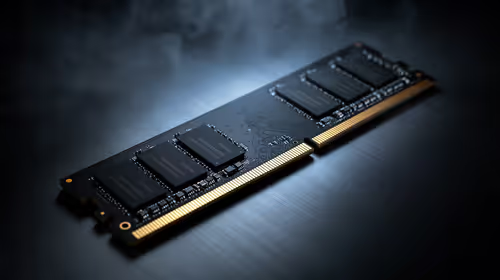
DDR5 build upgrade dead pixel checks should begin with the monitor. Run solid colour tests, compare screenshots, reseat display cables, and review GPU output before blaming RAM changes in an SA gaming PC. Document repeatable proof for support.
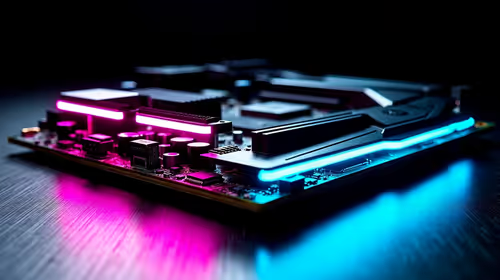
South African builders should prioritise exact CPU support, DDR5, chassis fit and device requirements before premium motherboard breadth. The E-ATX X870E Extreme then adds five M.2 positions, Wi-Fi 7, multi-gig LAN, USB4 Type-C and named AI tools.
South African buyers considering 32GB GDDR7 should confirm whether their games, AI models or creative projects place real pressure on smaller memory pools. The RTX 5090 costs R73,599, so its capacity must be weighed against the rest of the system budget.
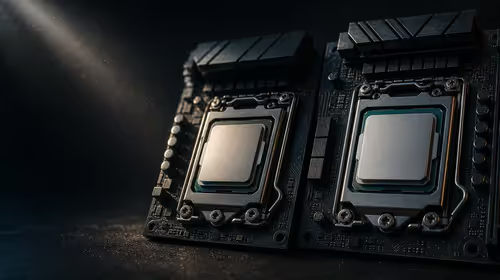
A large cache can reduce costly trips to slower memory in workloads that reuse data effectively, but FPS gains vary by game engine and settings. The Ryzen 7 5800X3D provides 100MB cache alongside eight Zen 3 cores, so representative game tests matter.
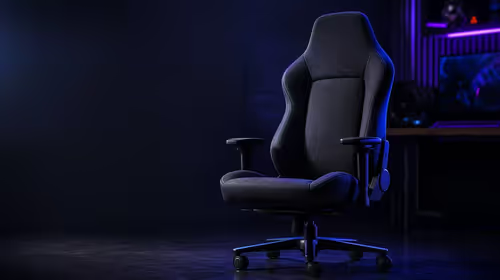
A fabric gaming chair price tier is useful only when the added spend improves fit, cushioning, hardware or daily surface comfort. At R7,899, the HERO TX provides a premium South African benchmark with TX fabric, cold-foam, 4D armrests and stainless-steel levers.
A South African R9,999 gaming PC was estimated at R25,091 eight months later. Current in-stock gaming desktops start from R6,929, so upgrade only the part that limits your games.

Microsoft now warns developers about Manifest V2 and expects enterprise deprecation to begin in early 2027. Edge users should audit essential extensions now, not uninstall everything today.
Testing across 11 games found no meaningful advantage between PCIe SSD generations. Checked SSDs start at R1,199, so buy enough capacity and the right interface before chasing peak speed.

Better router placement costs R0 and can fix weak home Wi-Fi. Start centrally, high and in the open, then test 2.4GHz, 5GHz and channels before buying mesh or an extender.