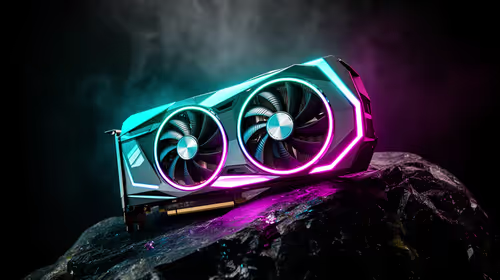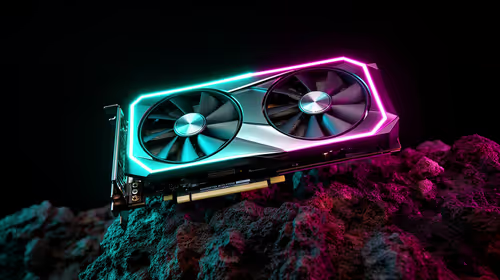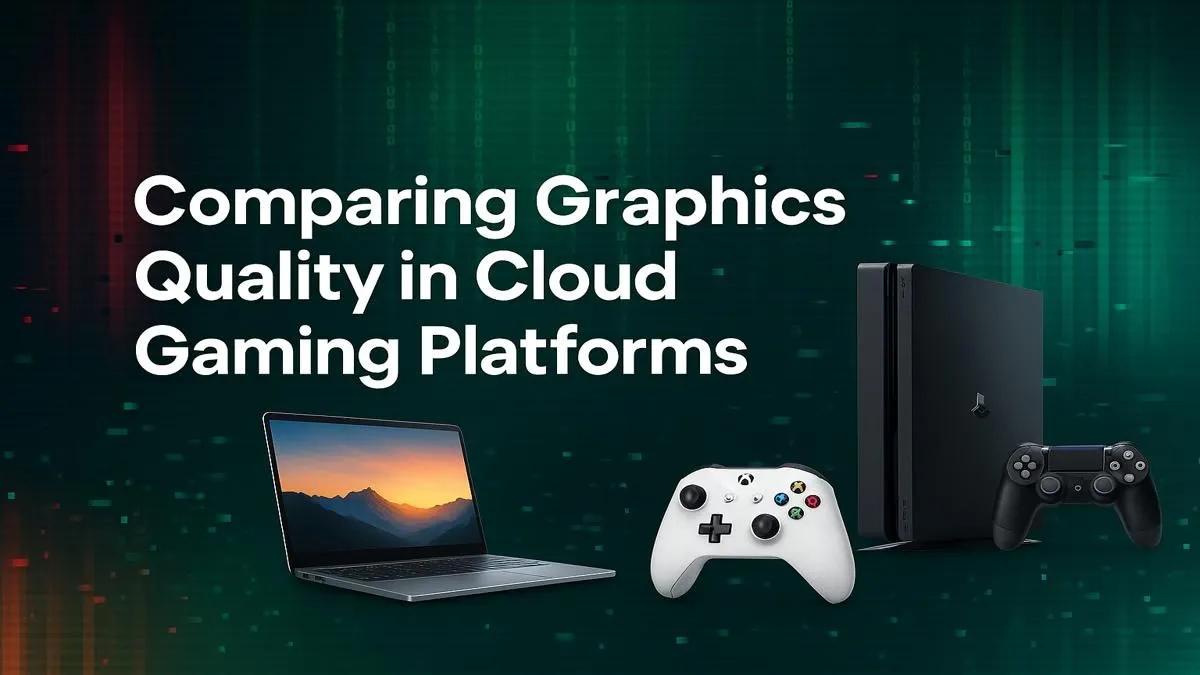
Tired of waiting for downloads? Cloud gaming promises the thrill of AAA titles on almost any device, streamed directly to you. But for South African gamers, there’s a crucial question: how do the graphics actually hold up with our internet realities? Is the visual quality a true replacement for a dedicated rig, or just a blurry compromise? This cloud gaming graphics comparison breaks down what you really see on your screen, from Johannesburg to Cape Town.
What Really Defines Cloud Gaming Graphics?
Before we compare services, let's get one thing straight: cloud gaming is a video stream. Think of it like a super-interactive, high-speed YouTube video. The server in some far-off country does all the heavy lifting—rendering the game at high settings—and beams the result to your screen.
The final cloud gaming graphics quality you experience depends on a few key factors:
- Resolution: Is the stream 1080p, 1440p, or true 4K?
- Framerate (FPS): Is it a smooth 60fps or even 120fps, or is it capped at a cinematic 30fps?
- Bitrate & Compression: This is the big one. To send all that data over the internet, the video stream is compressed. A higher bitrate means less compression and a clearer, sharper image with fewer blocky artefacts. Low bitrate is what causes that "muddy" look.
Even with a great connection, this process can never be as pure as the signal coming directly from a graphics card inside your machine, which is why even affordable budget gaming PCs can offer a crisper local image.
The Main Contenders: A Visual Showdown
While South Africa is still waiting for official local servers from many providers, gamers here often connect to European servers for services like NVIDIA's GeForce NOW and Xbox Cloud Gaming. So, how do they stack up visually?
NVIDIA GeForce NOW (Ultimate Tier)
This is widely considered the king of visual fidelity in the cloud. The top tier aims to deliver a 4K resolution at up to 120 FPS, complete with ray tracing. When it works perfectly, it's a stunning glimpse into the future, mimicking the performance of high-end rigs above R20k. The visual clarity is often best-in-class, provided your connection is rock-solid.
Xbox Cloud Gaming (via Game Pass Ultimate)
Microsoft’s service is all about value and accessibility. It’s an incredible bonus for Game Pass subscribers, but its visual target is more modest, typically capping at 1080p and 60 FPS. While it looks good, especially on smaller screens, a side-by-side cloud gaming graphics comparison reveals it lacks the sharpness and detail of GeForce NOW's premium tier. Still, it delivers a solid experience, much like many powerful PCs under R20k, without needing the local hardware.
Optimise Your Home Network 🔧
For the best cloud gaming experience, connect your device directly to your router with an Ethernet cable. Wi-Fi is convenient, but a wired connection provides a more stable, lower-latency signal, which is critical for reducing stutter and visual artefacts in a fast-paced game.
The South African Reality Check: Latency & Data
Here’s the catch for us in Mzansi. No matter how good the server-side graphics are, they have to travel thousands of kilometres to reach us. This introduces latency (or ping), the delay between you pressing a button and seeing the result. For competitive shooters, this can be a deal-breaker.
Furthermore, that high-bitrate 4K stream comes at a cost: data. Streaming games at high quality can consume over 15GB of data per hour. If you're on a capped fibre or mobile plan, those costs can add up faster than a new GPU. This is where owning your hardware gives you freedom, and with so many great pre-built PC deals, you get a predictable, one-time cost for years of gaming. ✨
The Verdict: Local Power Still Reigns Supreme
So, which service has the best cloud gaming graphics? On paper, a top-tier GeForce NOW subscription wins.
However, the bigger picture is that cloud gaming inherently involves a compromise on visual purity and responsiveness due to streaming and latency. For gamers who refuse to compromise—who want zero input lag, uncompressed visuals, and the ability to crank every setting to ultra—a dedicated gaming PC remains the undisputed champion. You control the hardware, the settings, and the experience, with no reliance on international servers. When you look at the best gaming PC deals available, the long-term value and superior experience become crystal clear.
Ready for Uncompromised Visuals? 🚀 Cloud gaming is an exciting technology, but for the ultimate, lag-free graphical experience in South Africa, a dedicated gaming PC is the undisputed champion. Browse our massive range of customisable gaming PCs and build a machine that delivers flawless visuals every single time.