You’re in the final circle, the tension is palpable... and then it happens. A massive stutter freezes your screen for a split second. By the time it recovers, you’re staring at the defeat screen. Jirre, that’s frustrating. PC lag and gaming stutters can ruin the best moments, but you don't have to put up with them. This guide will walk you through the essential steps to fix PC lag gaming issues, from simple software tweaks to knowing when it's time for an upgrade. 🚀
Understanding the Enemy: What Causes Gaming Lag?
Before we dive in, let's clear something up. "Lag" is often used to describe two different problems:
- Network Lag (High Ping): This is due to a slow or unstable internet connection. Your character rubber-bands, and your shots don't register. This guide doesn't cover network issues.
- Performance Lag (Low FPS/Stutter): This is when your PC itself can't keep up. The framerate drops, the screen hitches, or the game freezes momentarily. This is what we’re here to fix.
Eliminating that performance stutter is key to a smooth, competitive experience.
Quick Software Fixes to Reduce PC Gaming Lag
Let's start with the easiest and most effective solutions. These software-side adjustments can often provide a massive boost in performance without costing you a Rand.
Update Your Graphics Drivers
This is rule number one. Your Graphics Processing Unit (GPU) is the heart of your gaming experience, and its drivers are the instructions that tell it how to run your games. NVIDIA, AMD, and Intel constantly release updates that include performance optimisations, bug fixes, and new features for the latest titles. Keeping them updated is the single most important step to fix gaming lag.
Optimise In-Game Settings
Don't just crank everything to "Ultra" and hope for the best. Diving into the graphics menu is crucial. Settings like shadows, anti-aliasing, and texture quality are massive performance hogs. Try lowering a few settings one by one to see what gives you the biggest FPS boost. A stable 144 FPS with medium settings will always feel better than a stuttery 80 FPS on ultra, especially in fast-paced titles like the ones you'll find on a dedicated Fortnite gaming PC.
Tame Background Processes
Is Chrome eating all your RAM with 50 tabs open? Are other apps downloading updates in the background? Before launching a game, open your Task Manager (Ctrl+Shift+Esc) and close any unnecessary applications. This frees up precious CPU and RAM resources for your game, which is vital when you're trying to get the drop on opponents in PUBG.
Windows Power Plan Pro Tip ⚡
By default, Windows uses a 'Balanced' power plan. For gaming, you want maximum performance. Go to Settings > System > Power & sleep > Additional power settings. Select 'High Performance' or, if available, 'Ultimate Performance'. This ensures your CPU isn't being throttled to save a few watts of power, giving you more consistent frame rates.
Deeper Dives: Advanced Tweaks for a Smoother Experience
If the basics didn't completely solve your stuttering woes, it's time to dig a bit deeper. These next steps require a little more effort but can uncover hidden performance bottlenecks.
Check for Overheating 🌡️
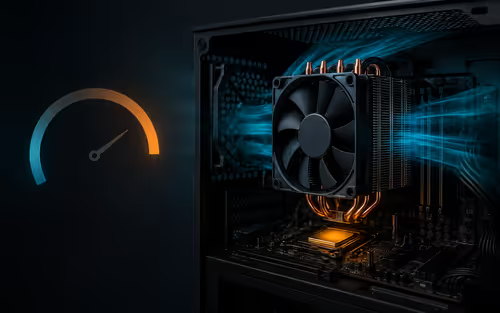
Modern PC components are designed to slow themselves down (a process called thermal throttling) to prevent damage when they get too hot. This is a common cause of sudden, severe stuttering.
- Clean Your PC: Dust is the enemy. Open up your case and carefully clean out dust from fans and heatsinks with compressed air.
- Monitor Your Temps: Use software like HWMonitor or MSI Afterburner to check your CPU and GPU temperatures while gaming. If they're consistently hitting 90°C or higher, you have a cooling problem.
Proper cooling is non-negotiable for graphically intense titles, which is why a well-built Cyberpunk 2077 gaming PC always prioritises airflow.
Is Your Storage a Bottleneck?
Are you still running your games from an old-school Hard Disk Drive (HDD)? While great for mass storage, their slow read/write speeds can cause stuttering, especially in open-world games that constantly need to load new assets from the drive. Upgrading to a Solid-State Drive (SSD) is one of the most noticeable improvements you can make. The difference when cruising through Los Santos on a machine built for GTA V is night and day.
RAM: More Than Just a Number
Running out of RAM (Random Access Memory) forces your PC to use a "page file" on your much slower storage drive, causing massive hitches. While 16GB is the standard for most gaming, titles like Microsoft Flight Simulator or even a heavily modded Minecraft can easily push past that, leading to stutter.
When Software Isn't Enough: The Hardware Upgrade Path
Sometimes, you’ve tried every trick in the book, and the simple truth is that your hardware has reached its limit. You can't expect a GPU from 2017 to run the latest AAA titles smoothly. If you've done everything above and still struggle to get a stable frame rate, it might be time to consider an upgrade.
A new GPU will provide the single biggest leap in gaming performance. A modern CPU ensures your powerful new graphics card isn't being held back. For competitive titles, a powerful combination is essential to maintain high frame rates in the heat of an Overwatch 2 team fight or when dropping into Al Mazrah on a Warzone 2.0 ready PC. For tactical shooters, achieving the highest possible FPS is the entire goal, and a system optimised for Counter-Strike 2 will give you that critical competitive edge. ✨
Ready to End Lag for Good? Tweaking your system can go a long way, but nothing beats the raw power of a modern gaming rig. Stop fighting with settings and start enjoying buttery-smooth gameplay. Explore our range of custom-built gaming PCs and find the perfect machine to conquer your favourite games.