Quick Answer
Gaming projectors prioritise high refresh rates, low input lag, and HDR for an immersive gaming experience, while ultra short throw projectors focus on placement flexibility and home cinema image quality. For home use, your choice depends on whether gaming performance or all-round media consumption takes priority.
Projectors have moved firmly into mainstream home entertainment, and the choice between a gaming-optimised projector and an ultra short throw model is one of the most consequential decisions for home theatre and gaming room setups. Both deliver large-screen experiences that televisions cannot match, but they are engineered for different priorities. Understanding how each category performs across gaming, movies, sport, and everyday use will help you invest in the right technology for your home.
What Makes a Gaming Projector Different
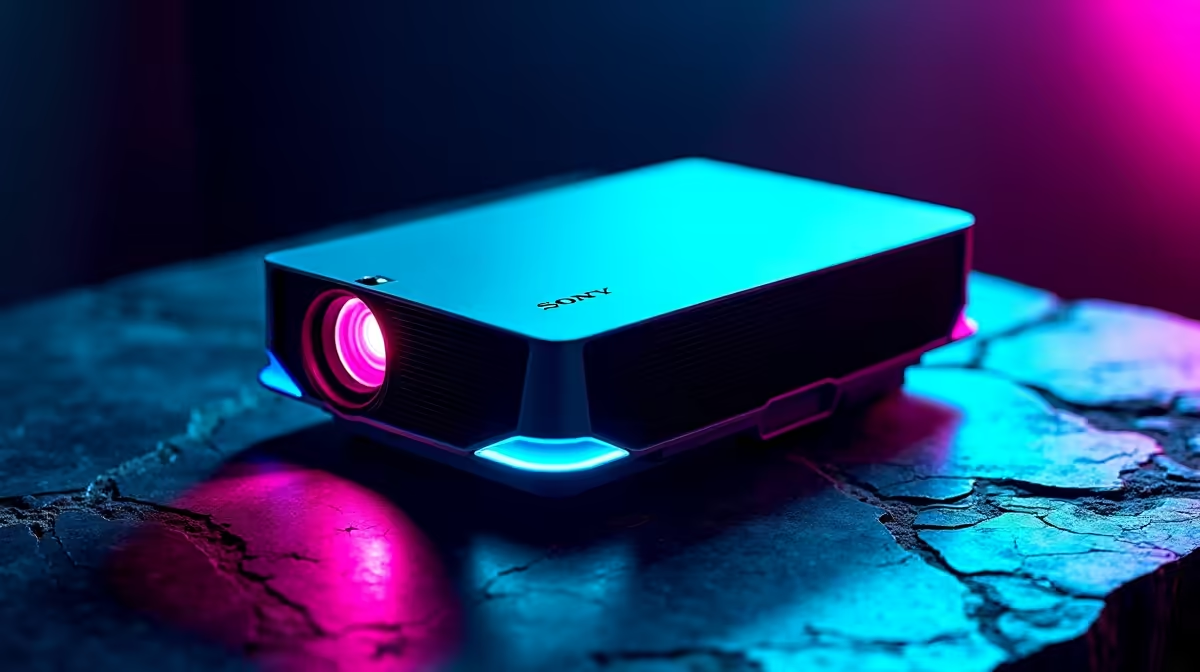
Gaming projectors are defined by their input lag and refresh rate specifications above all else. A true gaming projector delivers input lag below 16ms at 1080p and below 20ms at 4K, with many flagship models reaching sub-8ms response times. Refresh rates of 120Hz to 240Hz are standard in this category, ensuring smooth motion during fast-paced titles. Most gaming projectors use DLP display technology, which inherently produces sharp edges and high contrast for text and HUD elements - critical for competitive gaming and RPGs where readability matters.
Brightness typically ranges from 2,000 to 3,500 ANSI lumens on gaming projectors, making them usable in partially lit rooms but not ideal in bright daylight. Lamp or LED light sources affect lamp life and running costs - laser-based gaming projectors are increasingly common and eliminate bulb replacement costs. The throw ratio on gaming projectors is traditional - you need a significant distance between the unit and your screen, usually placing the projector on a ceiling mount or table at the back of the room.
Gaming projectors generally cost less than ultra short throw models at equivalent brightness levels, making them more accessible for dedicated gaming rooms where ceiling mounting is practical. Connection options typically include HDMI 2.1 for 4K 120Hz, USB for media playback, and audio out for external speaker systems.
Ultra Short Throw Projectors: Living Room Flexibility
Ultra short throw (UST) projectors are designed to sit within 30–50cm of the projection surface, typically on a low TV unit, projecting upward or forward onto a wall or ALR (ambient light rejecting) screen. This placement flexibility makes them ideal for living rooms where ceiling mounting is impractical or undesirable. UST models use laser or laser-phosphor light sources almost universally, delivering brightness levels from 2,500 to over 4,000 ANSI lumens - enough for usable daytime viewing with the right ALR screen.
Image quality for movies and streaming is a core strength of premium UST projectors. Many models support wide colour gamut coverage, Dolby Vision or HDR10+ certification, and integrated smart TV platforms with streaming apps built in. The optical design of UST lenses produces excellent image uniformity across the entire screen at close range. Audio systems in UST projectors tend to be more capable than those found in gaming projectors, with some models incorporating soundbar-grade speaker arrays.
The trade-off for UST projectors is input lag and refresh rate. Most UST models target home cinema use and deliver input lag in the 30–60ms range, which is adequate for casual gaming and story-driven titles but falls short for competitive gaming or fast-action genres where sub-16ms response is noticeable. Some newer UST models include a dedicated gaming mode that reduces input lag to around 20–25ms, bridging the gap for most non-competitive gamers.
Head-to-Head: Key Comparison Points
Brightness: UST projectors generally win here, making them more versatile across lighting conditions. Gaming projectors require a darker environment to deliver their best image quality, particularly for HDR content.
Input lag: Gaming projectors are clearly superior for competitive and fast-paced gaming. Sub-16ms response is nearly universal in gaming projectors and rare in UST models.
Installation: UST projectors are far simpler to install - no ceiling mount, no long cable runs, no permanent installation required. Gaming projectors mounted to a ceiling require cable management and fixed positioning.
Screen compatibility: Gaming projectors work with any standard projector screen or painted wall. UST projectors perform best with purpose-designed ALR screens that reject ambient light from overhead - these screens add to the total cost but significantly improve daytime image quality.
Sound: UST projectors typically include better built-in audio. Gaming projectors almost always require an external sound system or gaming headset.
Cost: At equivalent brightness and resolution, UST projectors carry a price premium of 30–60% over gaming projectors due to the complexity of their optics. However, factoring in the ALR screen cost required for optimal UST performance narrows this gap.
Which Is Best for Your Home?
If your primary use case is gaming - particularly fast-paced titles, competitive gaming, or console gaming with a large group - a gaming projector delivers the performance specifications that matter most. A dedicated gaming room with controlled lighting and a ceiling mount setup maximises what a gaming projector can do.
If your living room needs a large-screen solution for movies, streaming, sport, and occasional gaming without the installation complexity of a ceiling mount, a UST projector is the more practical choice. The image quality for non-gaming content is generally superior, and the living-room-friendly placement is a genuine quality-of-life advantage. For households where the projector serves multiple users with different needs, UST models offer the most flexibility.
For buyers who split their time evenly between competitive gaming and home cinema content, a gaming projector in a dedicated room paired with a good external audio setup remains the higher performance-per-rand choice in the South African market. UST models carry a significant price premium that is most justified when living room placement is the only practical option.
Frequently Asked Questions
Q: Can you use a gaming projector for movies and streaming? A: Yes - gaming projectors work well for movies and streaming content. Image quality is solid, particularly in darker viewing environments. The main limitation is that their integrated audio systems are usually basic, so a soundbar or speaker system improves the experience significantly.
Q: Do ultra short throw projectors have good enough input lag for gaming? A: For casual and story-driven gaming, most modern UST projectors with a dedicated game mode deliver acceptable input lag in the 20–30ms range. For competitive gaming or fast-action titles where sub-16ms response is important, a dedicated gaming projector is a better choice.
Q: What screen should I use with an ultra short throw projector? A: UST projectors require an ALR (ambient light rejecting) screen for best results - standard projector screens or painted walls will work but will look washed out in any lit environment. ALR screens are specifically engineered to reject light from overhead while accepting the low-angle projection of a UST unit.
Q: How far does a gaming projector need to be from the screen? A: Most traditional gaming projectors require 2.5–4 metres of throw distance to fill a 100-inch screen, depending on their specific throw ratio. Short throw gaming projectors reduce this to around 1–1.5 metres. Ultra short throw projectors can fill a 100-inch screen from as little as 25–35cm away.