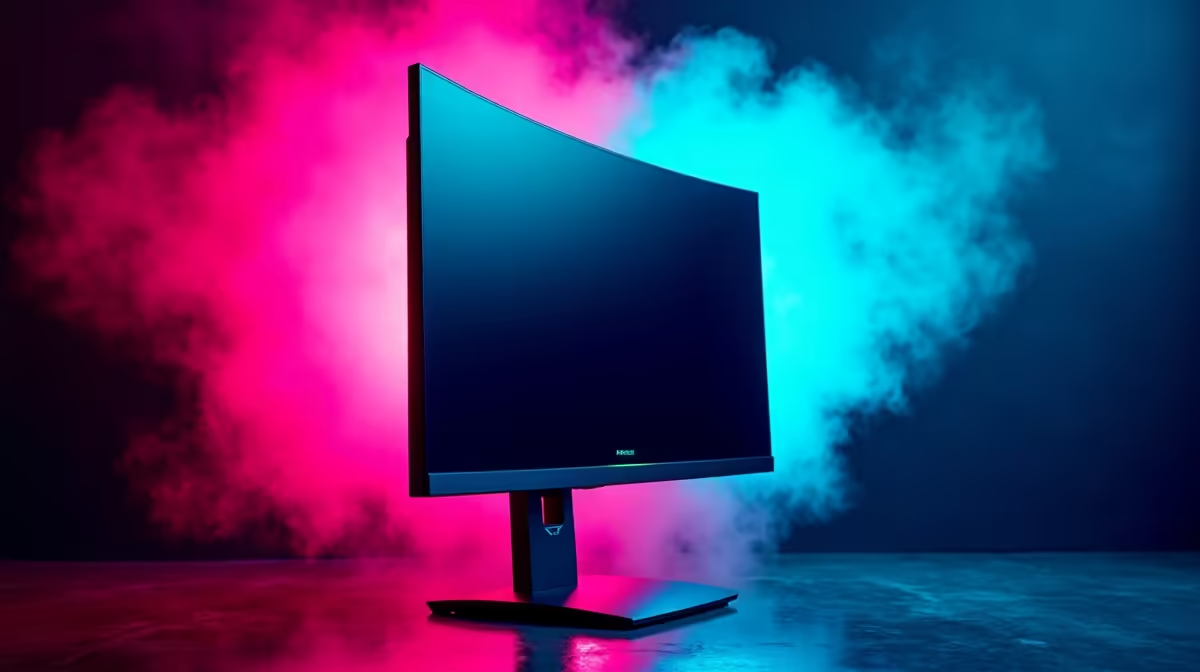
South African esports has grown rapidly, and a common question among competitive players - from Fortnite grinders in Johannesburg to Valorant teams in Cape Town - is whether a 144Hz monitor is still enough to compete at a high level in 2026. The short answer depends on the game and your rank, but the longer answer is more nuanced.
Quick Answer
For most competitive esports titles - including Valorant, CS2, and Apex Legends - 144Hz is absolutely viable and still recommended for players up to high-tier ranked play. Professional players at the very top level increasingly use 240Hz or 360Hz, but the performance gap is less significant than the gap between 60Hz and 144Hz.
The Real Difference Between 144Hz and 240Hz 🔧
Human perception of motion smoothness improves with higher refresh rates, but with diminishing returns. The jump from 60Hz to 144Hz is transformative - motion clarity, target tracking, and reaction time all improve measurably. The jump from 144Hz to 240Hz is real but subtle, typically measurable only in controlled testing at sub-10ms levels.
At 144fps, each frame is displayed for roughly 6.9 milliseconds. At 240fps, that drops to 4.2ms. In games where enemy movement is fast and precise aiming is critical - like CS2 - that reduction in display lag can help at the very highest skill levels. For the majority of ranked players, however, the bottleneck is game sense, crosshair placement, and decision-making, not monitor refresh rate.
Where 144Hz genuinely holds up well is in titles like League of Legends, Dota 2, and Rocket League, which are less dependent on sub-millisecond target acquisition. Even in CS2 and Valorant, professional analysts point to game knowledge as the primary differentiator below the top 1% of players.
Monitor Specs That Matter More Than Refresh Rate 💡
When evaluating monitors for competitive play, response time (GTG) and panel type often matter as much as refresh rate. An IPS panel at 144Hz with a 1ms GTG response will outperform a VA panel at 240Hz with 4ms GTG in fast-motion clarity.
Resolution is another factor. At 1080p, achieving 144fps or higher is significantly easier on mid-range hardware. Stepping to 1440p at 144Hz demands more GPU headroom but delivers better visual clarity - useful when spotting enemies at range in battle royale titles.
Local SA pricing for quality 144Hz IPS gaming monitors sits between R3,500 and R7,000 depending on brand and size. 240Hz panels carry a meaningful premium, typically R7,000 to R14,000 for quality options. Whether that delta justifies itself for your rank is worth honest self-assessment. Browse the full range of PC monitors available in SA to compare specs and pricing directly.
GPU Requirements to Actually Hit 144fps ⚡
A monitor is only as useful as the frame rate your PC can sustain. Running a 144Hz monitor at 80fps averages defeats much of the purpose. To reliably hit 144fps in competitive titles at 1080p, you need at minimum a mid-range GPU - something in the RTX 4060 or RX 7600 class.
For 1440p at 144fps, step up to an RTX 4070 or RX 7800 XT class card. CS2 and Valorant are CPU-bound at high frame rates, so your processor choice matters - a fast modern CPU like a Ryzen 5 9600X or Intel Core i5-14600K is important for pushing frames above 144.
If your current rig struggles to consistently hit 144fps, upgrading your GPU before your monitor is the smarter investment and will have a larger impact on your competitive experience.
Frequently Asked Questions ❓
Q: Will pros always have an advantage with 240Hz or 360Hz monitors? A: At the very top level - tournament professional play - yes, there is a marginal advantage. For ranked ladders below Radiant/Global Elite, the performance benefit does not meaningfully translate to win rate improvements.
Q: Does 144Hz help in slower-paced games like RTSs or MOBAs? A: Yes, motion clarity and cursor tracking both improve, but the gains are less impactful than in FPS titles. A quality 75Hz or 100Hz monitor is adequate for most MOBA players.
Q: Should I choose 144Hz 1080p or 1440p for esports? A: If your GPU can sustain 144fps at 1440p, the extra resolution is worth it for games where visual clarity aids spotting. If you're on mid-range hardware, 1080p at high frame rates is the better competitive choice.
Q: Is G-Sync or FreeSync important on a 144Hz monitor? A: Yes. When frame rate dips below 144fps, adaptive sync eliminates tearing and keeps gameplay smooth. It's worth prioritising, particularly for users whose GPU occasionally drops frames during intense fights.
Shop All Monitors and Graphics Card Deals at Evetech for fast delivery across South Africa.
Ready to Find Your Perfect Match? Explore relevant Evetech options, compare current South African pricing, and choose hardware that fits your setup. Shop now