Building a new PC rig in South Africa? You're staring at spec sheets, and one question keeps popping up: PCIe 5.0 vs 4.0. Is the new standard a must-have for a killer gaming experience, or is it just expensive hype that'll drain your budget for little reward? Let's cut through the noise and break it down for the local scene, helping you decide where to spend your hard-earned Rands for the best performance.
Understanding the PCIe Speed Difference
Before we dive into the PCIe 5.0 vs 4.0 debate, what even is PCIe? Think of it as the super-highway inside your PC. It connects your most important components—like your graphics card and SSD—to your motherboard and CPU. Each new generation of PCIe effectively doubles the number of lanes on this highway, allowing for much faster data transfer.
PCIe 4.0 offers a maximum bandwidth of about 64 GB/s. PCIe 5.0 doubles that to a massive 128 GB/s. On paper, that's a colossal leap. But does your gaming rig actually need that much speed right now? 🚀
Where Does PCIe 5.0 Matter Today?
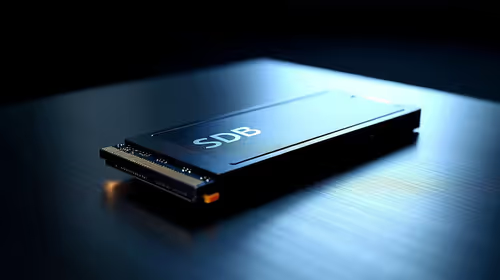
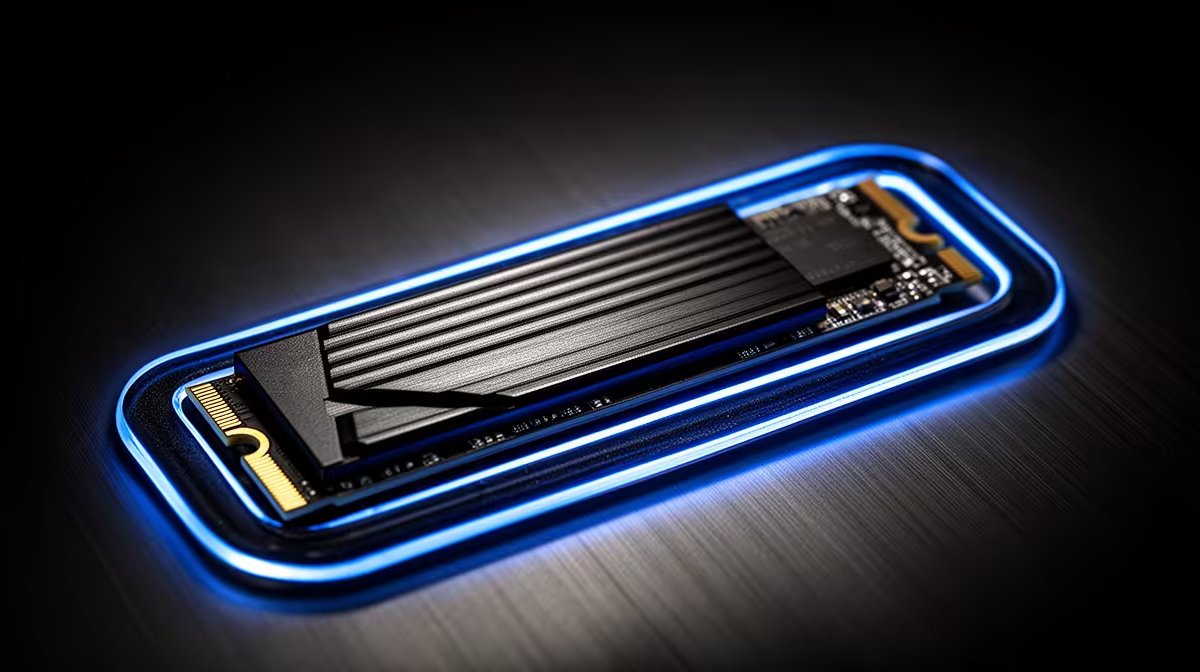
The practical benefits of PCIe 5.0 are currently limited to a very specific component: ultra-fast NVMe SSDs. A Gen5 SSD can achieve read/write speeds that are almost double what a top-tier Gen4 drive can manage. For professionals who move massive files daily—like 8K video editors or 3D artists—this is a significant workflow improvement.
However, for gaming, the difference is almost unnoticeable. Games simply don't require that level of storage bandwidth yet. Loading times between a Gen4 and a Gen5 SSD are often separated by a mere second or two. For most gamers, that's not worth the hefty price premium.
Quick Check 🔧
Unsure what your current motherboard supports? Download a free tool like CPU-Z. Under the 'Mainboard' tab, look for the 'Graphic Interface' section. It will clearly state the Link Width and the maximum supported specification (e.g., PCI-Express 4.0), so you know exactly what you're working with before you even think about upgrading.
Is the Upgrade Worth It for SA Gamers?
For the vast majority of South African gamers and PC builders, the answer is simple: probably not yet. The debate over PCIe 5.0 vs 4.0 comes down to real-world value, and right now, the value isn't there for gaming.
Here’s why:
- Graphics Cards: Even the mighty NVIDIA GeForce RTX 4090 doesn't fully saturate a PCIe 4.0 x16 slot. This means upgrading to a PCIe 5.0 motherboard for your GPU gives you zero performance gain in today's titles.
- Cost: PCIe 5.0 compatibility is found on newer, more expensive motherboards. Whether you are looking at the latest AMD motherboards with the AM5 socket or high-end Intel motherboards, you're paying a premium for a feature you likely won't use to its full potential for years.
- Smarter Spending: The money you'd spend on a PCIe 5.0-ready setup could be invested in components that deliver a tangible performance boost today. Think a better GPU, more RAM, a larger power supply, or a higher-quality display. ✨
Sticking with a robust PCIe 4.0 platform allows you to access a wide range of powerful and affordable motherboards, leaving more of your budget for the parts that truly impact your frame rates.
The Verdict: Stick with PCIe 4.0 for Now
While PCIe 5.0 is technically superior, its real-world benefits for gaming are still on the horizon. For a new build in South Africa today, PCIe 4.0 hits the sweet spot of performance, availability, and price. It provides more than enough bandwidth for the best hardware on the market without forcing you to overspend.
The discussion of PCIe 5.0 vs 4.0 will evolve as future GPUs and games become more demanding. But for now, build smart, save your Rands, and focus on a balanced rig that delivers maximum frames for your buck.
Ready to Build Your Perfect Rig? Choosing the right foundation for your PC is crucial. Whether you decide on a future-proof PCIe 5.0 board or a value-packed PCIe 4.0 option, we've got you covered. Explore our massive range of PC components and find the perfect hardware to conquer your world.