Refresh rate changes how often a screen redraws, not how many cells fit in a spreadsheet. 100Hz versus 60Hz for everyday business work is mainly a motion comparison across scrolling, cursor travel and animation.
Quick Answer
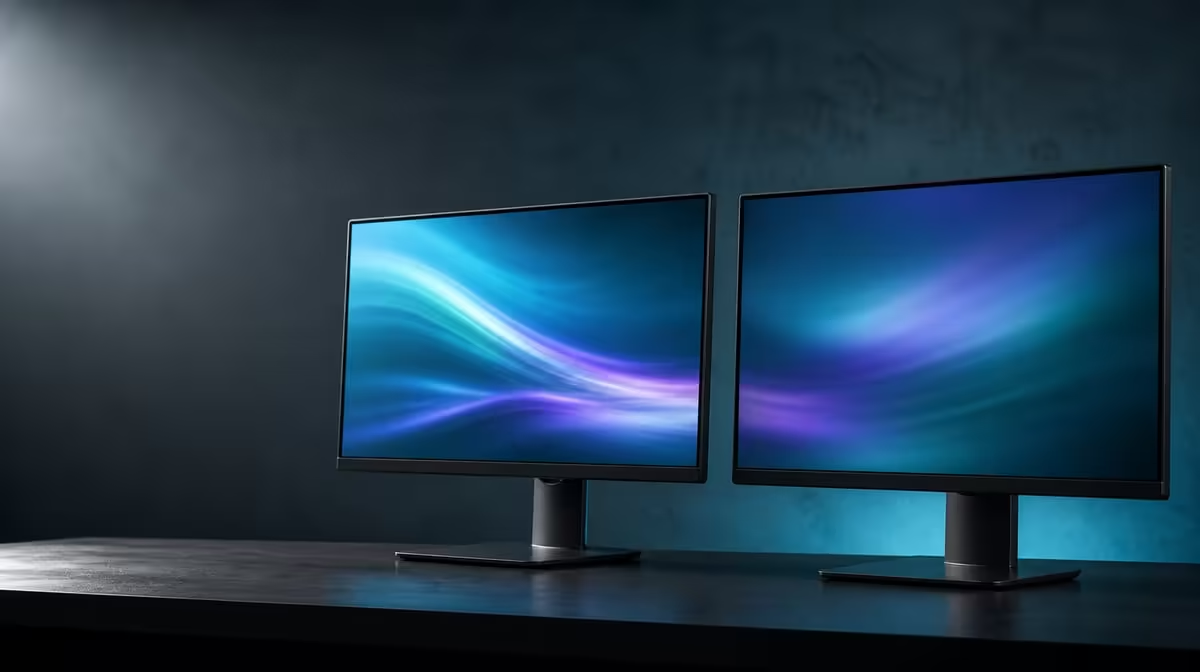
At R6,899, the UPERFECT Delta Mega can run its two 23.8-inch Full HD panels at 100Hz on a compatible laptop path. Compared with 60Hz, motion can look smoother, but document detail, colour and usable task area remain unchanged.
🖱️ See the difference in motion
A 60Hz panel refreshes 60 times per second, while 100Hz updates more frequently. The change can make a moving cursor, scrolling page and window animation appear more fluid.
Open the same long document on both Delta Mega screens and compare a controlled scroll at each rate. Keep resolution, scaling and application zoom unchanged.
The laptop and Type-C or HDMI connection must expose the intended mode. Confirm 100Hz individually for both panels.
Compare business screens through Evetech's portable monitor category with the source path written beside the refresh figure.
📄 Static work keeps the same pixels
The Full HD grid remains 1920 x 1080 at either rate. A still document, photograph or spreadsheet does not gain detail from 100Hz.
Task layout comes from two 23.8-inch panels, display scaling and window arrangement. The higher rate can improve visual fluidity while that workspace stays constant.
Colour also remains separate. Start both IPS screens from matched neutral settings when comparing motion.
🧪 Test everyday value
Use email, a browser, spreadsheets and the exact business applications for a full session. Note where motion is frequent and where the display remains mostly static.
Move a window across the panel boundary. If one screen looks different, check its active refresh rather than assuming both saved the same mode.
The Delta Mega lists 14ms response, which describes pixel transitions. It is not another way to write 100Hz and may matter differently for casual gaming.
Use Evetech's PC monitor range to compare refresh choices across fixed office displays.
💼 Decide from the workflow
Users who scroll, move windows or review animation frequently may value 100Hz more. People working mainly in still documents may notice less practical change.
Test built-in speakers and low blue light separately. Audio convenience and comfort modes should not be counted as refresh benefits.
At R6,899, 100Hz is one part of a laptop workspace that also includes two task zones and flexible folding. Check Evetech's popular monitor page with the motion trial in hand.
Create three matched tests: slow document scrolling, rapid spreadsheet movement and a window dragged in circles. Repeat at 60Hz and 100Hz without changing scaling or picture mode.
Ask the user to score smoothness and usefulness separately. A visible difference may be pleasant without improving a mostly static job.
Move the same test across the screen boundary. A sudden change can reveal that one Delta Mega panel did not retain 100Hz.
Check the laptop display too. If the cursor crosses between panels running different rates, the mixed motion may influence the overall impression.
Run the 100Hz profile after restart and after switching from horizontal to stacked use. Physical folding should not change the intended software mode, but reconnection can.
For casual gaming, use representative play and keep the 14ms response figure visible in the decision. Do not infer another response value from refresh.
At month end, record which business actions still benefit. This prevents a smooth setup demonstration from carrying the full purchase argument after motion-heavy tasks disappear.
Create a neutral 60Hz recovery profile for diagnosis. If a source change removes 100Hz, the user can first restore two stable Full HD screens and then investigate the higher mode.
Do not interpret a refresh change as a colour or speaker fault. Keep those tests on their own cards.
Ask another user to compare the motion samples without seeing the selected rate. Their result can reveal whether the practical difference is obvious in that workflow.
Frequently Asked Questions
What is the visible advantage of 100Hz?
Compatible motion such as scrolling, cursor movement and animation can appear smoother.
Does 100Hz show more document detail?
No. Both rates use the same Full HD pixel grid.
Can 100Hz improve ordinary office work?
It can improve visual fluidity where the workflow contains frequent on-screen movement.
What must support the higher refresh mode?
The laptop, connection, display settings and both panels must expose 100Hz.
Does refresh rate change built-in audio?
No. Speaker playback is a separate laptop and monitor function.
Who may notice little difference?
Users spending most of their time on static text or still content may value it less.
How does 14ms relate to 100Hz?
It describes pixel response behaviour, while 100Hz describes how often the screen refreshes.
Ready to judge 100Hz through your normal cursor and scroll work?
Explore Evetech's dual monitors and compare the Delta Mega at matched Full HD settings before assigning value to smoother motion.