Are Curved Monitors Better for Gaming or Just Different?
Quick Answer
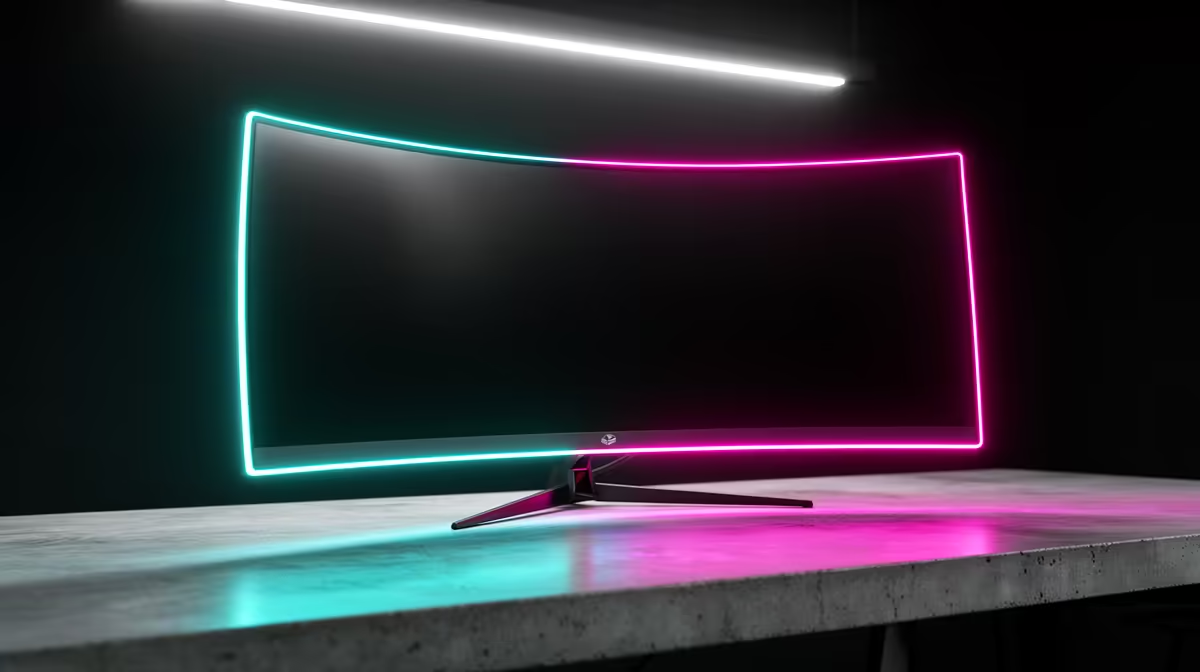
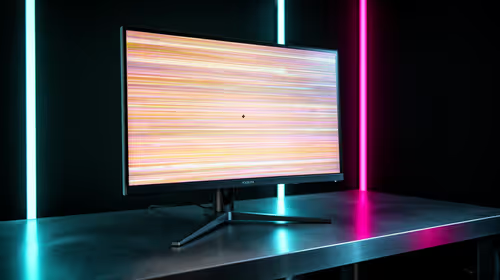
Curved monitors are different, not universally better. The bend can keep ultrawide edges closer to the same viewing distance and make games feel more immersive for one central player.
It does not improve frame rate, input lag or aim. A flat screen can be the better fit for competitive play, shared viewing and work where physical geometry matters.
Curve adds the most value on 34-inch ultrawide and 49-inch super-ultrawide panels. On a 27-inch 16:9 monitor, the effect can be modest.
Where Curve Helps
A wide flat panel places its corners further from your eyes than the centre. A suitable curve turns those edges towards you.
That can make racing, simulation and exploration games fill peripheral vision. VA panels can also show more consistent edge contrast when viewed closer to straight-on.
The benefit depends on one central seat. People watching from the side see another geometry.
Where Flat Wins
Competitive players often prefer a compact flat 24-inch or 27-inch view. The whole image fits without a strong physical bend.
Design, CAD and layout work can feel more natural on a flat surface. A curved screen still draws straight digital lines, but your view of the surface changes.
Flat monitors also align more easily in a multi-screen row.
Eye Strain Claims Need Care
A curve can reduce the distance difference between centre and edges on a wide screen. That does not prove a universal eye-strain benefit.
Brightness, glare, font size, viewing distance and breaks all affect comfort. Set those first.
If a curve makes you sit too close or move your head more, it can be less comfortable.
Pick From the Desk
Measure width, stand depth and viewing distance. Strong 1000R curves wrap more than 1500R or 1800R.
Browse current monitor formats and use popular screen choices to compare curved and flat models at the same resolution.
Check reflections and speaker placement. Curved edges can catch room light from another angle and take more physical depth.
Share the Screen Before Deciding
A curve is designed around a central viewer. Someone watching from the side sees the near edge from a sharper angle and the far edge turned away.
For couch co-op, client presentations or a family desk, a flat panel keeps the geometry more predictable across seats. For one racing rig or sim cockpit, the central wrap can be the whole point.
FAQ
Does curve improve gaming performance?
No direct performance gain exists. It changes immersion and viewing geometry.
Do esports players prefer flat?
Many do because compact flat screens match tournament setups. Personal preference and game still matter.
Should ultrawide always be curved?
Curve is useful as width grows, but a gentle or flat ultrawide can suit work and shared viewing.
Does curve cost more?
Price depends on the complete panel, size and features. Compare exact models rather than category assumptions.
Sit at your real desk distance and compare the same-size curved and flat screens, choosing the geometry that disappears once the game starts.