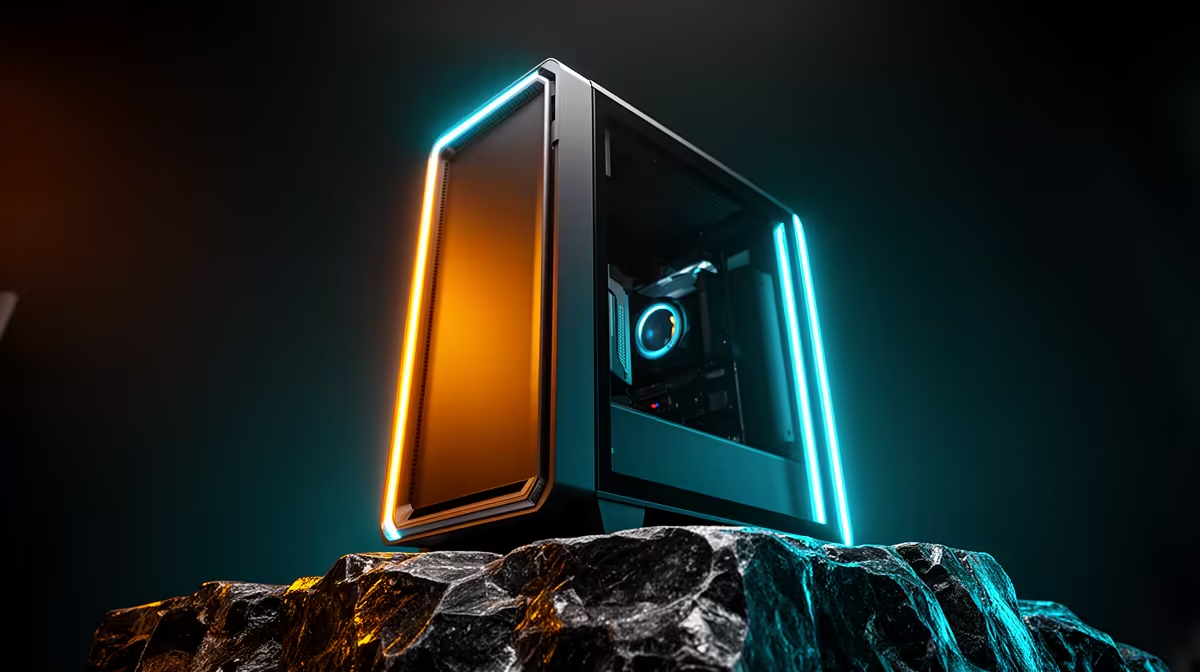
A rented room with one small desk, a shared home office, or student digs where the PC has to disappear during the day all share the same problem: a full tower simply does not fit the life happening around it. That is the exact gap a gaming mini pc exists to close, trading a big case for a footprint closer to a router than a desktop.
Quick Answer
This build packs a 16-core Ryzen 9 9955HX alongside an RTX 5070 8GB into a compact chassis for R66,399, real desktop-class hardware without the desktop-sized case. For SA bedrooms, digs and small home offices where desk space is tight, that combination lets you skip the tower entirely.
📏 Why Size Matters More Than People Admit
Most gaming PC advice focuses purely on frame rates and ignores where the machine actually has to live. A shared res room, a corner office with a standing desk, or a bedroom where the PC sits on a shelf all favour a smaller footprint over raw case volume. This build keeps the full spec sheet, a terabyte of NVMe storage and 32GB of memory included, in a chassis that clears those tight spaces without a compromise on power. Cable management gets easier too, since fewer, shorter runs are needed to reach the monitor and peripherals compared with a case tucked under a desk.
⚙️ What You Are Not Giving Up
The usual worry with a small-form gaming machine is thermals or clipped specs. That is not the trade-off here. The Ryzen 9 9955HX is a genuine sixteen-core desktop-class chip, and the RTX 5070 alongside it handles modern titles at high settings rather than the cut-down mobile parts some compact machines rely on. Windows 11 Home runs on it exactly as it would on any full-size desktop. Connectivity is not scaled back either: Wi-Fi 7, Bluetooth 5.4 and a 2.5G LAN port cover wireless and wired networking, while HDMI, DisplayPort and a Thunderbolt-enabled USB-C output handle displays and fast external storage.
🏠 Where a Compact Build Actually Pays Off
Students in shared accommodation, professionals working from a spare bedroom, and anyone renting rather than owning their space all benefit from a machine that can be moved or hidden away without a two-person lift. A mini PC also draws less attention on a desk shared with study materials or a second monitor for work.
Sizing this up against other small-footprint machines? Evetech's range of mini PCs is worth browsing before deciding, since configurations vary in GPU and storage. For the exact build referenced throughout this piece, see the full spec and price here. And if the graphics card is your main decision point rather than the form factor, current pricing on that tier of GPU gives useful context for where the RTX 5070 sits.
Frequently Asked Questions
Can a mini PC really deliver serious gaming performance?
Yes, when it uses full desktop-class parts like this one does. The sixteen-core processor and 8GB RTX 5070 are not mobile-scaled components, so performance is not compromised by the smaller case.
How much desk space does this machine realistically need?
Considerably less than a mid-tower case, since the chassis is built around a compact form factor rather than a full-size motherboard and multiple drive bays.
Can I still connect multiple monitors on a compact PC?
Yes. Between HDMI, DisplayPort and the Thunderbolt-capable USB-C port, a typical dual or triple-monitor setup for gaming or work is easily covered.
Does a smaller case mean worse cooling?
Not necessarily. The specs here are unaffected by case size in terms of what the chip and GPU are rated to do, though airflow design inside a compact chassis differs from a tower.
Ready to fit serious gaming power into a small SA room?
Pick up the compact GR70 from ASUS inside Evetech's mini PC shelf, selling at R66,399, made to fit serious gaming power into a bedroom or home office desk.