Quick Answer
Only for budget or small-form esports rigs - for serious competitive play a discrete GPU is the better buy. A modern APU like a Ryzen 8000G runs CS2 or Valorant at 1080p low at 80-120 fps, fine for casual play but short of the 240-plus fps competitive players want. If your budget stretches past R12,000 for the whole build, a discrete card pulls ahead clearly.
APU versus discrete GPU for esports
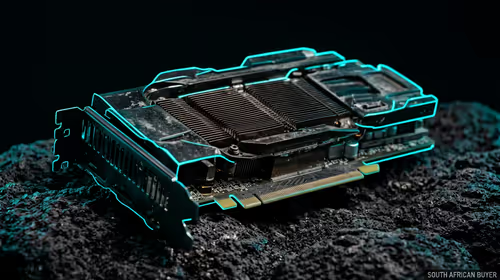
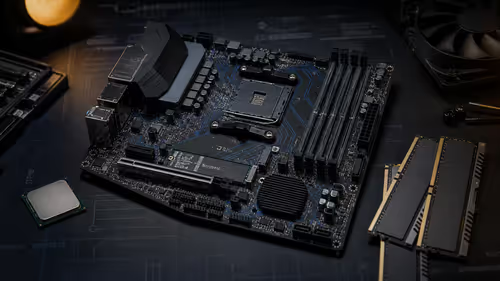
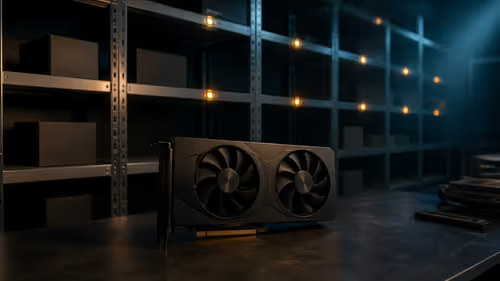
An APU folds the graphics into the CPU, saving the cost of a separate card and a bigger PSU - ideal for a compact, low-cost build. A Ryzen 8000G-class APU manages 80-120 fps in CS2 or Valorant at 1080p low. A discrete RTX 5060 or RX 7800 XT pushes those same games well past 200 fps, which is what a 240Hz panel needs. For competitive esports, the frames matter.
When the APU build makes sense
Choose the APU route for a sub-R12,000 starter rig, a LAN or travel box, or a second PC, where an APU build saves the R7,500-plus a discrete card adds. Step up to a discrete GPU the moment you want high-refresh competitive frames. Most SA gamers building around this can size the rest of the setup to match without overspending.
FAQ
Can an APU run CS2 or Valorant well?
Yes, at 1080p low a Ryzen 8000G-class APU hits roughly 80-120 fps - smooth for casual competitive play but below the 240 fps a high-refresh esports setup targets.
When should I pick a discrete GPU instead?
Once your budget passes about R12,000 or you want 200-plus fps for a high-refresh monitor. A discrete RTX 5060 or RX 7800 XT comfortably clears those frames where an APU cannot.
Is an APU build cheaper overall?
Yes - skipping the discrete card and using a smaller PSU can save R7,500 or more. That makes APUs ideal for compact or budget builds, less so for serious esports.
Building tight? An APU starter rig from Evetech gets you into CS2 and Valorant affordably. Want 240Hz competitive frames? Step up to a discrete RTX 5060 or RX 7800 XT and a high-refresh panel.