


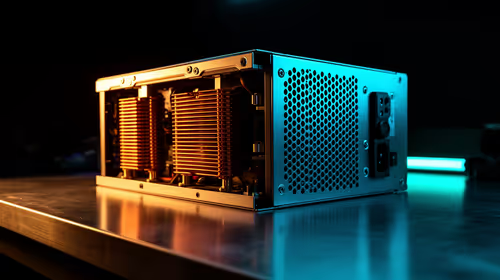
1000W PSU Planning for RTX 5090 Builds in SA
1000W for RTX 5090 needs a full-build check, not a simple yes. Review GPU guidance, CPU draw, transient load, connectors, PSU quality, and upgrade plans before deciding.
Read moreDedicated AI noise canceling microphones eliminate background audio distractions through a purpose-built noise engine that targets non-voice sound. Tuned only for audio cleanup, it removes fan and traffic noise more accurately than a general app. 🔇
Open-plan offices, shared student flats, and busy households are the reality for most South Africans on remote calls or recording audio. Generic noise suppression apps help, but they run as a layer on top of whatever the microphone delivers. A dedicated AI noise canceling microphone takes a different approach by building the noise engine directly into the hardware, so it processes audio before it ever reaches your PC or streaming app.
A dedicated AI noise canceling mic removes background audio distractions through an onboard engine trained specifically to separate voice from non-voice sound. Fan hum, traffic, and household noise drop significantly at the source. No extra software is needed since the engine runs on the mic itself.
Most software noise filters handle a range of audio tasks: echo removal, volume levelling, and noise reduction all running in the same processing pass. That breadth is convenient but it means the noise model was not trained exclusively on the voice-versus-noise separation problem.
A dedicated AI engine is trained on a single task. Its dataset is built from thousands of voice recordings layered against real-world noise signatures, everything from office air conditioning to Cape Town traffic, and the model learns the boundary between voice and background with much finer resolution. When you speak, the engine identifies your voice profile within the first few milliseconds and uses it as the reference for every subsequent frame of audio.
The practical result is that the engine can suppress a constant aircon drone by roughly 25 decibels without touching the clarity of your voice. A general software filter tends to either leave more of the noise in or introduce processing artefacts on the voice itself, particularly on consonant sounds that share frequency space with common background noise.
The onboard processing means the filtered audio arrives at your PC already clean. Whether you are on a video call, in a streaming app, or recording into audio software, the mic appears as a standard audio device sending a processed signal. There is no driver layer to configure and no app to run in the background consuming system resources.
This is a meaningful advantage on mid-range laptops or older desktop systems where background processes compete for CPU headroom. A software noise filter that runs during a live call adds measurable processing load. The dedicated AI mic offloads that work entirely to its onboard chip, keeping your system responsive during a long meeting or a recording session.
Most dedicated AI mics include a companion app for fine-tuning the suppression level and monitoring the processed signal, but the app is optional. Plug the mic in, select it as your input device, and the clean audio is already there.
Steady mechanical noise is where the engine performs best. Aircon units in shared offices, the hum of a refrigerator compressor, a desktop fan cooling a PC during a session; these are constant-frequency sources that the engine profiles quickly and suppresses aggressively. In most cases the noise drops below the noise floor of the recording within seconds of the engine locking onto it.
Traffic from a busy main road is slightly more variable because car pass-bys create peaks rather than a steady signal. The engine handles the background road rumble very well and manages most pass-by peaks, though sudden loud sources close to the window may produce brief transitions before the model suppresses them.
The genuinely difficult scenario is another person speaking in the same room. Speech has a similar frequency profile to the target voice, and the engine has to make fast decisions about which voice to preserve. Most dedicated AI engines prioritise the closest and loudest signal, so close mic placement at 15 to 20 centimetres helps the engine identify your voice as the primary source and push the secondary voice down significantly, though not always silently.
Training focus. A dedicated engine is built on a dataset aimed entirely at separating voice from background noise, giving its model far more detail at the voice-noise boundary. It classifies each audio frame against that specialised model, which allows finer cuts without clipping consonants or adding artefacts.
No. The engine runs onboard and delivers a clean signal through the USB connection without needing a running app or an active driver process. A companion app is available for adjusting suppression strength, but it is optional rather than required.
Very well. Steady aircon drone and fan hum are exactly the noise signatures a dedicated AI engine handles most reliably. A constant signal is profiled quickly and suppressed aggressively, dropping by around 25 decibels in most cases.
Partially. The engine prioritises the dominant voice signal, typically the person closest to the mic. Close placement at 15 to 20 centimetres helps the model identify your voice as the primary source. A secondary speaker will be reduced but rarely eliminated completely.
Often yes. Many dedicated AI mics receive firmware updates that refresh the noise model. A download through the companion app applies the updated model to the same hardware, which means the mic you buy today may perform noticeably better in six to twelve months at no extra cost.
Ready to cut the background noise before it reaches your recording? Explore the AI noise canceling microphone range built for South African creators and remote workers who need clean audio straight from the source.
Training focus. A dedicated engine is built on a dataset aimed entirely at separating voice from background noise, giving its model far more detail at the voice-noise boundary. It classifies each audio frame against that specialised model, which allows finer cuts without clipping consonants or adding artefacts.
No. The engine runs onboard and delivers a clean signal through the USB connection without needing a running app or an active driver process. A companion app is available for adjusting suppression strength, but it is optional rather than required.
Very well. Steady aircon drone and fan hum are exactly the noise signatures a dedicated AI engine handles most reliably. A constant signal is profiled quickly and suppressed aggressively, dropping by around 25 decibels in most cases.
Partially. The engine prioritises the dominant voice signal, typically the person closest to the mic. Close placement at 15 to 20 centimetres helps the model identify your voice as the primary source. A secondary speaker will be reduced but rarely eliminated completely.
Often yes. Many dedicated AI mics receive firmware updates that refresh the noise model. A download through the companion app applies the updated model to the same hardware, which means the mic you buy today may perform noticeably better in six to twelve months at no extra cost.
1000W for RTX 5090 needs a full-build check, not a simple yes. Review GPU guidance, CPU draw, transient load, connectors, PSU quality, and upgrade plans before deciding.
Read more
RTX 5080 Super with a 750W PSU is more comfortable than lower wattage if the unit is quality. SA builders should still confirm GPU guidance, CPU draw, connector type, airflow, and upgrade room.
Read more
How to fix FPS drops after a RX 9070 XT starts with driver cleanup, chipset updates, thermals, and power checks. For SA gaming PCs, confirm PCIe seating, monitor refresh, frame caps, and per-game graphics settings before replacing parts.
Read more
How to fix low FPS Windows 11 Wi-Fi 7 issues starts by checking whether the problem is frame rate or network lag. Test ping, drivers, power settings, Ethernet, and game FPS before adjusting visuals.
Read more
AM5 is smart for SA builders because it supports newer Ryzen CPUs, DDR5 memory, and a longer upgrade path. Compare board cost, cooling, gaming needs, and local part availability before choosing your next PC platform.
Read more
AM5 gives Randburg gaming builders a longer upgrade path. For SA buyers, DDR5 support, newer board features, and future CPU options can justify the platform. Weigh board cost, cooler support, BIOS maturity, and upgrade timing before choosing.
Read more
RTX 5090 on a 550W PSU leaves almost no practical room for OC plans. Treat the setup as constrained, with CPU draw, power spikes, cable quality, thermals, and stability checks more important than chasing extra clocks.

FPS drops on a Ryzen 9 9950X3D build often have a fixable cause. Check settings, drivers, thermals, background tasks, network conditions, and bottlenecks before assuming a part must be replaced.

The difference between PCIe 5.0 and PCIe 4.0 for SA gamers is mostly bandwidth headroom. Compare GPU slot needs, NVMe speed, motherboard support, and upgrade timing before paying extra for a newer platform.

Gaming PC stuck pixel checks in South Africa should confirm the monitor fault first. Use colour tests, screenshot comparison, cable swaps, display menu checks, and clear photos before deciding on support.

AMD's current driver now lists a Radeon RX 9050 4GB, while product coverage details a narrowed memory system. SA buyers should weigh the low VRAM ceiling against current local Radeon options.

Samsung Display has demonstrated a 16-inch 2.5K OLED laptop panel running at 300Hz. SA buyers should wait for a named notebook, full panel specifications and a local price before planning an upgrade.

Microsoft says some Windows 11 game crashes after recent updates are linked to RGB-related drivers. Affected SA gamers should confirm the update and driver before using the published registry workaround.
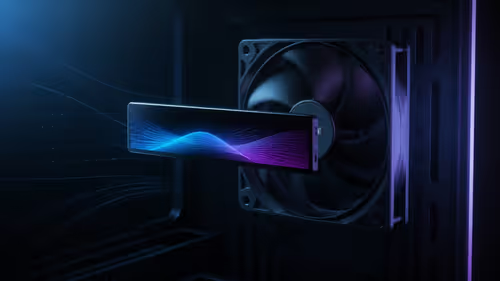
Thermalright's Fan Frame Vision-1 adds a 640x172 status screen to a standard 120mm fan. SA builders should check clearance, USB routing and local support before treating it as an easy upgrade.
1000W for RTX 5090 needs a full-build check, not a simple yes. Review GPU guidance, CPU draw, transient load, connectors, PSU quality, and upgrade plans before deciding.

Wi-Fi 6E vs Wi-Fi 6 matters for 4K video editing when files move across a network. The real-world difference between Wi-Fi 6E and Wi-Fi 6 for video editing in 4K depends on NAS access, cloud uploads, router range, and SA creator workflows.
RTX 5080 Super with a 750W PSU is more comfortable than lower wattage if the unit is quality. SA builders should still confirm GPU guidance, CPU draw, connector type, airflow, and upgrade room.
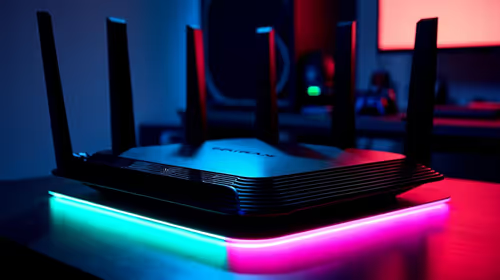
Wi-Fi 6E vs Wi-Fi 6 for Video Editing in 4K comes down to router support, latency, client devices, band support, and home network layout. SA buyers should match the choice to their setup instead of assuming one option always wins.