Quick Answer
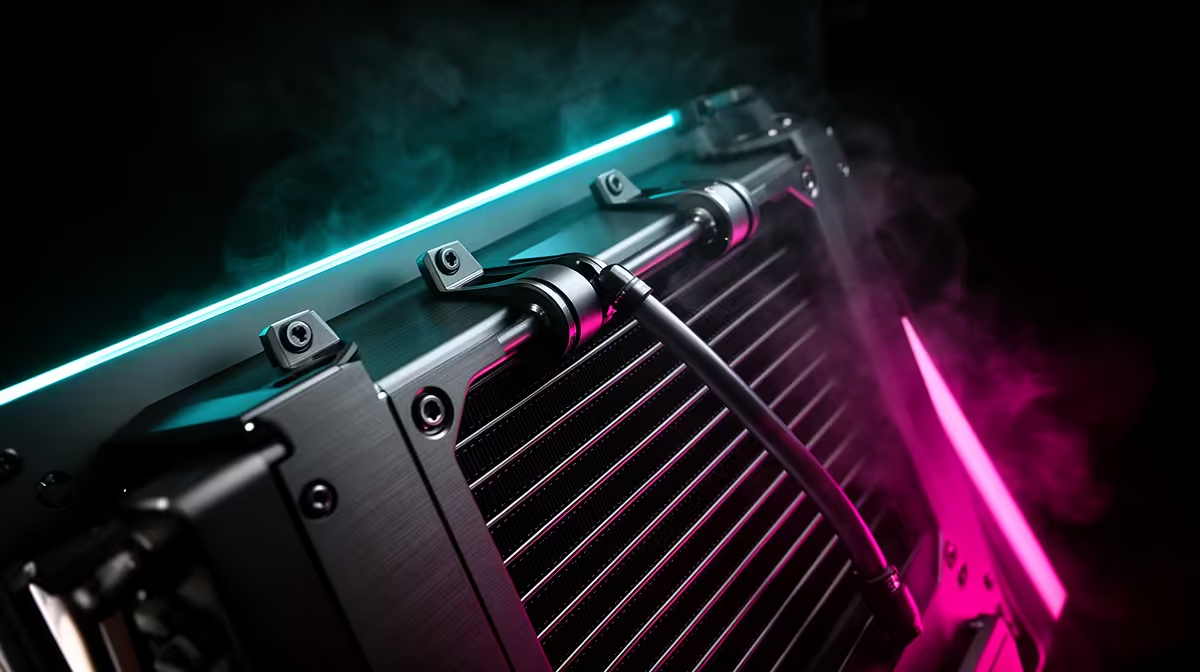
360mm radiator support in a modern PC case covers front, top, and sometimes side positions, each with different clearance requirements, fan thickness limits, and compatibility constraints. Front mounting is thermally superior; top mounting is the most common default in mid-tower designs.
Front 360mm Radiator Mounting: The Most Efficient Position 💧
A front-mounted 360mm radiator pulls unconditioned air from outside the case through its fins before that air enters the chassis. This gives the radiator the coldest possible inlet air, maximising heat rejection. Front mounting suits three 120mm fans in push configuration, or six fans in push-pull if the case interior has sufficient depth.
The trade-off is GPU clearance. The radiator plus its fans add 90 to 120mm of depth to the front of the case, reducing available GPU space. A case with 420mm total depth might only offer 300 to 330mm of GPU clearance with a front 360mm radiator installed. Always check the case spec for the GPU clearance figure with front radiator fitted, not just the maximum GPU clearance headline number.
Top 360mm Radiator Mounting: The Common Default 🔧
Top-mounted 360mm support is more widely available than front 360mm, appearing in standard ATX mid-towers from R1,800 upward in South Africa. The top position exhausts warm radiator air directly out of the case without passing over other components, which keeps case ambient temperatures lower.
The constraint is clearance above the motherboard. Tall VRM heatsinks, vertical RAM slots, or high DDR5 heatspreaders can reduce the usable space between the motherboard PCB and the top fan mount frame. Cases that specify top 360mm support with DDR5 tall heatspreader compatibility have been verified by the manufacturer. Others may require manual confirmation before purchasing.
Simultaneous Radiator Support and Why It Matters 🌡️
Builders running custom loops or dual AIO configurations need to confirm whether the case supports multiple radiators simultaneously. A case might list both front 360mm and top 240mm support, but this only matters if both positions can be occupied at the same time without one restricting the other.
For South African builders investing in a full custom loop cooling both CPU and GPU, simultaneous 360mm front and 360mm top is the ideal spec, found in full-tower and high-end E-ATX cases typically above R3,500 locally. This enables the highest heat rejection capacity available in a standard form factor, keeping a Ryzen 9 9950X and RTX 5090 pairing thermally stable even in warm Johannesburg office environments.
Radiator Fan Direction Convention ⚡
Mount front radiator fans to pull air from outside the case through the radiator into the chassis (intake direction). Mount top radiator fans to push case air through the radiator and out the top (exhaust direction). Mixing these conventions creates pressure conflicts that reduce overall cooling efficiency by 10 to 15 percent.
FAQ
Can I mount a 360mm radiator in a standard ATX mid-tower?
Yes, if the case specifically lists 360mm front or top support. Not all mid-towers qualify. Compact and budget mid-towers often max out at 240mm. Check the radiator support row in the spec sheet rather than inferring from the case size classification.
Do I need special screws to mount a 360mm radiator?
Most AIOs and cases include the required M3 screws. Verify thread type matches before ordering third-party fans for push-pull configurations, as some older fan designs use different thread pitches.
Does a 360mm radiator make noise at normal fan speeds?
At 800 to 1,000 RPM, three 120mm fans produce 22 to 28 dB, near-silent. At full speed during stress testing, noise rises to 38 to 45 dB, audible but typical for a high-performance cooling setup. Custom UEFI fan curves keep the AIO quiet during everyday gaming.
Planning a 360mm liquid-cooled build? Evetech stocks ATX and full-tower cases with verified 360mm radiator support alongside a range of AIO coolers ready for installation.