Quick Answer
For a high-end mATX build pairing an RTX 5080 or RX 9070 XT with a 280 mm or 360 mm AIO, prioritise GPU length clearance above 360 mm, top or front radiator mounting that accepts thick 30 mm radiators, CPU cooler height up to 165 mm for air cooler alternatives, and a PSU shroud with cable routing channels at least 20 mm deep.
GPU Clearance, Slot Width, and Support 🖥️
High-end GPUs in the RTX 5080 and RX 9070 XT tier measure 336 mm to 360 mm in length and cover two to three expansion slots (62 mm to 65 mm wide).
Radiator and Fan Mounting Options 💧
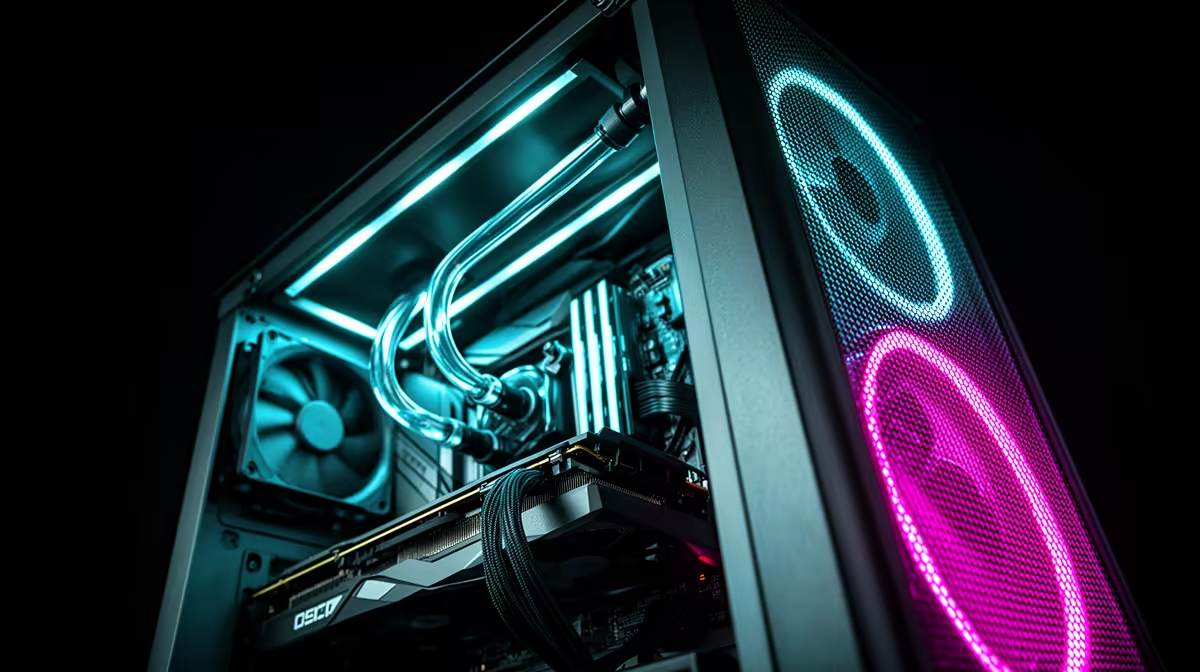
A 280 mm AIO is typically the sweet spot for mATX: it fits in cases that cannot take 360 mm and delivers CPU temperatures two to four degrees Celsius lower than a 240 mm at the same fan speeds. For a Ryzen 9 9950X or Core Ultra 9 285K in an mATX shell, a 360 mm AIO is worth the extra effort of finding a compatible case. Confirm that the mounting frame accepts 30 mm thick radiators, as slim 20 mm radiators are less common and limit pump and fin density. Fan mounts are usually shared between radiator and case fans, so a top-mounted 280 mm radiator may consume the only two top fan positions, leaving just front and rear for additional case airflow.
PSU Compatibility, Cable Routing, and Front I/O 🔌
Compact mATX cases cap PSU length at 160 mm to 180 mm. Full-modular units in the 850 W to 1,000 W range (required for RTX 5080 builds to handle peak transient loads up to 600 W) often measure 170 mm to 200 mm, so check specifications carefully. Cable management channels behind the motherboard tray should be 20 mm or deeper to clear 24-pin and multiple PCIe cables without forcing the side panel. Front I/O on cases in the R1,500 to R2,800 price range increasingly includes USB-C 3.2 Gen 2 at 10 Gbps, which matters for SA builders who transfer large game installs between portable SSDs and their rig.
Case Materials, Tempered Glass Options, and Build Quality 🔧
Steel gauge in the R1,000 to R1,800 range is typically 0.7 mm to 0.8 mm, with premium cases at R2,000 and above using 1.0 mm SECC steel that reduces flex and vibration resonance. Tempered glass side panels are either hinged or tool-free latch depending on the case, and thickness varies between 3 mm (budget) and 4 mm (mid-premium). High-end mATX cases often feature curved tempered glass for a wider viewing angle of the interior, which highlights AIO tubing routing and ARGB fan lighting. Dust filters on intake points (front, top, and bottom) are standard in this category; check that filters are magnetic or slide-out rather than friction-fit for easier cleaning.
Verify PSU Length Before Checkout ⚡
PSU length is rarely checked until assembly day, but it is one of the most common mATX build problems. Pull the exact depth spec from your PSU's product page, compare it to the case's maximum PSU length in the specs tab on Evetech's product page, and confirm before ordering. An 850 W or 1,000 W modular unit for an RTX 5080 build is often 175 mm to 200 mm long.
FAQ
What GPU length is too big for most mATX cases?
Cards longer than 340 mm are risky in most entry mATX cases because after subtracting space for cables and drive cages the real clearance drops below the stated figure. High-end mATX cases typically guarantee 360 mm to 380 mm, which accommodates most current-gen high-end GPUs.
Can I use a 360 mm AIO in an mATX case?
Yes, but only in mATX cases that explicitly support it, such as the Phanteks Eclipse G300A or Lian Li LANCOOL 205M. Many mATX cases top out at 240 mm or 280 mm, so confirm the spec before choosing a cooler.
What PSU wattage do I need for an RTX 5080 or RX 9070 XT in an mATX build?
At minimum 850 W, with 1,000 W recommended for RTX 5080 builds to handle transient power spikes safely. An 80 Plus Gold or Platinum unit in that range runs R1,600 to R2,800 locally at Evetech.
Building a compact powerhouse? Browse Evetech's full mATX case range including radiator-ready and GPU-clearance-verified models, stocked locally and available for delivery across South Africa.