Quick Answer
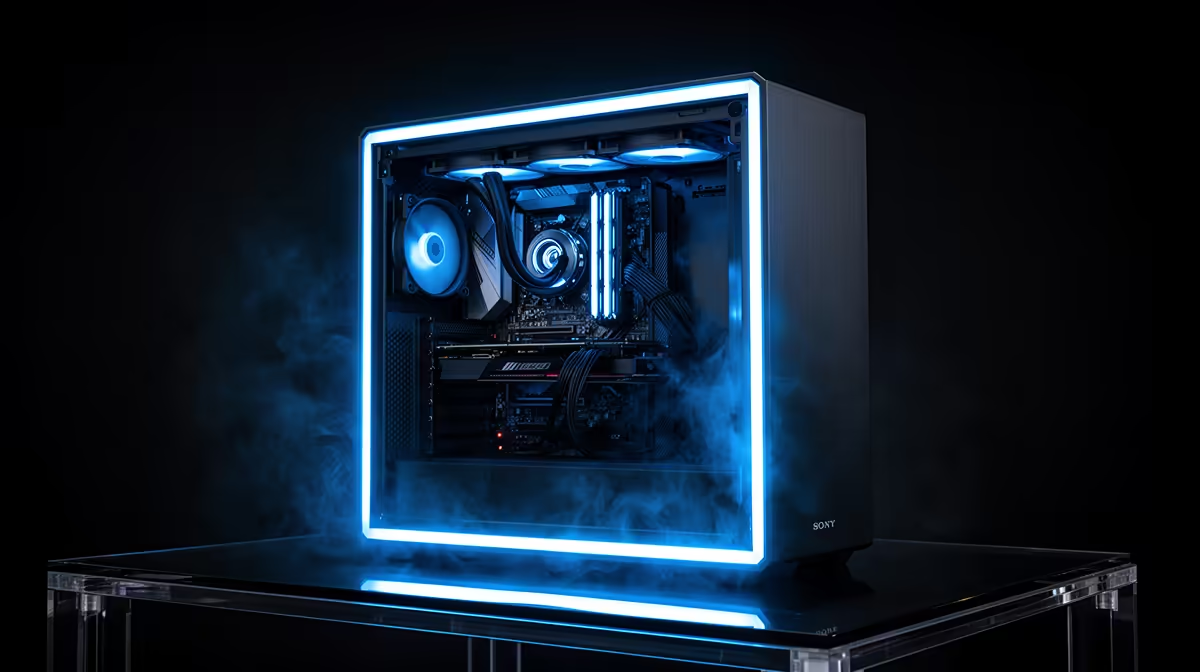
PC case clearance specs tell you exactly which components fit without physical interference. GPU length clearance, radiator support dimensions, CPU cooler height, and cable management depth are the four specs that determine build compatibility before you purchase. Ignoring any one of them risks a mismatch that forces a return or an awkward workaround after the build is already underway.
GPU Length Clearance 🖥️
GPU clearance is measured in millimetres from the PCIe slot to the front panel or front-mounted drive cage. A case rated for 380mm GPU clearance accommodates any card up to 380mm long. Current high-end cards like triple-fan RTX 5090 AIB models reach approximately 360mm to 375mm, making 380mm to 420mm clearance the safe target range. Cases with front-mounted 3.5-inch HDD cages may reduce effective GPU clearance by 20mm to 40mm compared to the advertised maximum. Always confirm whether the stated clearance is with or without the drive cage installed. PSU cable routing alongside the GPU end also consumes clearance, so a 12VHPWR right-angle connector is worth budgeting for builds using long cards in tighter cases.
Radiator Support Dimensions 🔧
Radiator support is listed by mounting position (front, top, rear) and by radiator width in millimetres: 120mm (single fan), 240mm (dual fan), 280mm (dual 140mm fan), or 360mm (triple 120mm fan). A case listing 360mm front and 240mm top can house a 360mm AIO in the front and a smaller radiator or additional fans on top simultaneously. Verify three sub-specs: first, the fan thickness supported (25mm standard, some cases block 30mm thick radiator fans), second, the clearance between the front radiator and the motherboard RAM slots (tight cases allow only 35mm of combined radiator and fan thickness before contacting high-profile RAM), and third, whether the radiator mounts before or after the motherboard is installed, which affects build order.
CPU Cooler Height and Cable Management Depth 💡
CPU cooler height clearance in a mid-tower typically falls between 155mm and 175mm. Premium tower air coolers like the Noctua NH-D15 G2 stand 168mm tall, fitting in cases rated 170mm or above. Check this specification if using air cooling rather than an AIO. Cable management zone depth, listed as the rear panel clearance, should be at least 20mm to accommodate modular PSU cables and SATA cable routing without forcing the side panel closed. Premium cases specify 25mm to 35mm for comfortable cable management, which is meaningfully easier to work with when adding an extra GPU power cable or swapping a drive.
Check Specs Against Your Parts List ⚡
Before ordering a case, write down your GPU length, CPU cooler height, radiator size, and PSU cable type (standard ATX or 12VHPWR). Cross-check each against the case spec sheet. This five-minute review prevents the most common compatibility mistakes SA builders make when ordering components across multiple suppliers.
FAQ
Does the radiator size affect CPU temperatures significantly?
Yes. A 240mm AIO versus a 360mm AIO on the same CPU under sustained all-core load shows a 5 to 12 degree Celsius difference. For CPUs like the Ryzen 9 9950X under rendering workloads, this is meaningful for sustained boost clock maintenance.
What does PSU clearance mean in a case spec sheet?
PSU clearance specifies the maximum PSU length the shroud can accommodate, typically 140mm to 220mm. Most ATX PSUs are 140mm to 180mm long. Longer PSUs in narrow-depth cases can conflict with front-mounted drives or cable routing behind the PSU shroud.
Is cable management depth different from GPU clearance?
Yes. Cable management depth refers to the space behind the motherboard tray, not the main chamber. GPU clearance is in the main chamber from the PCIe slot to the front panel. They are measured independently and affect different components.
Want to verify your components fit before buying a case? Browse Evetech's PC case range with full spec sheets for every model, available with local warranty and delivery across South Africa.