


Quick Answer
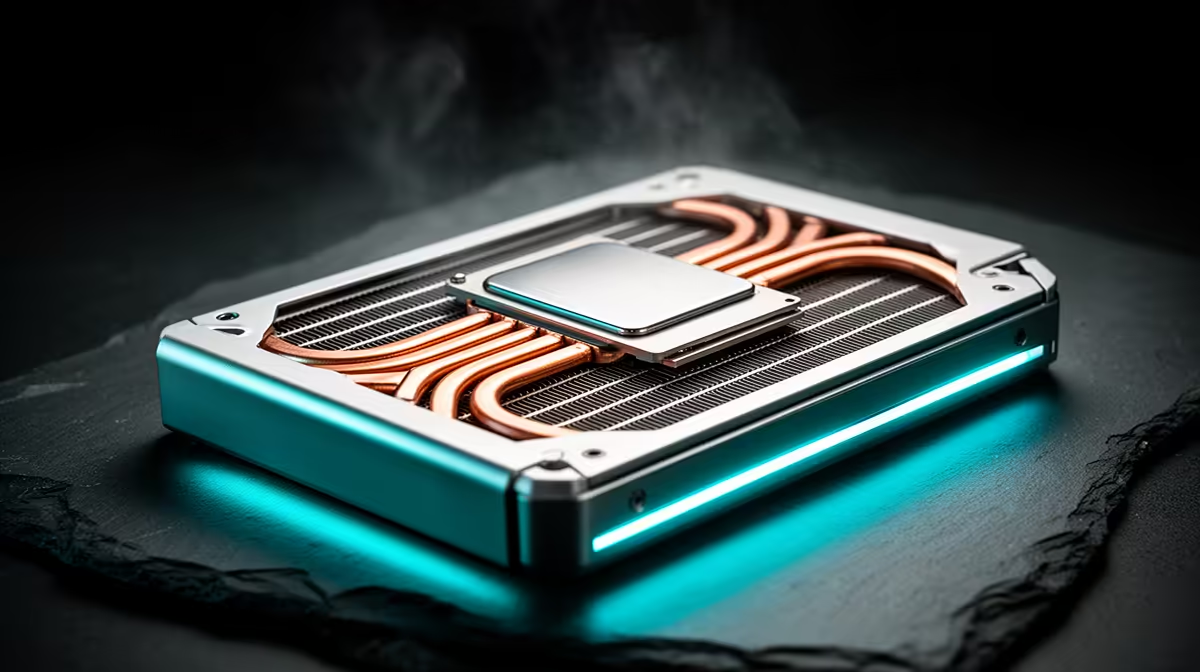
Finned microchannels in an AIO cold plate are dense copper fins that increase the surface area in contact with flowing coolant. More fin density means more heat transferred per unit of coolant flow. A dense microfin cold plate can lower CPU hot-spot temperatures by 5 to 12 degrees Celsius compared to a plain channel design under sustained all-core loads on chips like the Ryzen 9 9950X or Core i9-14900K.
How Cold Plate Fins Work 🔬
When coolant flows across the CPU contact area, it absorbs heat through convection. A flat surface is inefficient because only a thin layer of coolant touches the copper at any moment. Finned microchannels solve this by creating dozens to hundreds of narrow parallel passages bounded by thin copper fins, dramatically increasing the wetted surface area in contact with moving coolant without increasing the cold plate's footprint.
Asetek's Gen 7 platform uses jet impingement: coolant is forced directly at the cold plate surface before flowing outward through radial channels, combining high velocity and high surface area for efficient heat extraction. ASUS describes its enhanced cold plate geometry as a high-density copper microfin structure targeting Ryzen AM5 and Intel LGA 1851 die layouts.
CPU Contact Area Size and Die Coverage 🖥️
AMD Ryzen 9000-series chips on AM5 have a compact IHS measuring roughly 40mm by 40mm. Intel Core Ultra 200-series chips on LGA 1851 have a slightly larger and more elongated IHS footprint. A well-designed cold plate covers the full IHS with uniform pressure and contact, preventing hot spots at die edges.
AIOs for mainstream AM5 and LGA 1851 use standard 40mm by 40mm effective contact zones, which is sufficient if mounting hardware applies even pressure across the IHS without flex or tilt.
Why CPU Contact Pressure Matters ✨
Even the best microfin cold plate underperforms if improperly seated. Uneven mounting creates micro-gaps where air acts as insulation, raising effective thermal resistance significantly. Quality AIO mounting brackets use spring-loaded screws or torque-limited fasteners to apply the correct 40 to 60 Newton of contact force without flexing the motherboard PCB.
In South African summer conditions with ambient temps reaching 28 to 35 degrees Celsius, any contact inefficiency becomes visible as CPU temperatures creep toward the thermal throttle threshold at around 95 degrees Celsius on most Ryzen 9000-series chips.
Clean and Reapply Thermal Paste After Three Years ⚡
The pre-applied compound on most AIO cold plates performs well initially but degrades in conductivity after 30 to 36 months of heat cycling. Replacing it with fresh Thermal Grizzly Kryonaut or similar high-performance compound can recover 3 to 7 degrees Celsius on an older AIO installation.
FAQ
Does a copper cold plate perform better than aluminium?
Yes. Copper has roughly twice the thermal conductivity of aluminium at approximately 400 W/mK versus 205 W/mK. All quality AIO cold plates use copper for the base and fin structure, while aluminium suits the radiator where lower weight matters more.
How do I know if my cold plate is seated properly?
Run Cinebench R23 multi-core for 10 minutes. On a Ryzen 9 9950X with a quality 360mm AIO, temperatures above 90 degrees Celsius suggest poor contact, insufficient thermal paste coverage, or a non-spinning pump. Re-seating the cooler usually resolves it.
Can I lap or modify the cold plate on an AIO?
Physically possible but it voids virtually all consumer AIO warranties and risks damaging the sealed pump-cold plate assembly. Rather re-seat with quality thermal paste before considering any physical modification.
Interested in AIO coolers with advanced cold plate designs? Evetech stocks liquid coolers from brands known for high-density microfin cold plates suited to AMD AM5 and Intel LGA 1851 builds.











