Frame generation can make a camera pan look like 120fps while the mouse still feels anchored to a much lower rate. That is not imaginary. Frame generation input lag is the gap between smoother presentation and the slower chain of real game updates underneath it.
Quick Answer
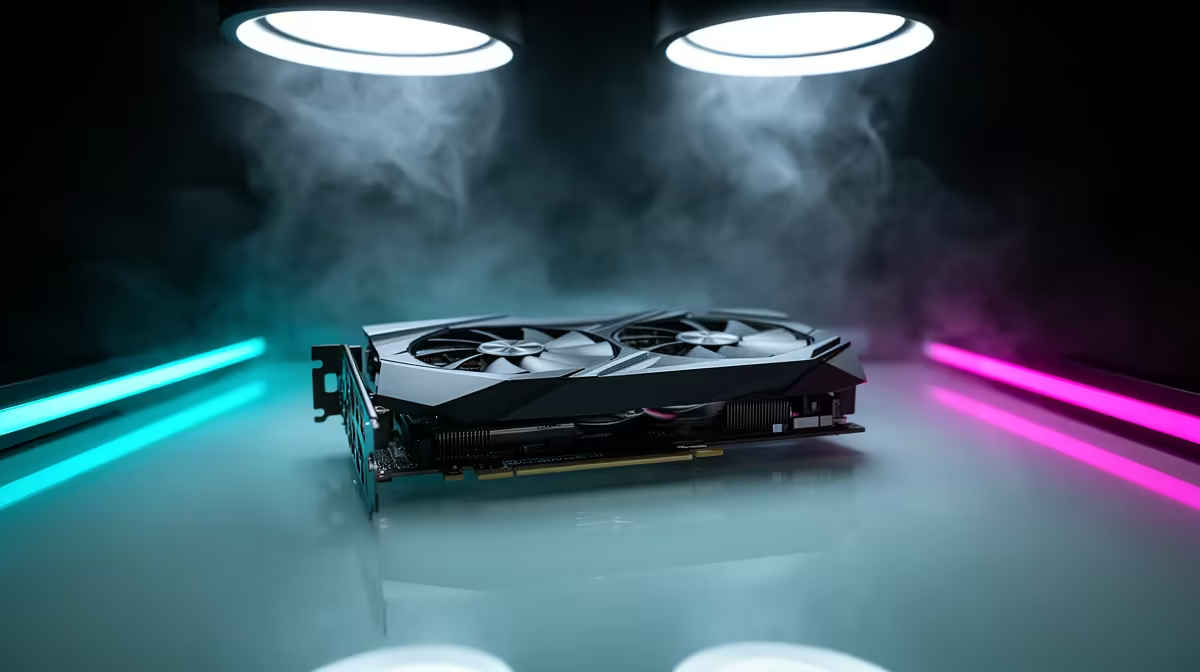
Frame generation does not lower input lag by itself. It inserts calculated frames between fully rendered ones, so displayed FPS rises without an equal increase in fresh input samples. Use it after native or upscaled performance is already stable, preferably around 60fps or better. Evetech's Palit RTX 5060 Infinity 2 OC 8GB was R6,999 as of July 2026; compatible hardware helps, but a higher generated-frame counter cannot rescue a poor base rate.
🖱️ What your hand actually feels
Mouse input affects a rendered frame after the game simulation, CPU and GPU have processed it. A generated frame is created from surrounding visual information; it does not rerun that entire chain with newer input.
At a 60fps base, each real frame begins roughly 16.7ms apart. Frame generation can fill the visual gaps, but control response remains much closer to that base than to native 120fps, where real frames begin about 8.3ms apart.
Latency tools such as NVIDIA Reflex or AMD Anti-Lag 2 can reduce waiting elsewhere in the pipeline. They improve the result but cannot make an interpolated frame newly simulated.
🎮 When the trade feels good
Slower single-player games, driving views and controller-based play often benefit most. Smooth motion can matter more than the last few milliseconds of response.
Fast competitive shooters expose the mismatch. If aim feels disconnected, disable Frame Generation and spend the performance budget on lower settings or upscaling instead.
Compare the present NVIDIA graphics-card range with GPU best-sellers, but judge the feature in the exact game and monitor setup.
Frequently Asked Questions
Does frame generation actually lower input lag?
No. It improves displayed smoothness. Latency reduction requires a higher real frame rate or a separate latency tool.
Why does 120fps with frame generation feel slower than native 120fps?
Native 120fps contains twice as many newly rendered game states as a 60fps base. Generated frames fill visual gaps without adding equivalent input updates.
Does Nvidia Reflex offset frame generation's added latency?
It can reduce system latency around the render queue, but it does not turn generated frames into native ones.
Is frame generation noticeable in slower-paced games?
Its smoothness benefit can be very noticeable, while the response trade is less important than in competitive play.
Can you feel the difference between DLSS and FSR frame generation latency?
Possibly, but base frame rate, game integration and latency settings matter more than the brand name alone.
What base frame rate makes frame generation latency unnoticeable?
There is no universal threshold. Around 60fps or higher is a sensible starting point; sensitive players may want more.
Should esports players disable frame generation entirely?
Usually when minimum latency is the priority. Test the game, but native rendered frames remain the clearer competitive target.
Choosing a GPU for smoother play?
Compare Evetech graphics cards by real performance first, then use Frame Generation as a presentation upgrade on a healthy base frame rate.