Quick Answer
GTA 6 lag caused by in-game settings is most often linked to resolution scale, shadow quality, and extended draw distance running beyond what your GPU and VRAM can handle. Dropping these three settings first almost always recovers significant frame rate. Thermal throttling from a hot CPU or GPU can compound the problem, especially in warmer SA climates.
The Settings Most Responsible for GTA 6 Lag
GTA 6 is a demanding title, and Rockstar's settings menu gives you many dials to turn. Not all of them cost equally. The settings that cause the most performance damage are resolution scale (anything above 100% is essentially supersampling), shadow quality and distance, extended draw distance in dense urban areas, and ambient occlusion quality.
Resolution scale above native is the single fastest way to tank your frame rate. If you have this set to 110% or higher, drop it to 100% first. The visual difference is subtle but the GPU savings are substantial. Shadow quality set to Ultra adds significant GPU load without major visual improvement at typical viewing distances. High or Medium shadow quality recovers 10-20% frame rate on mid-range cards with minimal visual sacrifice.
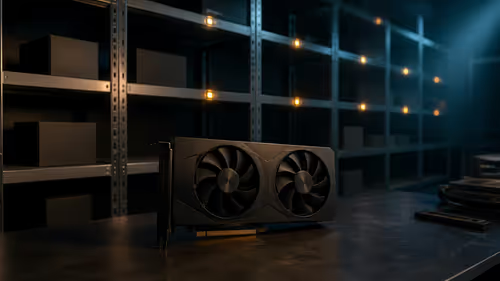
Draw distance in GTA 6's dense city environments is particularly expensive. The engine streams massive amounts of geometry and texture data. If your system has less than 12GB VRAM, dropping draw distance from Ultra to High prevents VRAM overflow that causes severe stuttering on top of base frame rate loss.
CPU, GPU, and Thermal Factors Behind GTA 6 Performance Issues
GTA 6 uses a wide CPU core count. Six cores is the practical minimum, and eight cores or more gives the game room to spread its simulation load across threads. If your CPU is running at sustained 95-100% usage during play, it is the bottleneck. Lowering GPU-side settings will not fix a CPU bottleneck. In this case, enabling the in-game CPU priority setting or closing background applications that compete for cores helps.
South African summers push ambient case temperatures higher, which affects sustained performance. A CPU throttling from 5.0GHz down to 3.5GHz due to thermal limits can cause microstutter that looks identical to a settings problem. Check your CPU and GPU temperatures with monitoring software. If your CPU exceeds 90 degrees Celsius under sustained load, reapplying thermal paste or improving case airflow is a hardware fix that no graphics setting change can replicate.
VRAM overflow manifests as severe hitching every few seconds rather than uniformly low frame rates. If you see sudden 1-second freezes in traffic-heavy areas, your GPU is swapping textures to system RAM, which is dramatically slower. Reducing texture quality one step cures this completely.
Frequently Asked Questions
What are the best GTA 6 settings for a mid-range PC in South Africa?
For a mid-range PC with an RTX 4060 or similar, target 1080p with resolution scale at 100%, shadow quality at High, draw distance at High, and textures at High. This delivers smooth 60fps gameplay without VRAM overflow. Ambient occlusion at Medium or Off recovers additional frame headroom.
Why does GTA 6 stutter even with good average FPS?
Stuttering with good average FPS usually points to VRAM overflow, shader compilation hitches on first load, or a CPU bottleneck in dense simulation zones. Enabling DirectStorage if your drive supports it reduces streaming stutter. Keeping GTA 6 on an NVMe SSD rather than a spinning HDD eliminates a common stutter source.
Can a loadshedding power cut damage my PC running GTA 6?
A sudden power loss during a gaming session can corrupt save files and in rare cases cause issues with open game data. A UPS keeps your PC running through short loadshedding cycles, giving you time to save and shut down cleanly.