Quick Answer
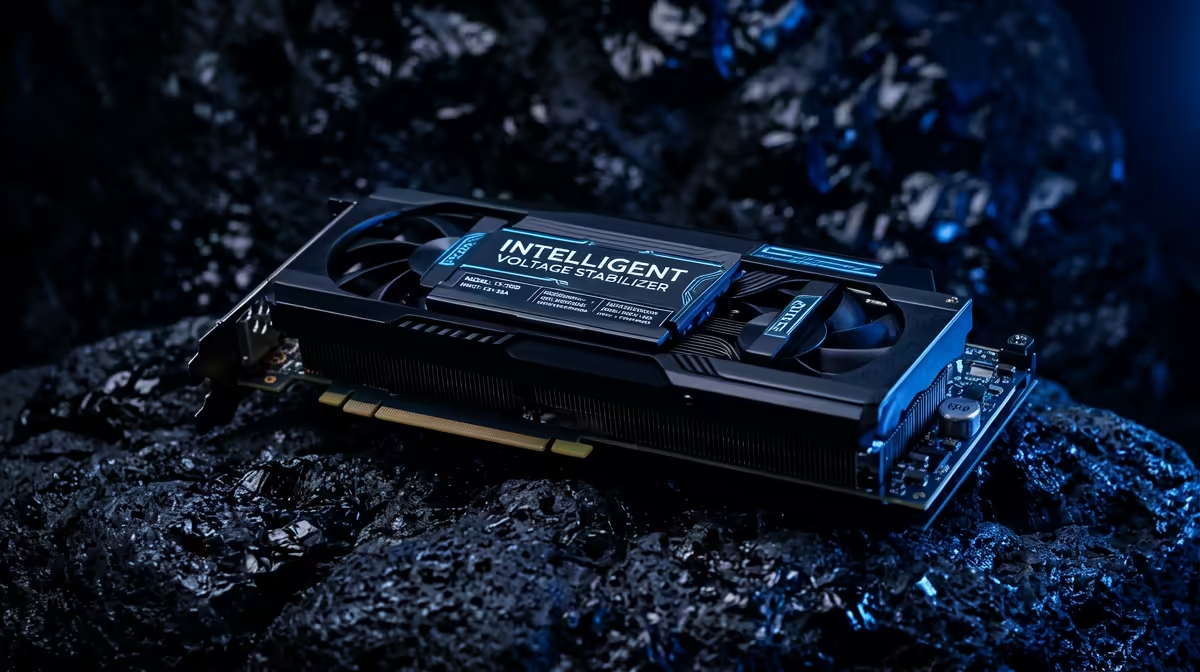
GPU-First Intelligent Voltage Stabilizer is a circuit design used in certain high-end PSUs, notably ASUS ROG Thor units, that prioritises voltage regulation on the PCIe power rails during peak GPU transient load events. It reduces the voltage droop on the 12V rail during the brief but intense current spikes generated by modern GPUs like the RTX 5090, which prevents nuisance shutdowns and improves overclocking stability.
The Problem: GPU Transient Spikes and Voltage Droop ⚡
Modern high-end GPUs do not draw power in a steady, predictable stream. They spike heavily during complex shader calculations and then drop back to idle-level draw within microseconds. An RTX 5090 with a 575W TBP can briefly demand current equivalent to 700W or more during these spikes. When that spike hits, a PSU's 12V rail must supply the extra current instantly or the output voltage drops momentarily, a phenomenon called voltage droop. Severe droop causes GPU driver crashes, system restarts or, in the worst case, corruption of data being processed by the GPU. Standard PSU designs manage this with bulk capacitance and fast-responding control loops, but GPU-First Intelligent Voltage Stabilizer adds a dedicated regulation circuit on the PCIe output stage that responds faster and with greater precision specifically on the GPU power path.
How the Circuit Works in Practice 🔧
The GPU-First topology works by giving the GPU's PCIe power rail priority access to the PSU's regulation headroom. When the GPU draws a spike, the stabiliser circuit identifies the transient within nanoseconds and pre-emptively increases drive current to the rail before the voltage has time to sag below acceptable thresholds. This is different from simply having a larger bulk capacitor bank: it is an active feedback loop tuned to the transient signature of modern PCIe 5.1 GPUs. The result is that the 12V rail stays within plus or minus 1% of nominal voltage even during 200% rated-load spikes, which the ATX 3.1 standard mandates. ASUS implements this in the ROG Thor 1200W Platinum III and select other units, where it is backed by a 10-year local warranty path in South Africa.
Who Benefits Most from This Technology 🖥️
The practical benefit is most noticeable in two scenarios. First, enthusiast gamers who push their RTX 5090 or RTX 5080 beyond factory power limits through GPU overclocking: a standard PSU may trigger overcurrent protection during those spikes, but a GPU-First stabilised unit absorbs them cleanly. Second, creators who use their GPU for CUDA-accelerated rendering in DaVinci Resolve or Blender, where sustained 100% GPU load is followed by brief idle periods and then another full-power spike as the next frame is processed. In South Africa, the ROG Thor 1200W Platinum III retails in the R7,500 to R9,000 range at Evetech, making it a premium purchase justified by the most demanding RTX 5090 and multi-GPU compute builds.
Pair GPU-First PSUs with a Quality UPS ⚡
South Africa's grid, even without rolling blackouts, experiences occasional voltage brownouts and brief outages, particularly during summer thunderstorm season in Gauteng. A GPU-First stabilised PSU protects your GPU from internal rail droop, but it cannot protect against incoming mains voltage problems. Pairing a premium PSU with a line-interactive UPS rated at 1,500VA to 2,000VA protects your entire build from grid-side events.
FAQ
Does every PSU need GPU-First voltage stabilisation for an RTX 5090?
No.
Is GPU-First technology exclusive to ASUS ROG PSUs?
The specific GPU-First Intelligent Voltage Stabilizer branding is ASUS ROG's.
How can I tell if a PSU has adequate transient response without GPU-First branding?
Look for ATX 3.1 certification and a manufacturer specification stating the PSU meets 200% hold-up on PCIe rails.
Building an RTX 5090 system that demands flawless power delivery? Evetech stocks the ASUS ROG Thor range and other premium ATX 3.1 PSUs with GPU-first rail design, backed by local warranty support for South African builders.