Quick Answer
Gaming hardware in SA often loses about 20-35% of value in the first year, then depreciation slows if the parts remain desirable. On a R20,000 budget, protect resale value by putting money into a sensible GPU, known CPU platform and standard parts rather than niche extras.
Depreciation By Component
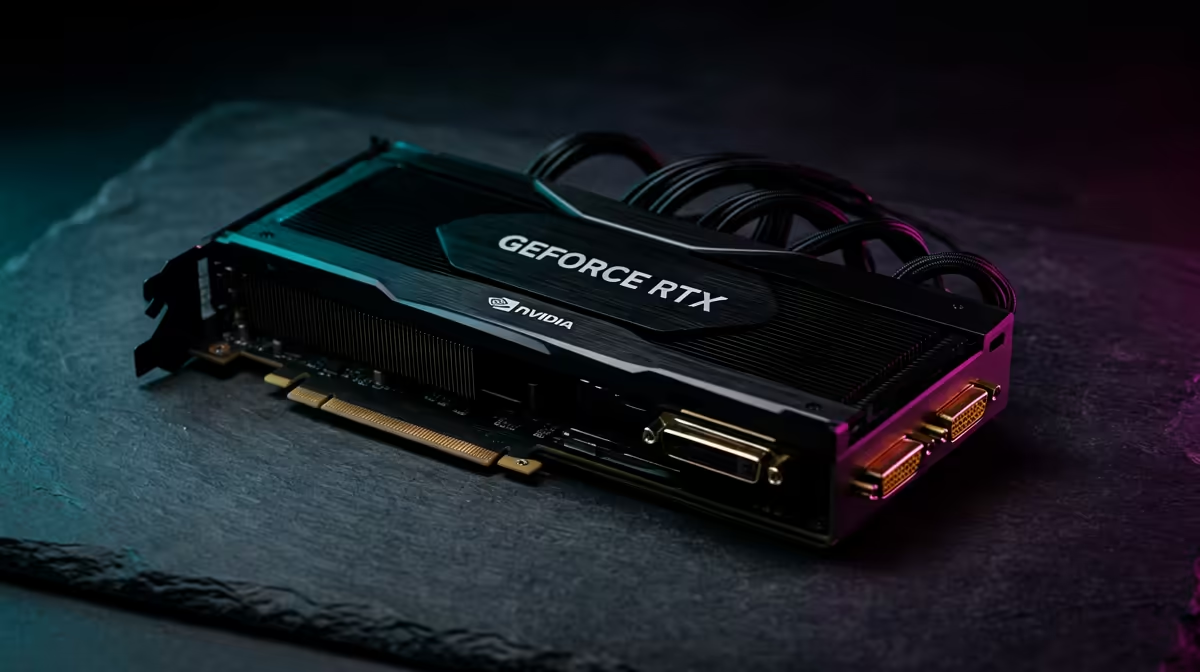
GPUs usually move the most because new generations change performance-per-rand quickly. CPUs and motherboards hold value better when the platform still has upgrade demand, while cases and power supplies depreciate more slowly if they are clean and standard. RGB-heavy extras rarely recover their full cost on resale.
R20,000 Example
On a R20,000 gaming budget, a practical GPU allocation might be around R8,000, with the rest split across CPU, board, RAM, SSD, PSU and case. If the build uses a common Ryzen 5 or Core i5 class CPU, 16GB-32GB RAM and a current 1080p or 1440p GPU, it is easier for a future buyer to understand the value.
How To Reduce Loss
Keep boxes, invoices, spare cables and the original cooler brackets. Avoid custom changes that make the PC harder to inspect. A clean, stable PC with clear specs and benchmark screenshots will usually sell better than a messy build with vague part names.
FAQ
How much value does a gaming PC lose after one year?
A common range is about 20-35%, depending on the GPU, condition and how quickly new hardware arrives. Premium parts can drop faster if a new generation offers better value.
Which parts hold value best?
Quality CPUs, motherboards, cases and power supplies can hold value better than older GPUs. Standard, well-known parts are easier to resell than obscure models.
Should I buy cheaper parts to reduce depreciation?
Not always. Buy balanced parts that fit the budget, because underpowered hardware can become hard to sell even if the original spend was low.
Buyer tip
Record the exact CPU, GPU, RAM and SSD model names on day one; clear specs protect resale value better than vague descriptions.