Quick Answer
For streaming in South Africa, 25Mbps for one 1080p stream, 50Mbps for 4K streaming, and 100Mbps when several people share the line. The R50,000 hardware budget does not require a matching expensive fibre package; latency, router quality and household sharing matter more than raw Mbps. A sensible fibre-and-router plan is usually cheaper than overspending on speed you cannot use.
Recommended Speed Tiers
25Mbps works for one user doing streaming with light background traffic. 50Mbps is the better family baseline because it handles updates, calls and another stream without immediate congestion. 100Mbps is the practical sweet spot for shared homes, 4K streaming, frequent game downloads and cloud backups. Above 200Mbps is a convenience tier for large downloads, not a requirement for gameplay.
Ping, Wi-Fi And Router Fit
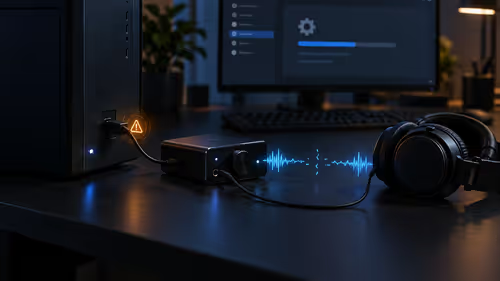
For gaming, acceptable ping to local servers is usually below 40ms, while 40-80ms is playable and above 100ms starts to feel rough in esports. Ethernet is still the cleanest connection. If Wi-Fi is unavoidable, use a Wi-Fi 6 router such as TP-Link Archer or ASUS RT class hardware, keep the PC near the router, and avoid crowded 2.4GHz channels.
SA Buying Notes
Do not spend PC money on a fibre tier that only improves downloads. A R50,000 gaming setup may include an RTX 4060, RTX 4070 Super or 144Hz monitor, but those parts do not need 500Mbps to play online. Rather keep R1,200-R3,500 for a reliable router if the provider unit is weak.
FAQ
What Mbps is enough for streaming?
25Mbps is enough for one light user, 50Mbps is the safer minimum, and 100Mbps is the practical shared-home target. Faster lines mostly reduce download waiting time.
Is ping more important than speed?
Yes for gaming. Low, stable latency matters more than a huge speed number once the line has enough Mbps.
Should I use Wi-Fi or Ethernet?
Use Ethernet for a desktop PC or console where possible. Wi-Fi 6 is acceptable when cabling is not practical, but distance and walls can raise latency.
Buyer Check
Test ping, packet loss and Wi-Fi signal at the desk before upgrading the fibre tier; the local network is often the real problem.