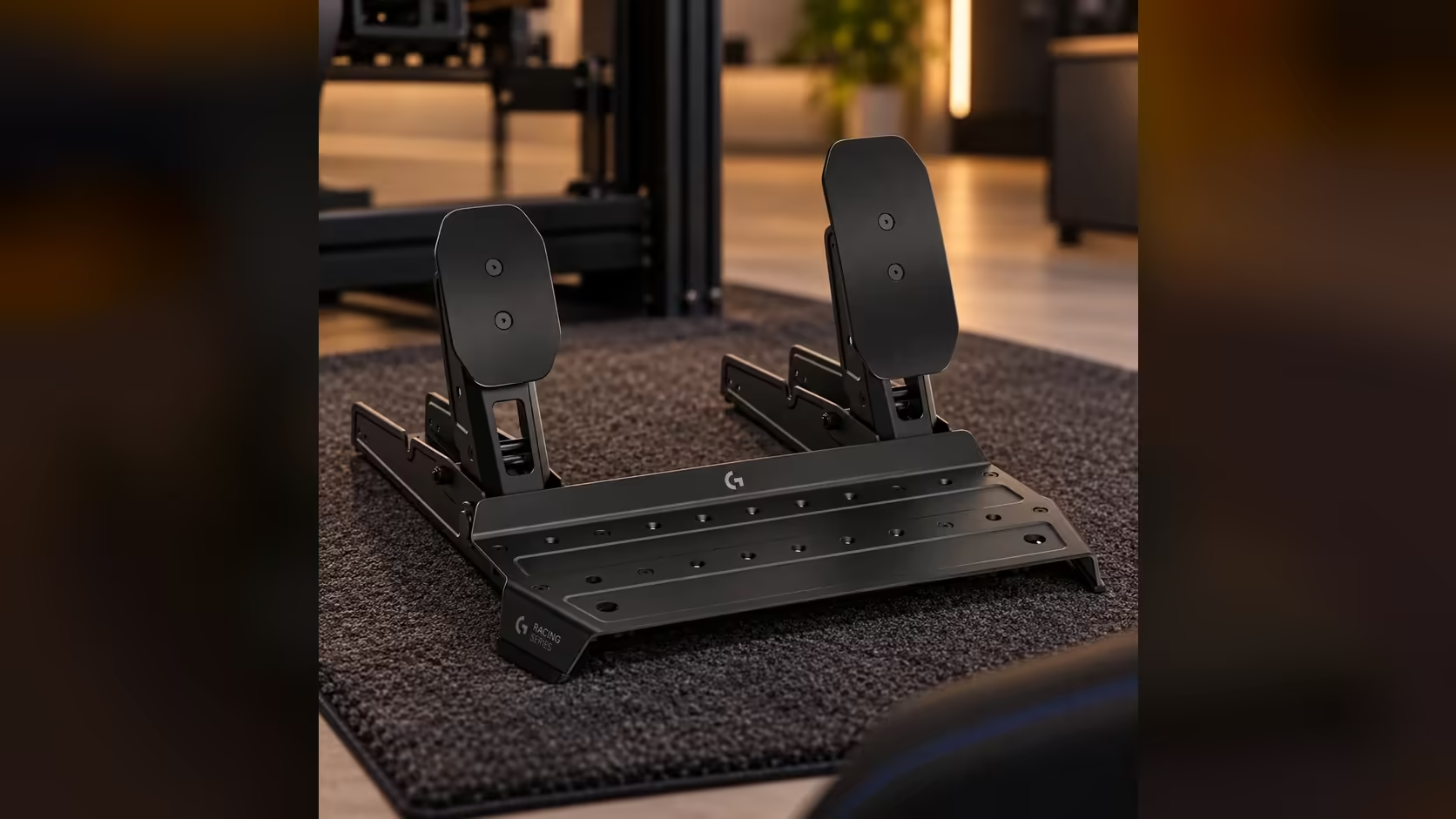
A set of sim racing pedals that slides across the floor during a hard stop is a set that costs you laps. The Logitech G RS Pedals SE was built to resist that movement with rubber feet and carpet grips, but how well those parts bite depends on what is underneath them. Carpet and tile behave very differently, and most of the slipping people report comes from choosing the wrong spot rather than from the pedals themselves.
Quick Answer
The rubber feet and carpet grips built into the Logitech G RS Pedals SE hold the set in place on pile, so start there. Add a rubber-backed mat only if a firm sideways push still moves the frame. The set sells for R2,799 including VAT through Evetech, so a mat is a small extra next to the pedals themselves.
🧱 Why a hard stop pushes pedals sideways
Braking pushes your foot forward and down, but the pedal face also resists your heel, and that reaction shoves the frame across the floor. The harder the stop, the bigger the shove. A brake from 100 km/h to a standstill in a sim is short but intense, and it happens dozens of times in an hour of racing.
Carpet pile gives the grips something to catch on. The fibres push back against the feet and hold the frame, which is why the same pedal set often stays put in a lounge and creeps on a bare floor. Tile gives almost nothing to grip. The rubber feet do the work there, and a smooth tile floor can still let the set walk if the frame sits on a thin rug.
🏠 Test the spot before the rig goes down
In a Johannesburg flat the lounge carpet and the kitchen tile are often a few steps apart, so test both before you decide where the rig lives. Put the pedals on the carpet first, sit in your usual position, and brake hard from a 100 km/h run in your racing game three times. Then move the set to the tiles and repeat the test.
Give each spot a 30-minute session rather than a single stop, because the frame often holds for the first few brakes and starts to walk only after the rhythm of a race sets in. Watch the frame, not the pedal face. If the frame slides more than the width of your palm during the three stops, the spot is a poor one. If it holds still, the carpet grips are doing their job and you can leave the set there.
🧽 Add a mat only if the frame still moves
If the frame creeps on a spot you cannot move, a rubber-backed mat under the whole footprint is the simplest fix. Choose a mat that is at least 5 cm bigger than the frame all round, so the feet never sit on the edge of the rubber, where they can roll off. Lay it down, sit the set on it, and run the three-stop test again before you call the spot finished.
Keep the mat flat. A mat that curls at one corner lets that corner lift under load, and the frame then rocks instead of holding. Clean the underside of the mat now and then, because grit trapped under it reduces the grip faster than anything else.
Do not stack a thick mat under a pedal set on a rug. The extra height changes the angle of your heel and can make the first part of braking feel different from the way you calibrated it.
If you are still choosing a home for the rig, our gaming desk range has stable surfaces to compare. For the pedals and related accessories, see our simulation accessories and the racing simulation category.
Frequently Asked Questions
Will a rug keep the pedals still?
A rug helps if it is firm and has some pile to grip. A thin, loose rug can let the whole frame move on a hard stop.
Can I use the pedals on tiles?
Yes, but test them first. The rubber feet do most of the work on tile, so check that the frame does not walk during a few hard stops.
Do the carpet grips need a mat underneath?
Usually not on carpet. Add a mat only when a firm sideways push still moves the frame.
Want a steadier rig?
Explore Evetech's gaming desks and sim racing accessories to find a base that keeps your pedals planted.