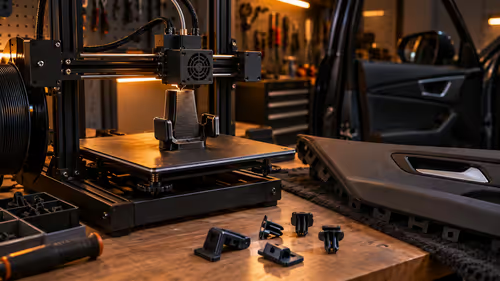
A PLA print left on the dashboard of a car parked in Pretoria in January can start to bend. PLA begins to soften at roughly 60 degrees C, and a dark dashboard in full Highveld sun can climb past that. PETG holds its shape to a much higher temperature, so it is the safer choice for anything that will live in a car, on a window ledge or in a hot bakkie cab.
Quick Answer
PETG survives a hot South African car far better than PLA, which starts to soften near 60 degrees C. Print any part that will sit in a parked car or a sunny window in PETG. The ELEGOO Rapid PETG 1 kg spool is R299 in red, R329 in white and R399 in black, while the Soleyin Ultra PLA 1 kg spool is R249.
🌞 Where PLA gives way in a parked car
PLA is easy to print, which is why it is the default for most hobby printers. Its weakness is heat. Once the surface passes roughly 60 degrees C the part starts to relax, and the stresses frozen into the print let it bend. A dark dashboard, a rear shelf or a sill that takes full afternoon sun can get there on a summer day, so a PLA clip left on the dash can end up out of shape.
Thin walls and tall, slender parts show the damage first, because they have the least material to hold their shape. A bracket that looks fine on the bench can sag once it sits in a Highveld car park for an afternoon.
🔥 Why PETG holds its shape longer
PETG usually holds its shape to around 70 to 80 degrees C, which leaves a clear margin above the point where PLA gives way. That margin matters in a Durban or Cape Town summer, when the inside of a parked car runs hotter than the air outside. Clips, brackets, phone holders and cable guides suit PETG well. Browse the 3D printing filament range to compare the PETG spools against the PLA ones. Check the maker's technical data sheet for the exact figure on your spool, because blends differ.
🌡 When to step up to ASA
ASA tolerates roughly 100 degrees C and resists UV better than PETG, so it is the material to reach for when a part must survive a car roof or long summer sun outdoors. It is less forgiving at the printer. ASA usually needs a hotter nozzle than PETG, so check your printer's maximum nozzle temperature before you buy the spool. If your machine cannot reach the temperature ASA needs, stay with PETG, which is fine for most indoor parts and some outdoor ones, rather than forcing ASA through it. Compare the 3D printers range if you are still choosing a machine.
🧪 A R249 heat test you can run this week
Heat claims are easy to make and hard to check, so run your own test. A Soleyin Ultra PLA 1 kg spool at R249 gives enough filament for several test blocks. Print a 20 mm cube in PLA and another in PETG, park both on a sunny windowsill for a week, then compare them side by side. Any sag, twist or rounded edge on the PLA cube answers the question for your climate.
Keep spools sealed with silica gel between sessions. Humid coastal air in Durban can add moisture to both materials, and damp filament prints rough.
Frequently Asked Questions
At what temperature does PLA start to soften?
PLA starts to soften at roughly 60 degrees C, so a dark dashboard in full sun can reach that. Keep PLA prints out of closed cars and off sunny window ledges.
Does PETG handle heat better than PLA for printed parts?
Yes. PETG usually holds its shape to around 70 to 80 degrees C, well above standard PLA. Pick it for clips, brackets and phone holders that sit in a sunny spot.
When should I step up from PETG to ASA in a South African summer?
Step up to ASA for parts that face the car roof or long summer sun, since it tolerates roughly 100 degrees C. Confirm that your printer can reach the nozzle temperature it needs before you buy.
Why do PLA parts bend in a parked car?
Once the surface passes its softening point, the stresses locked into the print begin to relax and the part bends. Thin walls and tall, slender shapes show it first because they have the least material to resist.
Does a black PETG print warm up faster than a white one?
Yes. Dark surfaces absorb more sunlight, so a black print warms faster than a white one of the same shape. The ELEGOO Rapid PETG Black is R399 at Evetech, against R329 for the white.
Can I keep filament spools in a hot car?
No. Heat and moisture both spoil print quality, so store spools indoors in a sealed bag with silica gel, away from direct sun.
Printing parts that have to survive the sun?
Browse Evetech's 3D printing filament range and choose PETG for car-side parts, or PLA for indoor prints.