A cooler that ramps its fans the moment you open a browser tab gets annoying fast, which is exactly the problem fixed-speed fans create. Every 240mm liquid cooler worth buying now ships with PWM control instead, letting the fans idle down when the CPU is barely working and only climb when a game or render actually demands it. The MasterLiquid 240 Atmos leans on this difference for most of its everyday quietness.
Quick Answer
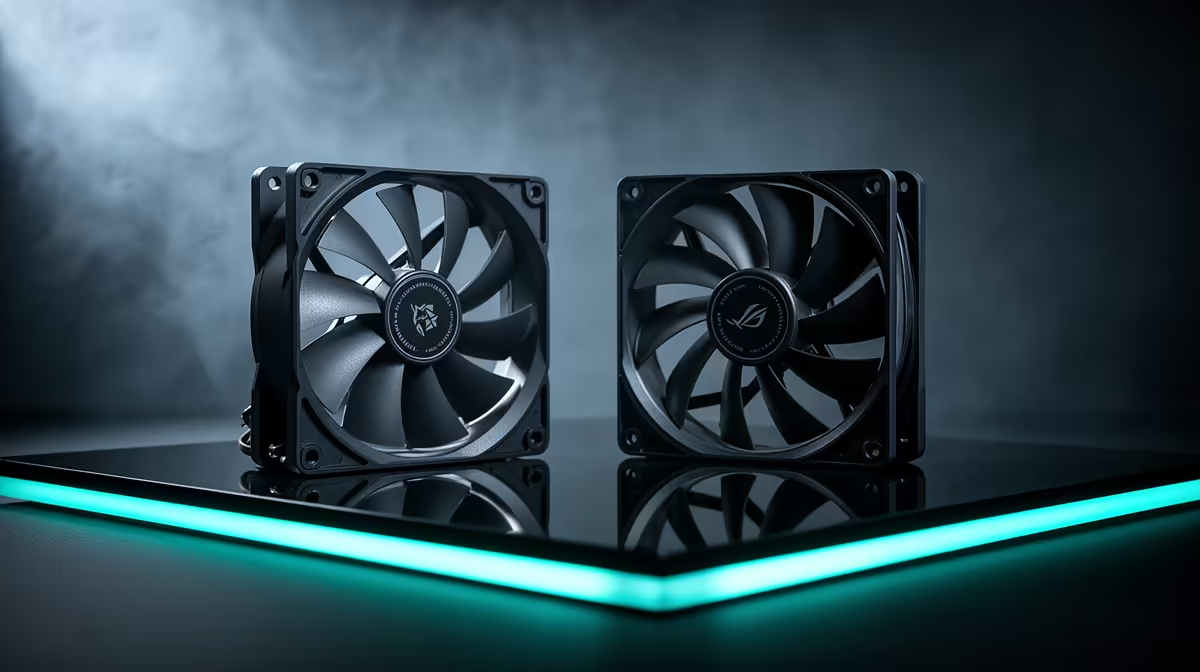
PWM fans adjust their speed continuously based on CPU load, while fixed-speed fans run at one constant RPM regardless of what the processor is doing. The two SickleFlow Edge PWM fans on the MasterLiquid 240 Atmos, priced at R1,399, stay near-silent during browsing or office work and only spin up under sustained gaming load.
Why Constant-Speed Fans Feel Louder
Fixed-speed fans have no way to read CPU temperature, so they run at whatever RPM the manufacturer picked as a safe average. That means idle noise during light desktop use is identical to noise during a demanding game, since the fan cannot slow itself down when the load drops. Over a full day of mixed use, that constant hum becomes the more noticeable annoyance rather than the occasional spike under load.
How PWM Fans Track Temperature
PWM fans receive a variable signal from the motherboard header, adjusting blade speed dozens of times a second as CPU temperature shifts. At idle or light load, the SickleFlow Edge fans included here spin low enough to disappear into ambient room noise. Once a game or export pushes the chip past a set threshold, RPM climbs quickly to move enough air through the 240mm radiator before temperatures spike.
Setting Fan Curves for Your Case
Most motherboards let you tune the PWM curve in BIOS or through vendor software, choosing how aggressively fans ramp for a given temperature. A gentler curve trades a few degrees of headroom for quieter running, while a steeper curve prioritises lower temperatures over noise. For anyone unsure which setting suits their case, Evetech's liquid cooler stock page has other 240mm and 360mm options if noise tuning alone is not resolving things.
When Fixed-Speed Still Makes Sense
Fixed-speed fans occasionally show up on budget air coolers where a controller adds unnecessary cost, and some silent-focused builds intentionally cap fans at a single low RPM instead of letting them scale. Outside those narrow cases, PWM control is the better default for anyone running a liquid-cooled build day to day. You can compare the full CPU cooler line-up to see how many current options include PWM as standard.
Frequently Asked Questions
Do PWM fans wear out faster than fixed-speed fans?
No, PWM fans use the same bearing types as fixed-speed models; the variable speed control does not shorten lifespan.
Can I force PWM fans to run at a constant speed?
Yes, most BIOS menus allow a fixed duty cycle override if you prefer constant RPM over automatic scaling.
Does the MasterLiquid 240 Atmos support fan speed customisation?
Yes, both SickleFlow Edge PWM fans respond to standard 4-pin PWM headers and BIOS fan curves.
Why do my PWM fans still sound loud at idle?
Check the BIOS fan curve; an aggressive default profile can keep fans spinning higher than necessary at low temperatures.
Is a 3-pin fixed-speed fan compatible with a PWM header?
It will run, but only at whatever speed the header's voltage supplies, ignoring any PWM signal entirely.
Ready to cut fan noise with proper PWM control?
Rely on the Cooler Master MasterLiquid 240 Atmos at R1,399 on Evetech, which runs PWM radiator fans that scale down when the CPU is idle.