Quick Answer
For 360mm radiators, static pressure fans outperform high airflow fans. Radiator fin stacks create resistance that high-airflow fans cannot overcome efficiently; static pressure fans push through that resistance and move more air through the radiator at equivalent noise levels.
Why Radiators Demand Static Pressure 🌀
A 360mm radiator fin stack is a dense matrix of thin aluminium fins spaced 1 mm to 2 mm apart. Moving air through this structure requires force, measured as static pressure in mm H2O. A high-airflow fan optimised for open case ventilation (like a Lian Li Uni Fan or standard mesh-face fan) achieves high CFM in open air but its pressure drops sharply when meeting resistance. A static pressure fan with sealed blade geometry and higher blade pitch maintains pressure through the radiator, delivering more actual airflow to the fin surface. Noctua's NF-F12 iPPC and Arctic P12 are classic examples with static pressure ratings above 2.5 mm H2O that suit 360mm radiators well.
Performance Comparison in Numbers 💡
At 1,500 RPM, a high-airflow fan like the Noctua NF-A12x25 (a hybrid design) delivers 60.1 CFM and 2.34 mm H2O. A dedicated static pressure fan at the same RPM might deliver 52 CFM but 3.1 mm H2O, pushing measurably more air through a radiator under load. Real-world cooling differences on a 360mm radiator with a Ryzen 9 9900X under all-core Cinebench R23: static pressure fans drop CPU temperatures 3 C to 7 C lower than equivalent high-airflow fans at matched noise levels. For South African builds where summer ambient temperatures in Gauteng or the Western Cape can hit 30 C, that margin keeps the CPU further from thermal limits.
When to Use Each Fan Type in a Build 🔧
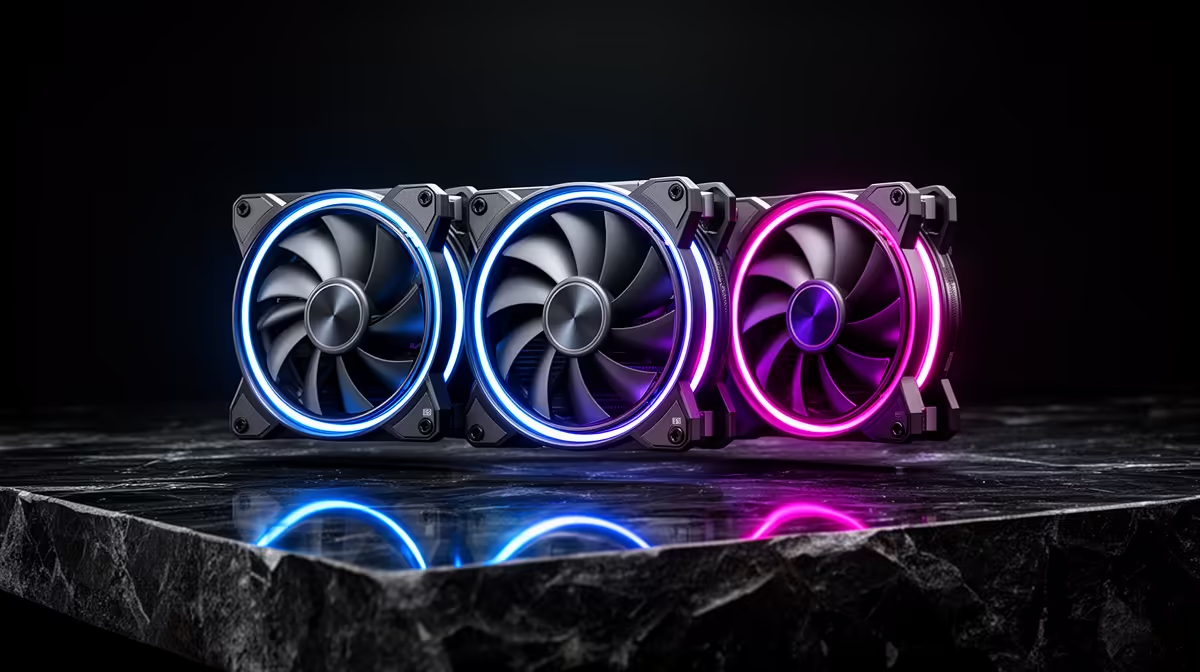
Static pressure fans belong on radiators and restricted-airflow heatsinks. High-airflow fans belong on case intake and exhaust positions where air moves through open space. A common approach for 360mm AIO builds: use three static pressure fans on the radiator and standard airflow fans for the remaining case positions. Many premium AIOs include purpose-built static pressure fans in the box; if you plan to replace them, match or exceed the bundled fan's static pressure rating to avoid a thermal regression. In South Africa, dedicated static pressure fans like the Arctic P12 PWM PST are available at Evetech at around R120 to R200 each.
Match Fan Type to Mounting Position ⚡
simple rule for any build: static pressure fans wherever air must pass through fins or mesh (radiators, dense front mesh panels), airflow fans everywhere else (rear exhaust, open top exhaust). Mixing them correctly costs nothing extra if you already plan to choose fans individually and delivers measurably better thermal results than using one type throughout.
FAQ
Can I use the fans bundled with my AIO on a 360mm radiator?
Yes, most premium AIO bundles include purpose-built static pressure fans. Budget AIO bundles sometimes include standard airflow fans; replacing those with dedicated static pressure fans is a worthwhile upgrade.
Does fan RPM matter more than fan type for radiator performance?
Both matter. A high-airflow fan at 2,000 RPM may push similar air through a radiator as a static pressure fan at 1,500 RPM, but the high-airflow fan will be significantly louder. Static pressure fans deliver better performance per dBA on radiators.
What static pressure rating should I look for on 120mm radiator fans?
Aim for at least 2.0 mm H2O at your target RPM. Above 2.5 mm H2O is excellent. Ratings below 1.5 mm H2O indicate a primarily airflow-optimised blade design that is not ideal for radiator duty.
Upgrading your AIO fans for better thermal performance? Browse static pressure and high-performance case fans at Evetech to find the right match for your 360mm radiator.