Quick Answer
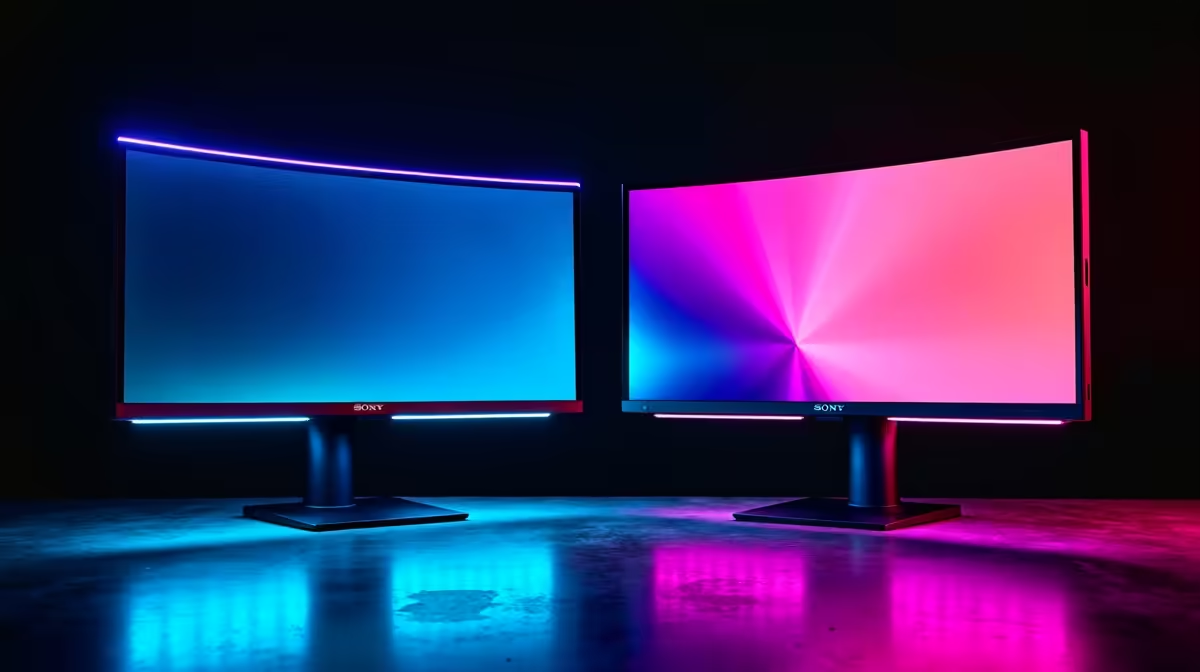
Mirror mode sends an identical copy of the primary display signal to a second screen, both showing the same content at the same resolution. Extended desktop mode treats each monitor as an independent section of one large virtual desktop, allowing different content on each screen simultaneously.
How the GPU Generates Each Mode 🖥️
In mirror mode, the GPU renders a single framebuffer and duplicates the output signal to both display outputs. If the monitors have different native resolutions, the OS scales the lower-resolution monitor up or downsizes the output to the lowest common denominator, which means a 4K primary paired with a 1080p secondary in mirror mode will often output 1080p to both unless the OS scales intelligently. In extended desktop mode, the GPU maintains two independent framebuffers and renders content separately for each monitor at its native resolution and refresh rate. An RTX 50-series GPU or an RX 9000-series card handles this with negligible performance overhead for desktop use, though gaming across two monitors in extended mode requires specific software to span the game window.
Refresh Rate and Resolution Behaviour in Each Mode 📡
Mirror mode synchronises refresh rates to the lower of the two monitors, so pairing a 240Hz gaming panel with a 60Hz secondary monitor results in both running at 60Hz during mirroring. This is a critical consideration for SA streamers or tournament players who want to show a referee or audience monitor while playing: if your second display drops your primary to 60Hz, competitive advantage is lost. Extended desktop avoids this entirely, each display runs at its own native refresh rate. For dual-monitor productivity setups at SA universities or home offices, extended desktop is the standard because it allows a working document on one screen and reference material or a Teams call on the other.
When to Choose Each Mode 💰
Mirror mode is appropriate for presentations, where you need your laptop screen content duplicated on a projector or large conference display, and for retail demo kiosks where a customer-facing screen mirrors the operator interface. Extended desktop is the correct choice for virtually every other use case: productivity, content creation, trading terminals, and gaming with a secondary utility screen. Most SA buyers running dual-monitor setups via DisplayPort cables will want extended desktop as their default. Switching between modes in Windows is as simple as pressing Windows key plus P, which brings up the projection menu with options for mirroring or extending without needing display settings.
Set Each Monitor to Its Native Resolution ⚡
In extended desktop mode, right-click the desktop, open Display Settings, and confirm that each monitor is set to its recommended (native) resolution independently. Letting Windows default to a shared resolution frequently results in one monitor appearing blurry, particularly if the two displays have different pixel densities.
FAQ
Does mirror mode affect gaming frame rates?
Only if the mirrored display forces a lower refresh rate on the primary output. If both monitors run at the same refresh rate in mirror mode, gaming performance is unaffected. Extended desktop avoids this concern entirely.
Can I run different wallpapers in mirror mode?
No. Mirror mode shows identical content on both screens by definition. Different wallpapers and application windows on separate displays require extended desktop mode.
Does my GPU need to support a specific DisplayPort version for extended desktop?
Any GPU with two or more display outputs supports extended desktop at the resolutions and refresh rates those outputs support. DisplayPort version matters for maximum resolution and refresh rate per output, not for extended desktop capability itself.
Ready to upgrade to a proper dual-monitor setup? Evetech stocks gaming monitors and cables to build a clean extended desktop configuration, visit the Evetech website to compare screen sizes and specs.