DLSS Quality can look soft on a 1080p monitor because it has fewer source pixels to work with. At that output resolution, Quality mode starts from about 720p, so small text, grass, distant wires and texture detail give the reconstruction a tougher job than they would at 1440p or 4K.
Quick Answer
Try native 1080p with DLAA if the game offers it and your GPU has enough performance. If you need the speed from DLSS, keep Quality mode and adjust the game's sharpening control in small steps. Compare movement as well as screenshots, since excess sharpening can create shimmer and bright outlines.
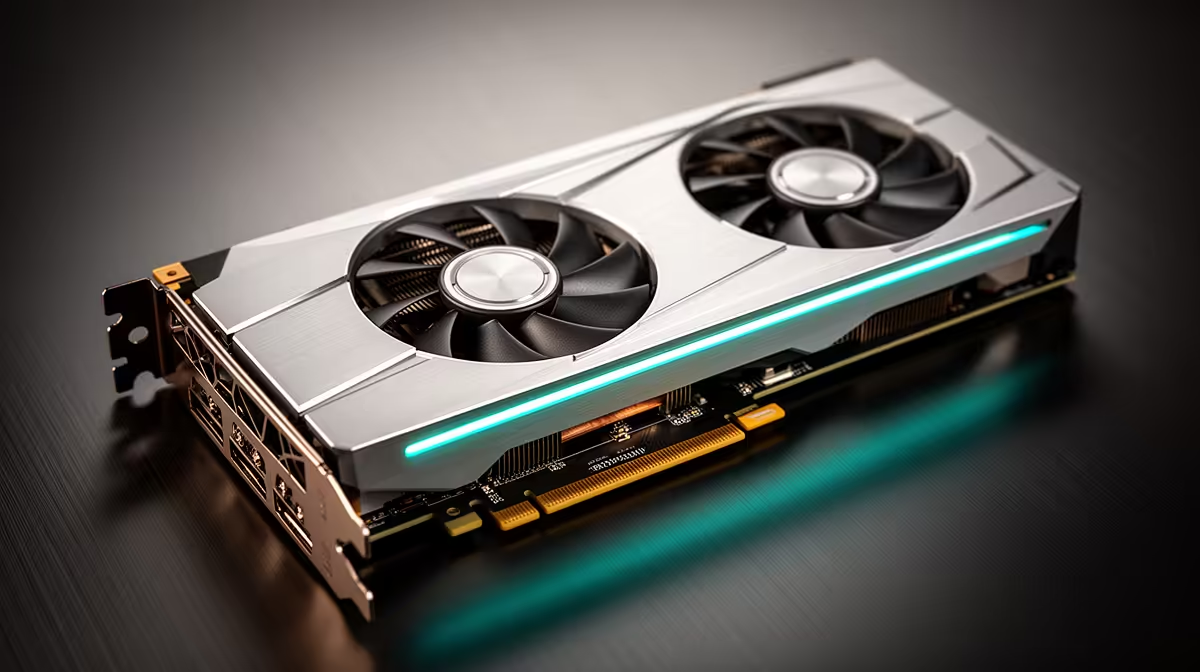
The current NVIDIA graphics-card catalogue helps you compare RTX options, while the GPU best-seller page puts other popular cards beside them. Check the game and card generation before relying on a specific DLSS model.
Why 1080p Exposes Softness
DLSS Quality uses a percentage of the target resolution as its input. The ratio may match across output resolutions, but the pixel count does not. A 4K Quality image supplies far more samples than a 1080p Quality image, giving the model more real detail for edges and textures.
The game's own presentation matters too. Temporal anti-aliasing, motion blur, depth of field and a soft post-processing pass can blur the result before or after DLSS. A low-resolution texture pack cannot be recovered by sharpening.
Test the Cleanest Option First
Set the game to native 1080p and disable motion blur for a short comparison. Use DLAA where available. It applies NVIDIA's anti-aliasing model at the output resolution without the lower internal render, often producing a cleaner image than DLSS Quality at the cost of frames.
If DLAA is too heavy, return to DLSS Quality. Avoid Balanced or Performance at 1080p unless the frame-rate need outweighs the loss of source detail. Those modes reduce the input further.
Add Sharpening With Restraint
Use one sharpening control. Start low, inspect faces, foliage and UI edges, then move it up until detail reads cleanly. Stop when outlines appear around objects or fine patterns sparkle during camera movement.
Some games expose a DLSS sharpening slider, while others rely on a game filter or driver option. Stacking two sharpeners makes the image harsher and can amplify reconstruction artefacts.
Check the Newer Model
For a supported game, the NVIDIA App can apply its Recommended DLSS model through the game's program settings. Newer transformer models can improve stability and fine detail, though an RTX 20 or RTX 30 card may lose more performance with the latest preset. Use the app overlay's DLSS view to confirm what loaded.
Keep the same save, camera position and lighting for the comparison. The best setting is the one that stays clear while you play, not the one that wins a paused crop.
FAQ
Is DLSS Quality always a poor choice at 1080p?
No. Results vary by game, model and scene, and the extra performance can still be worthwhile.
Does sharpening restore missing texture detail?
No. It increases edge contrast; it cannot recreate detail absent from the source asset or internal render.
Is DLAA faster than DLSS Quality?
Usually no. DLAA works from native resolution, so it gives up the main rendering saving of DLSS Super Resolution.
Compare native 1080p, DLAA and DLSS Quality in one moving scene, then add only enough sharpening to keep fine detail stable.