Quick Answer
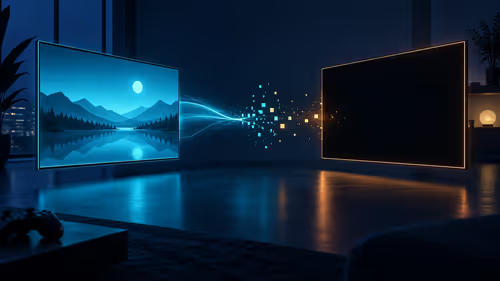
GTG stands for Grey-to-Grey, the time in milliseconds for a pixel to transition between two shades of grey. A 0.3ms GTG rating means the panel transitions between the most favourable pair of grey values in 0.3 milliseconds under controlled lab conditions. In real gameplay, average transition times are typically 1ms to 2ms, but the rating still signals a very fast panel.
How GTG Response Time Is Measured 📊
Manufacturers measure GTG by testing the pixel transition from one specific shade of grey to another and reporting the fastest result. The ISO standard for response time would produce much higher numbers, which is why you rarely see it used in marketing.
The practical implication is that 0.3ms GTG indicates the panel uses aggressive overdrive circuitry and fast LCD material. TN panels traditionally dominated at these speeds, but current OLED displays achieve 0.03ms and modern fast IPS panels regularly hit 0.5ms to 1ms GTG in real-world testing by independent reviewers.
What It Means for Your Gaming Experience 🎮
At 240Hz and above, each frame is on screen for 4.2ms or less. A panel transitioning pixels in under 1ms means the displayed image closely tracks what the game engine rendered, with minimal ghosting or trailing behind fast-moving objects.
However, aggressive overdrive used to hit 0.3ms GTG can cause inverse ghosting on some panels: a bright halo that appears ahead of a moving object. Manufacturers tune overdrive to minimise this tradeoff, but at maximum overdrive settings on some monitors, inverse ghosting becomes visible.
How It Compares Across Panel Types 💡
For South African buyers choosing between panel technologies: a TN panel rated at 0.3ms GTG is a genuine representation because TN liquid crystal responds fastest of the three legacy types. An IPS panel rated at 0.3ms GTG should be tested with a camera or reviewed by independent hardware sites before trusting the spec sheet.
OLED monitors, increasingly available locally at R8,000 to R25,000, sidestep the GTG framing entirely because their per-pixel emissive technology achieves near-zero transition times with no overdrive required. If absolute response time is the priority, a QD-OLED or WOLED gaming monitor is now the definitive answer.
Test Overdrive Before Locking Your Settings ⚡
When you first set up a new monitor, open a free browser-based motion test and cycle through the overdrive presets. The correct setting is the fastest one before inverse ghosting becomes visible. On most panels this is the second or third option from maximum, not the absolute maximum setting.
FAQ
Is 0.3ms GTG noticeably better than 1ms GTG in actual gameplay?
For most players, no. The difference between 0.3ms and 1ms GTG is 0.7 milliseconds, which is below the threshold of human visual perception in normal gaming. The more significant factor is whether the monitor's overdrive is well-tuned to avoid inverse ghosting at its advertised speed.
Why do manufacturers advertise the best-case GTG instead of an average?
Marketing convention. The fastest single transition produces the most impressive number on a spec sheet. Independent reviewers measure a matrix of grey transitions and report averages, which gives a more useful picture of panel behaviour. Reading third-party monitor reviews before purchasing provides the real-world response time profile.
Does response time affect input lag?
No, response time and input lag are separate specifications. Input lag measures the delay from a mouse click or keypress to the frame appearing on screen, typically 1ms to 5ms on modern gaming monitors. GTG response time measures pixel transition speed only. Both matter for competitive play, but they are independent of each other.
Shopping for a fast-response gaming monitor? Evetech stocks gaming monitors across panel types and refresh rates, including fast IPS and OLED options. Visit the monitors category to compare specs and find a panel suited to your game and budget.