


Quick Answer
420mm GPU clearance means the case has 420 millimetres of unobstructed horizontal space from the PCIe slot bracket to the nearest front obstruction. This accommodates every current-generation RTX 5090 and RX 9070 XT AIB triple-fan cooler variant currently available.
How GPU Clearance Is Measured and Why It Varies 📐
Manufacturers measure GPU clearance from the rear I/O bracket cutout to the nearest front obstacle, typically the front fan frame or a radiator. This figure is only valid without a front-mounted radiator unless the spec sheet explicitly states otherwise. A case advertising 420mm may drop to 300mm when a 360mm front radiator is fitted, making the headline figure misleading for liquid-cooled builds.
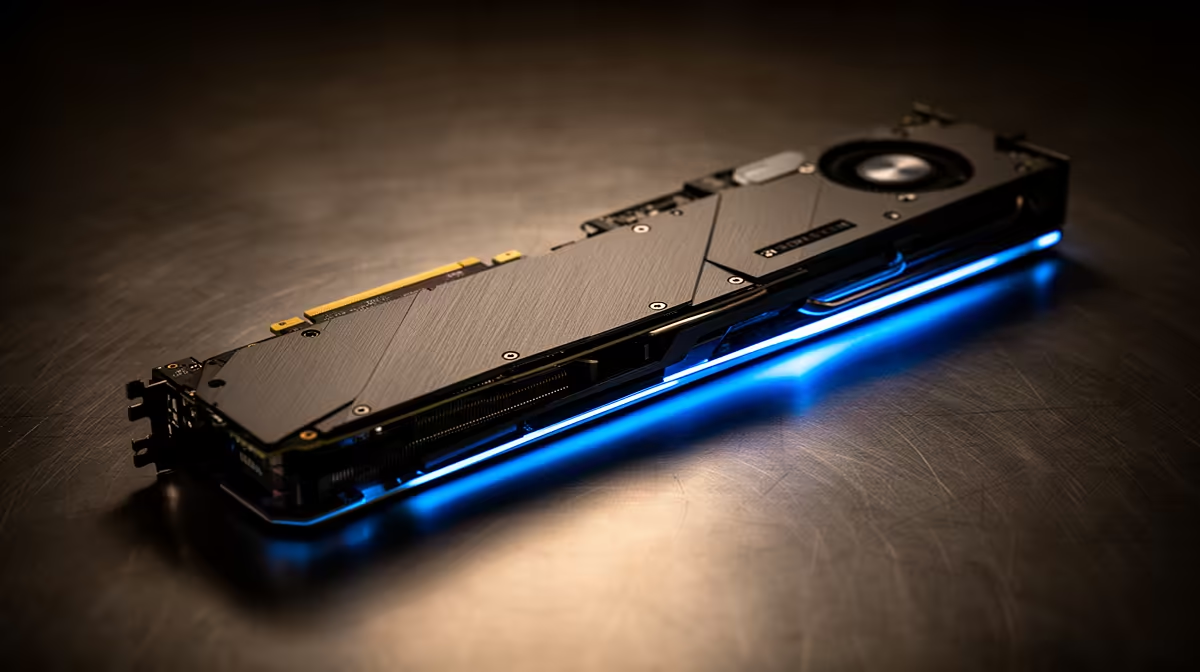
The GPU itself is measured from the slot bracket edge to the far end of the cooler shroud, which always extends beyond the PCB. An RTX 5090 Founders Edition PCB is approximately 336mm, but AIB partner card cooler shrouds commonly extend the full assembly to 360mm to 400mm. A handful of extreme AIB designs reach 420mm or beyond, and these are exactly what a 420mm clearance case is designed to accommodate.
Compatibility Across Current High-End GPU Lines 🖥️
For practical purchasing: the RTX 5090 in ASUS TUF Gaming configuration measures approximately 377mm. The MSI Gaming Trio Plus edition reaches around 360mm. Sapphire Nitro+ RX 9070 XT variants run 320 to 340mm. Virtually all current flagships fit within a 420mm clearance case with the drive cage removed, and most fit even with it present in cases where the cage sits outside the GPU path.
420mm clearance becomes specifically necessary for anticipated future releases and for builders who prefer not to remove drive cages. South African builders investing R25,000 to R50,000 or more in a flagship GPU benefit from a case accommodating any card they might upgrade to within the next two to three hardware generations.
Vertical Mounting and the Impact on Effective Clearance 🔩
The 420mm clearance rating applies to horizontal (standard) mounting. Vertical GPU mounting via a PCIe riser changes effective maximum card length because the riser bracket adds 10 to 20mm overhead at the PCIe slot end, reducing vertical-mount clearance to approximately 390 to 400mm in a case rated at 420mm horizontal.
Additionally, side glass panel clearance for vertical mounting is a separate spec. A case may fit a 420mm GPU horizontally but only accommodate a 2.5-slot card vertically before the cooler sits uncomfortably close to the glass. Confirm the vertical mount GPU thickness clearance (distance from riser to side glass) separately from length clearance when planning a vertical showcase build.
GPU Clearance Verification Before Purchase ⚡
Download the spec sheet PDF for your chosen GPU model from the manufacturer's site and compare total length including cooler against the case's clearance spec. This five-minute check prevents a costly return or exchange, which in the South African market can involve two to three weeks of turnaround time.
FAQ
Does every ATX case support 420mm GPU clearance?
No. Standard ATX mid-towers typically support 380 to 400mm. 420mm clearance is found predominantly in high-clearance mid-towers and full-tower designs. Check the spec sheet rather than inferring from case size alone.
Does larger GPU clearance affect case ventilation?
Not directly. However, cases designed for very long GPUs sometimes have repositioned front fan mounts to create that clearance, which can affect intake fan configuration. Look for cases that maintain three or more front intake fan positions even at 420mm clearance.
If my GPU is only 320mm, does 420mm clearance still benefit me?
Yes. Excess clearance leaves more unobstructed space for airflow and future upgrade flexibility. It does not harm cooling and slightly improves it by reducing restriction between front fans and the GPU.
Fitting a flagship GPU into your next build? Evetech stocks gaming cases with 400mm and 420mm GPU clearance, sized for the current generation of triple-fan high-end graphics cards.











