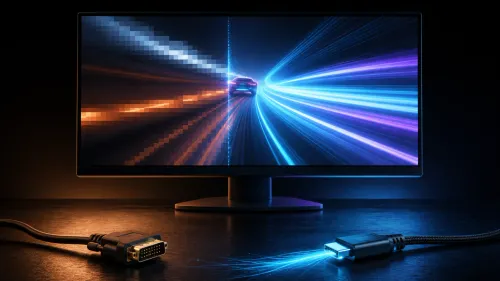
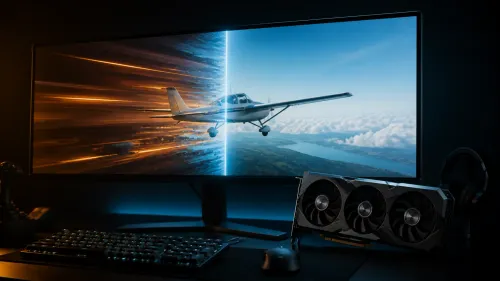
Fast FPS motion is a sequence of imperfect colour changes, not a parade of finished still images. What 1ms GTG does for esports games is shorten selected pixel transitions so the previous frame leaves less residue as the next one arrives. The Alienware AW2726DL combines that 1ms GTG specification with 280Hz and QHD IPS at R4,499.
Quick Answer
A 1ms GTG response can make moving edges look cleaner and help a high-refresh panel separate rapid frames. It does not mean the whole system responds in 1ms, and it can be undermined by poor overdrive or uneven frame delivery. At R4,499, the AW2726DL pairs 1ms GTG with 280Hz and FreeSync Premium, giving the response figure suitable supporting hardware.
🧱 Follow one edge through a fast turn
During a camera pan, each pixel must leave one value and reach another before the next image demands another change. Slow transitions produce a soft trail, especially around dark objects and high-contrast outlines. That can make an opponent harder to track even though the refresh counter looks impressive.
Grey-to-grey testing measures selected steps between luminance values. Real games contain many colour and brightness combinations, so the headline does not describe every transition. Use walls, railings, text and shadowed characters as separate test subjects.
Compare responsive panels through the gaming monitors page, but reserve judgement until moving content has been inspected.
🧨 Distinguish speed from overshoot
Overdrive accelerates pixel changes. A weak setting can leave conventional blur; an excessive one can overshoot the intended value and create pale or dark halos. That inverse ghosting may be more distracting than a small amount of ordinary trailing.
Test the same pan at a high frame cap and a lower one. FreeSync Premium changes refresh timing as performance varies, and a response mode can behave differently across that range. The strongest mode name is not an instruction.
The PC monitor deals collection lets you compare response claims at different prices. The AW2726DL's R4,499 value rests on how 1ms GTG fits with its wider display package, not the number alone.
🎛️ Clean up the rest of the chain
Input passes through the mouse, game simulation, CPU, GPU, render queue, display scan and pixels. Frame-time spikes can add far more delay than the final transition. Keep unnecessary background tasks closed and tune settings for consistent delivery.
Mouse polling and sensitivity should stay fixed during a display comparison. A changed aim setting can alter perceived smoothness and make the new response mode seem responsible. Use the same training drill, crosshair path and target speed so visual differences have fewer places to hide.
Confirm Windows is using 2560x1440 at 280Hz. Choose a deliberate sync and cap strategy, then compare overdrive at a fixed frame rate so two variables do not move together. Record the cleanest mode for later restoration.
The AW2726DL's IPS viewing consistency, HDR10 and 93% DCI-P3 add visual range outside esports. Its height, tilt, swivel and pivot stand helps hold the screen at a repeatable eye line. Look at the monitor best-sellers shelf to evaluate how motion features sit beside these everyday qualities.
Finally, test for thirty minutes rather than one dramatic flick. The chosen response setting should remain clean across different maps and frame rates without causing eye-catching halos. Reliable moderation beats a benchmark-friendly extreme.
Viewing distance affects what you notice. Sit too far away and subtle trails disappear along with useful target detail; sit too close and the full 27-inch field becomes harder to scan. Set the QHD screen for a natural full-frame view before comparing its moving edges.
Save one response mode for competitive use and resist changing it after every poor round. Player consistency, connection quality and game pacing vary. Revisit the monitor only when a repeatable visual artefact returns under the same conditions.
Frequently Asked Questions
Does 1ms GTG mean one millisecond of input lag?
No. It describes pixel transitions, while total input response includes several processing and rendering stages before the panel changes.
Why can the fastest overdrive setting look worse?
Too much acceleration can push pixels beyond their target, producing inverse ghosts around movement. A lower setting may be clearer.
Is 1ms useful below 280 frames per second?
Yes. Fast, well-controlled transitions can preserve edge clarity at lower rates too, though behaviour should be tested across the adaptive-sync range.
Can better response time fix frame-time spikes?
No. A delayed frame is an upstream performance problem. Response time only affects how the pixels change after a frame reaches the display.
Ready to trace the shot from mouse input to the final changing pixel?
Explore Evetech's responsive monitors and select the motion mode that stays clean across the frame rates your matches actually produce.