Quick Answer
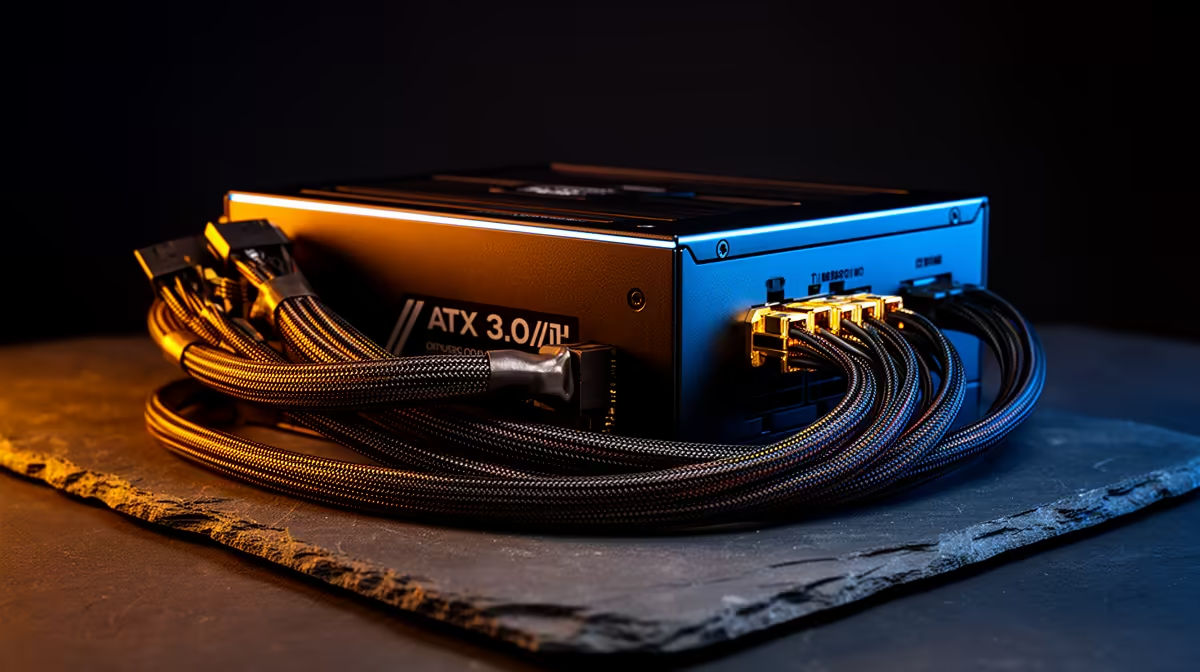
ATX 3.0 (and its successor ATX 3.1) is an updated PSU specification from Intel that raises the requirement for handling power excursions, defines the 16-pin 12VHPWR (now 12V-2x6) native connector for high-power GPUs, and improves transient response. Any PSU built for RTX 40-series, RTX 50-series, or RX 9000-series GPUs should be ATX 3.0 or 3.1 certified.
What Changed From ATX 2.x to ATX 3.0 🔧
The most visible change in ATX 3.0 is the native 16-pin 12VHPWR connector (later refined to 12V-2x6 in ATX 3.1), capable of delivering up to 600W on a single cable versus the 150W per 8-pin connector of the older standard.
Why This Matters for RTX 50-Series and RX 9000-Series Builds 🖥️
The RTX 5080 and RTX 5090 both use the 16-pin 12V-2x6 connector natively. The RX 9070 XT from AMD also uses a 16-pin connector on reference and many AIB designs. A PSU without a native 12V-2x6 cable requires an adapter that converts two or three 8-pin PCIe cables to the 16-pin connector. These adapters are electrically safe when rated and seated correctly, but they require careful installation and have been associated with connector damage when improperly seated under high load. An ATX 3.0 or 3.1 PSU with a native 12V-2x6 cable eliminates the adapter entirely. For South African builders purchasing RTX 5070, 5080, or 5090 builds, choosing an ATX 3.0 certified PSU is strongly recommended, not strictly required but meaningfully safer and cleaner.
Identifying ATX 3.0 Certified PSUs on the SA Market 💰
ATX 3.0 certification is printed on the PSU packaging and listed in the spec sheet. Look for the Cybenetics or 80 PLUS certification stickers alongside an explicit ATX 3.0 or ATX 3.1 badge. SA retailers including Evetech list this specification on product pages. Brands offering ATX 3.0 certified units in South Africa include Corsair (RM1000x Shift, HX series), Seasonic (Focus GX ATX 3.0 variants), be quiet! (Dark Power 13), and MSI (MEG Ai1300P). Prices for 850W to 1000W ATX 3.0 certified Gold or Platinum units currently run from R2,500 to R5,500 in South Africa. Older ATX 2.x inventory is still sold and remains functional for previous-generation GPU builds using 8-pin connectors.
Seat the 12V-2x6 Connector Until It Clicks ⚡
The 16-pin 12V-2x6 connector has a positive locking click that confirms it is fully seated. Partially seated connectors on high-power GPUs can arc or overheat under the 600W draw. Push the connector firmly until you hear and feel the click before powering on. This applies to both native cable and adapter cable versions of the connector.
FAQ
Can I use an ATX 2.x PSU with an RTX 5080 in South Africa?
Yes, via an adapter cable from two or three 8-pin PCIe cables to the 16-pin connector. The GPU will function normally. The risk is limited to connector seating quality and transient response limitations in older PSU designs. For a new high-end build, buying an ATX 3.0 PSU is the cleaner and more future-proof approach.
Is ATX 3.1 significantly better than ATX 3.0?
ATX 3.1 refined the 12VHPWR connector to the 12V-2x6 design, which improved the connector latch and reduced the risk of the partial-seating issue found in early 12VHPWR implementations. Thermal and electrical performance specifications are similar between 3.0 and 3.1. A certified ATX 3.0 PSU with a 12VHPWR cable is functionally equivalent to an ATX 3.1 unit for most builds.
Do lower-wattage builds (under 650W system draw) need ATX 3.0?
Not critically. If your GPU uses an 8-pin PCIe connector (most mid-range cards do), ATX 2.x PSUs work correctly and the 16-pin connector is irrelevant. ATX 3.0 becomes important specifically when connecting to GPUs with native 16-pin power requirements.
Upgrading to an RTX 50-series GPU and need a matching PSU? Evetech stocks ATX 3.0 and ATX 3.1 certified power supplies across 750W to 1600W ratings, all with local SA warranty coverage. Browse the PSU section for your wattage and efficiency tier.