Quick Answer
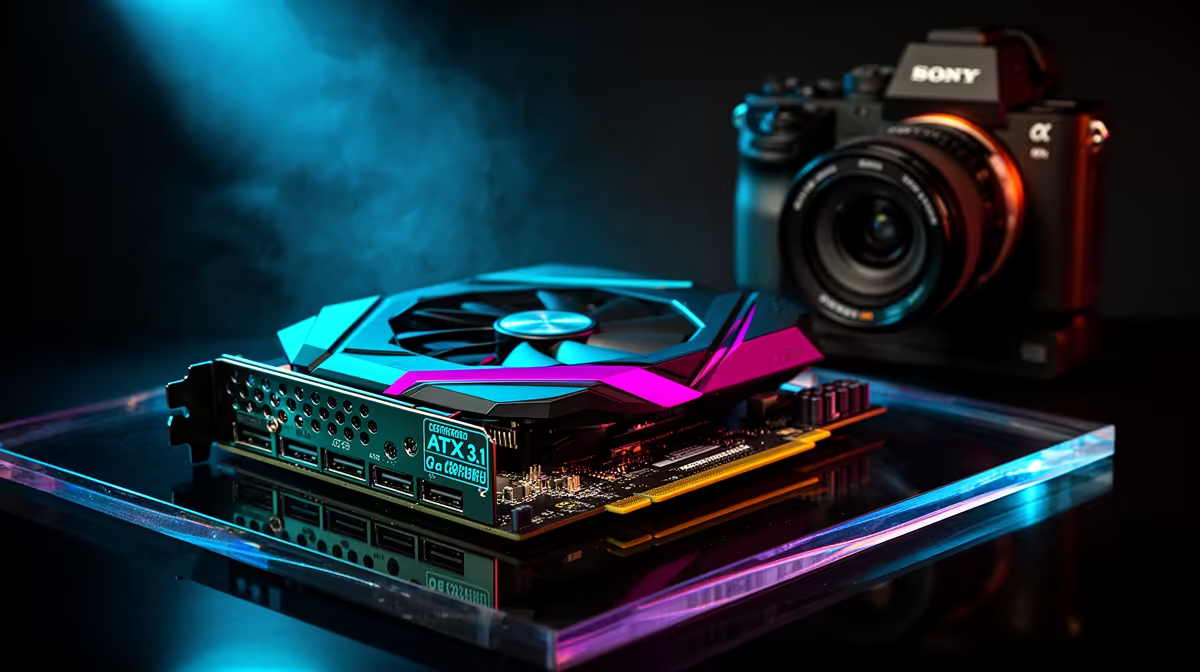
ATX 3.1 is the current PSU standard introducing the native 12V-2x6 connector for high-wattage GPUs, requiring PSUs to handle transient power spikes up to 200% of rated wattage, and tightening voltage regulation tolerances on all rails. For RTX 5090, RTX 5080, and RX 9070 XT builds, ATX 3.1 compliance eliminates the power instability that plagued early 12VHPWR adapter setups on RTX 4090 builds.
The 12V-2x6 Connector and Why It Matters 🔌
ATX 3.0 introduced the 12VHPWR connector capable of delivering 600W to a single GPU. In practice, poorly seated 12VHPWR adapters on early RTX 4090 builds caused melting incidents due to inadequate pin contact force. ATX 3.1 replaced it with the 12V-2x6 connector, which uses a revised pin design with improved contact force and a redesigned retention latch giving clear tactile feedback when fully seated. RTX 5090 and RTX 5080 cards use 12V-2x6 natively; any ATX 3.1 compliant PSU includes a native 12V-2x6 cable rather than requiring an adapter. For South African builders, this directly removes the legacy adapter failure point that made RTX 4090 power delivery a concern.
Transient Excursion Handling Under Gaming Loads 🎮
Modern GPUs spike power dramatically during certain rendering operations. The RTX 5090 can surge from 400W to over 600W in under a millisecond during shadow rendering or scene transitions. ATX 3.0 required PSUs to handle 150% rated wattage in transients; ATX 3.1 raises this to 200%. On a 1000W ATX 3.1 PSU, this means tolerating a 2,000W transient for up to 100 microseconds without tripping overcurrent protection. This eliminates the random system shutdowns that occurred with some pre-ATX 3.1 PSUs paired with RTX 4090 cards during specific in-game scenarios.
Tighter Voltage Regulation Across All Rails ⚡
ATX 3.1 tightens allowable deviation on the 12V, 5V, and 3.3V rails compared to ATX 2.x, which allowed up to 5% deviation. For SA builders running high-capacity DDR5 kits at tight sub-timings, or fast NVMe SSDs, stable voltage from an ATX 3.1 PSU contributes to system stability during memory-intensive workloads like large Blender scenes or multi-stream DaVinci Resolve editing.
Verify ATX 3.1 on the Spec Sheet, Not the Box ⚡
Some PSUs include a 12V-2x6 cable but are not fully ATX 3.1 compliant in transient excursion handling. Look for explicit ATX 3.1 certification on the product data sheet. Evetech's listings specify the compliance standard for current PSU stock.
FAQ
Is an ATX 3.0 PSU compatible with ATX 3.1 GPUs?
Physically yes, using a 12VHPWR-to-12V-2x6 adapter. Electrically, ATX 3.0 lacks full ATX 3.1 transient handling, which can cause instability on GPUs with aggressive power spikes. For a new premium build, a native ATX 3.1 PSU is the correct choice.
Do all new PSUs support ATX 3.1?
Not automatically. Most premium units from Corsair, Seasonic, ASUS ROG, and be quiet! have ATX 3.1 compliant models, but budget units and older stock may still be ATX 2.x or 3.0. Always verify the spec sheet.
What wattage ATX 3.1 PSU pairs with an RTX 5080?
For a single-GPU build with an RTX 5080 and a Ryzen 9 9800X3D or Core Ultra 9 CPU, an 850W to 1000W ATX 3.1 Platinum unit is the recommended pairing, providing headroom for transient spikes while keeping the PSU in its peak efficiency load range.
Upgrading to an RTX 5000-series GPU? Evetech stocks ATX 3.1 compliant PSUs with native 12V-2x6 connectors across 850W, 1000W, and 1200W Platinum-rated options for South African builders.