Quick Answer
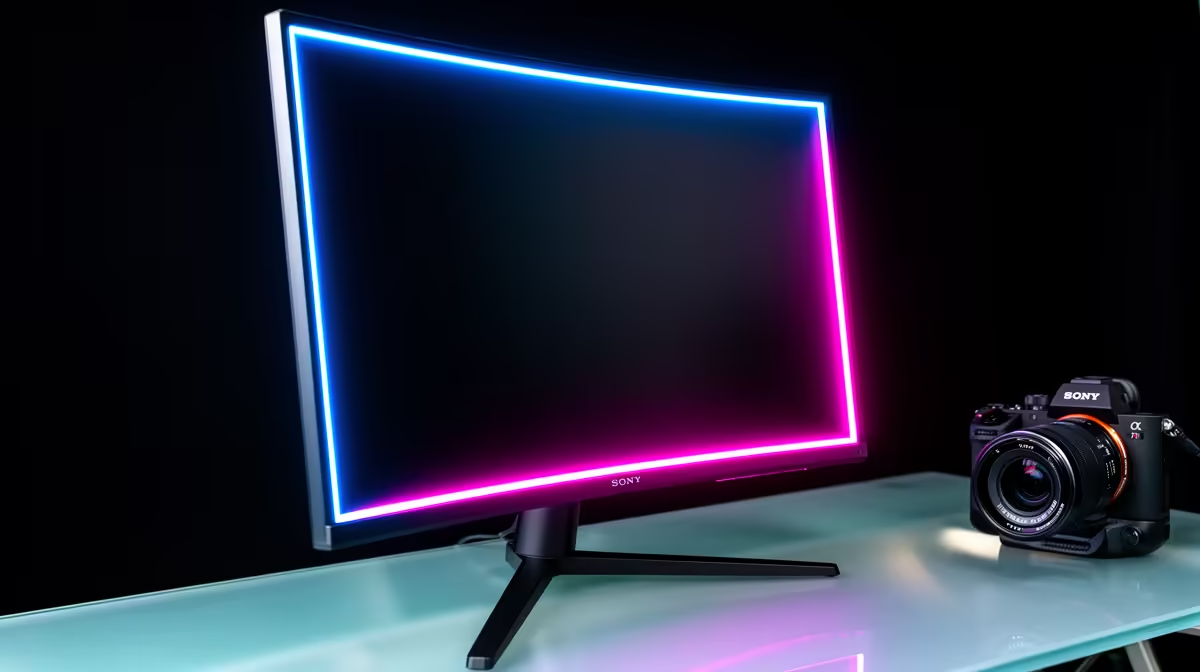
Dual-mode refresh rate on a 4K gaming monitor means the panel can operate in two distinct resolution and refresh rate combinations, typically 4K at 160Hz for visual fidelity and FHD at 320Hz for maximum smoothness in competitive gaming. The switch between modes happens in the monitor OSD without any hardware change.
How Dual-Mode Technology Works at the Panel Level 🔬
A dual-mode 4K panel is a native 4K display whose controller firmware groups sets of four physical pixels (a 2x2 cluster) to act as a single logical pixel in FHD mode. This pixel-grouping reduces the effective resolution to 1920x1080 while simultaneously allowing the panel's controller to complete two refresh cycles in the time it would normally take for one at 4K. The result is that the maximum refresh rate in FHD mode is approximately double the 4K ceiling: a 4K 160Hz panel becomes FHD 320Hz when mode-switched. The grouping is handled by the monitor's electronics; no GPU software change is required beyond updating the output resolution and refresh rate in Windows Display Settings after the OSD switch.
Why Both Modes Exist and Who Benefits 🎮
Dual-mode solves a long-standing dilemma: 4K offers the best image quality but requires a powerful GPU for high frame rates, while FHD 240Hz or 320Hz is achievable on mid-to-high-tier GPUs in competitive titles. A dual-mode panel gives a single screen both capabilities. A gamer who plays Baldur's Gate 3 in 4K 160Hz on Saturday and queues CS2 ranked in FHD 320Hz on Sunday gets the optimal display setting for each genre without owning two monitors. This is particularly relevant in South Africa where desk space and budget often preclude a two-monitor gaming setup, and the cost of a dual-mode panel (typically R12,000 to R18,000 locally) is less than buying two separate specialised monitors.
Setting Up Dual-Mode and What to Check First 🔧
After toggling mode in the OSD, confirm two things: the monitor's indicator shows the correct active mode, and Windows Display Settings shows the matching resolution (3840x2160 for 4K or 1920x1080 for FHD) and refresh rate. Some games detect the resolution change automatically on launch; others need a manual selection in their graphics settings. DisplayPort 1.4 with DSC handles both modes from a single cable without swapping. If the FHD 320Hz option does not appear in Windows, confirm DSC is enabled in the GPU driver and that the monitor's firmware is on the latest version from the manufacturer's support page.
Confirm Both Modes Activate Correctly at First Setup ⚡
When you first connect a dual-mode monitor, test both modes before settling into your game library. Switch to FHD, confirm 320Hz is available in Windows Advanced Display settings, then switch back to 4K and confirm 160Hz appears. A cable or driver issue is easier to diagnose at setup than six months later.
FAQ
Does dual-mode affect the monitor's lifespan or panel health?
No. Dual-mode switching is a firmware and controller function; the physical LCD panel undergoes no additional stress from switching modes. The panel degrades at the same rate as any standard IPS monitor regardless of which mode is used or how frequently the switch occurs.
Can I use dual-mode with a console like a PlayStation 5?
Consoles connect via HDMI 2.1, which does not participate in the dual-mode mechanism (that is controlled by the monitor's internal controller triggered by the OSD). The PS5 outputs 4K at up to 120Hz over HDMI 2.1, displayed in standard 4K mode.
What is the viewing experience like switching between 4K and FHD 320Hz?
At 32 inches, 4K is noticeably sharper in static content; FHD looks softer for text and desktop use. In fast-paced gaming, the FHD 320Hz mode's smoother motion often compensates subjectively.
Want to understand dual-mode in practice before you buy? Evetech stocks dual-mode 4K gaming monitors locally, with knowledgeable pre-sale support and South African warranty on every unit.