Quick Answer
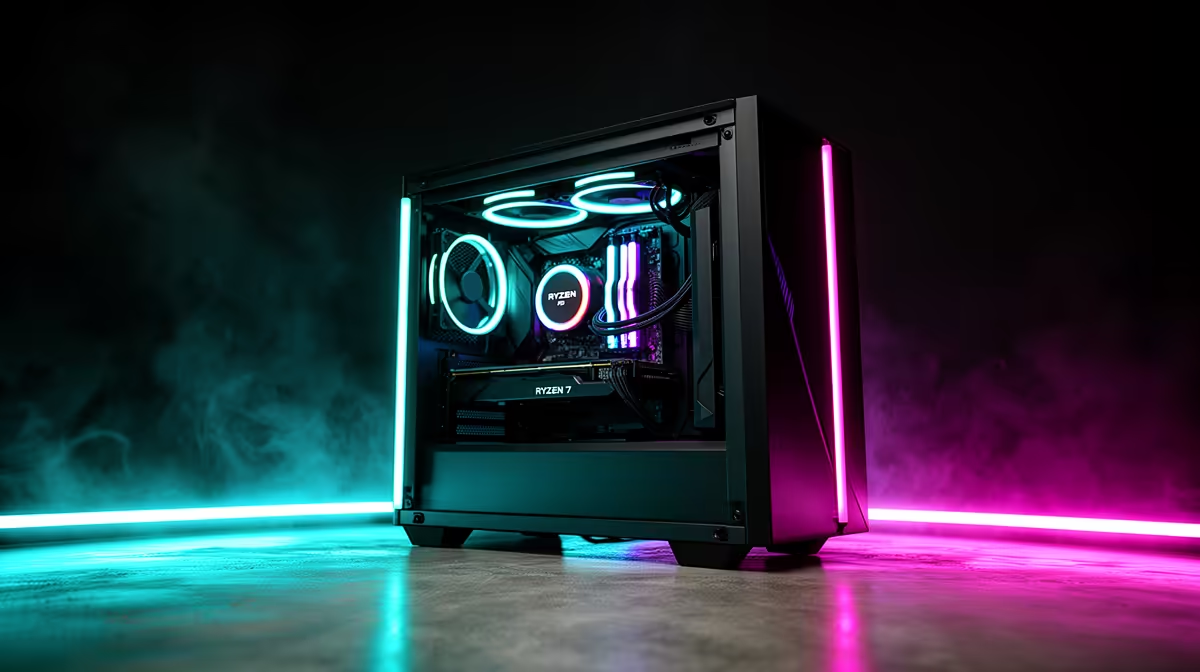
PCIe 4.0 ready means the motherboard and CPU support the fourth-generation PCI Express standard, which doubles the bandwidth of PCIe 3.0. On a Ryzen 7 8700F build this is the default since AM5 supports PCIe 4.0 and 5.0. Any PCIe 4.0 GPU or NVMe SSD will run at full speed in such a system.
What PCIe 4.0 Actually Does in a Gaming PC 🔧
PCI Express is the high-speed interface that connects your GPU, NVMe SSDs, and other expansion cards to your CPU and motherboard. Each PCIe generation doubles the bandwidth of the previous one. PCIe 3.0 delivers 8GT/s per lane; PCIe 4.0 delivers 16GT/s per lane. For a GPU running in an x16 slot, PCIe 4.0 provides 32GB/s of theoretical bandwidth, which is more than enough for current graphics cards including the RTX 5060. In practical gaming benchmarks, the difference between PCIe 3.0 x16 and PCIe 4.0 x16 for a GPU is very small since modern GPUs rarely saturate even PCIe 3.0 bandwidth. Where PCIe 4.0 makes a more noticeable difference is in NVMe SSD sequential read and write speeds.
PCIe 4.0 NVMe SSDs: The Real Beneficiary 💾
A PCIe 4.0 NVMe SSD can achieve sequential read speeds of 5,000MB/s to 7,000MB/s, roughly twice the ceiling of a PCIe 3.0 drive. For gaming this translates to faster level load times, quicker texture streaming in open-world games, and near-instant Windows boot sequences. In competitive titles like Valorant or Apex Legends, faster storage means you are in the lobby and ready before opponents on slower drives. For South African gamers who also use their PC for work, large file transfers between drives happen in seconds rather than minutes. PCIe 4.0 SSDs are widely available locally in the R500 to R1,800 range for 1TB to 2TB capacities.
Does PCIe 4.0 Future-Proof Your Ryzen 7 8700F Build? 📡
The AM5 platform supports both PCIe 4.0 and PCIe 5.0 depending on the slot. The primary GPU slot on most B650 and X670 motherboards runs at PCIe 4.0 x16 or PCIe 5.0 x16. The RTX 5060 itself uses a PCIe 4.0 interface internally, so it operates at full rated bandwidth on both 4.0 and 5.0 slots. If you plan to upgrade to a future GPU that leverages PCIe 5.0, an X670E motherboard with a 5.0 x16 primary slot gives you that upgrade path. For the current build, PCIe 4.0 is fully adequate, and the 8700F on AM5 ensures you are not leaving bandwidth on the table with any current hardware.
Slot Your NVMe in the Right M.2 Socket ⚡
Most AM5 motherboards have multiple M.2 slots but not all of them are wired to PCIe 4.0 bandwidth. The first M.2 slot closest to the CPU typically runs at PCIe 4.0 x4 speeds. Check your motherboard manual before installing your fast NVMe drive to make sure it is in the correct slot, or it will default to a slower interface speed.
FAQ
Does the RTX 5060 need PCIe 4.0 or will it run fine on PCIe 3.0?
The RTX 5060 runs on PCIe 4.0 but is backwards compatible with PCIe 3.0 slots. In most gaming scenarios the performance difference between PCIe 3.0 x16 and PCIe 4.0 x16 for this GPU is one to three percent, which is within noise margins.
Is PCIe 5.0 worth paying extra for on an 8700F build right now?
For current hardware, PCIe 5.0 offers no meaningful gaming advantage over 4.0. PCIe 5.0 NVMe drives exist and are very fast, but they are expensive and the speed difference is not noticeable in everyday gaming or work tasks. PCIe 4.0 is the practical choice for a Ryzen 7 8700F build today.
What is the difference between PCIe 4.0 x4 and PCIe 4.0 x16?
The number after the x indicates how many PCIe lanes are used. x16 uses sixteen lanes and is standard for GPUs, delivering the full bandwidth ceiling. x4 uses four lanes and is standard for NVMe SSDs, which do not require GPU-level bandwidth. Both are PCIe 4.0 and benefit from the generation's improved per-lane throughput.
Want a Ryzen 7 8700F build with PCIe 4.0 ready hardware? Evetech stocks AM5-based gaming PCs and individual components including PCIe 4.0 NVMe SSDs and compatible motherboards. Explore the range to build or buy your next system.