A local LLM is a language model whose full set of weights runs on your own computer, so every prompt, document and line of code you feed it stays on the machine. There is no API call leaving your network, no per-token bill, and no dependence on an internet connection once the model is downloaded. That combination is why local models have moved from a curiosity to a genuinely useful tool for privacy-sensitive and offline work.
Quick Answer
A local LLM runs entirely on your own hardware instead of a remote server. Your data never leaves the device, there are no usage fees per request, and it keeps working offline. The main requirement is enough memory and, ideally, a capable GPU, because a 7-to-8-billion-parameter model comfortably needs around 8GB of VRAM or system RAM to run at a usable speed.
How a Local Model Differs From the Cloud
When you use a cloud chatbot, your text travels to a data centre, the model processes it there, and the answer comes back. A local LLM collapses that loop onto your desk. You download a model file, usually in a quantised GGUF format that shrinks the weights to fit consumer hardware, and a runtime such as Ollama or LM Studio loads it and serves responses directly.
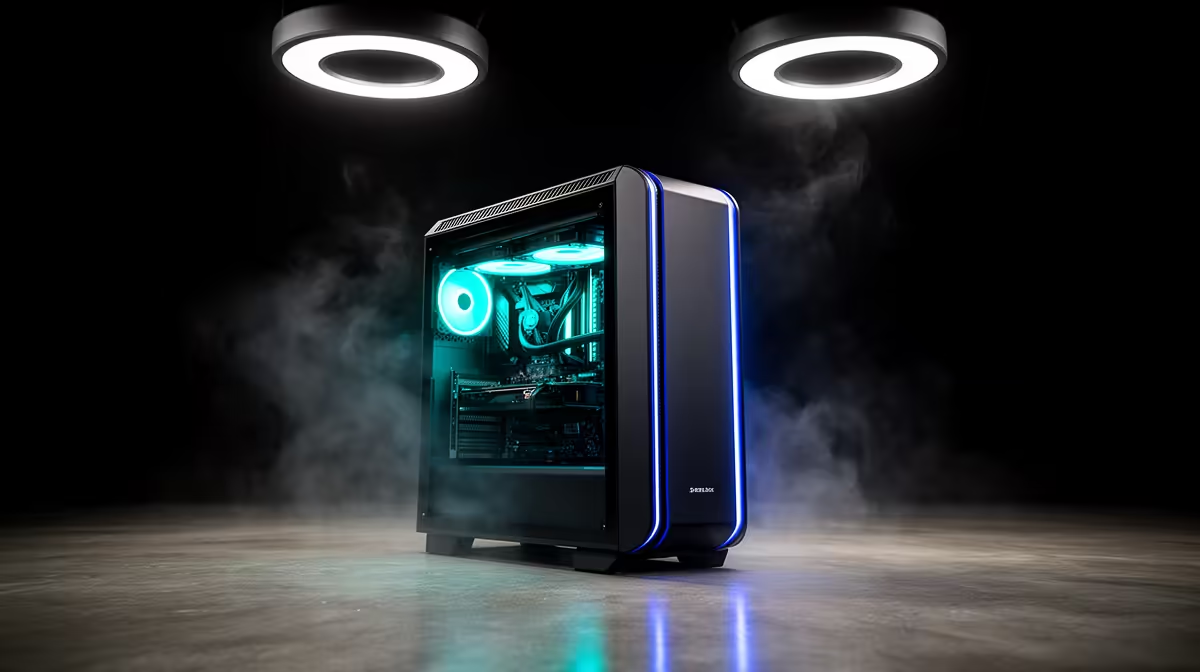
The trade-off is straightforward. Cloud models can be enormous because someone else pays for the hardware. Local models are smaller, so a 7B or 13B model running on your PC will not match the largest frontier systems on the hardest reasoning. For summarising, drafting, code assistance, classification and chat over your own files, though, a well-chosen local model is more than capable. The hardware that makes this practical sits in the AI PC range at Evetech, where the GPU memory is the figure that matters most.
Why People Run Models Locally
Three reasons come up again and again. Privacy is the biggest: legal, medical and financial work often cannot be sent to a third-party server, and a local model removes that risk entirely. Cost is the second: heavy daily use through a paid API adds up, while a local model has no marginal cost once your hardware is bought. Offline capability is the third, which matters for fieldwork, travel or anywhere connectivity is unreliable.
There is also a tinkering appeal. Running models locally lets you swap between them, fine-tune behaviour and integrate them into your own scripts without rate limits. Builders who want to see what other South African enthusiasts are putting together can scan the most popular PC builds at Evetech for a sense of the GPU and memory configurations that handle this work well.
What You Need to Get Started
Start with VRAM. A modern GPU with 8GB runs small models smoothly, 12GB to 16GB opens up larger and more capable ones, and 24GB lets you run bigger models or longer context comfortably. System RAM matters too if you run on the CPU, though that is slower. Then pick a runtime like Ollama, pull a model, and you are chatting within minutes.
Frequently Asked Questions
Do I need an internet connection to use a local LLM?
Only to download the model the first time. After that it runs fully offline, which is one of its main advantages for privacy and remote work.
How much VRAM do I need for a local LLM?
Around 8GB handles a 7-to-8-billion-parameter model at a usable speed. For larger models or longer context, 12GB to 24GB gives you more headroom.
Is a local LLM as good as ChatGPT?
For everyday tasks like drafting, summarising and code help, a good local model is very capable. The very largest cloud models still lead on the hardest reasoning because they are far bigger than anything that fits on a home PC.
What software runs a local LLM?
Popular options include Ollama and LM Studio. They download the model, load it onto your GPU or CPU, and give you a chat interface or an API you can call from your own apps.
Can a local LLM run on a laptop?
Yes, if the laptop has a capable GPU with enough VRAM. Smaller models run on modest hardware, while larger ones benefit from a desktop with a dedicated graphics card.
Want to run models on your own machine? Browse AI-ready PCs at Evetech (https://www.evetech.co.za/components/ai-pcs-443) and pick a configuration with the GPU memory your chosen model needs.