Plug in a modern VR headset and you are playing within minutes, no wall sensors, no cables to mount, no calibration dance. That convenience comes from inside-out tracking, the technique that moved positional tracking from the room onto the headset itself. Cameras on the device watch your surroundings and your hands, and the headset works out where everything is in real time.
Quick Answer
Inside-out tracking uses cameras mounted on the headset to map both your head position and your controller locations, with all the processing done onboard. It removes the external base stations that older outside-in systems needed. Setup is as simple as drawing a play boundary in your room once.
How inside-out tracking works
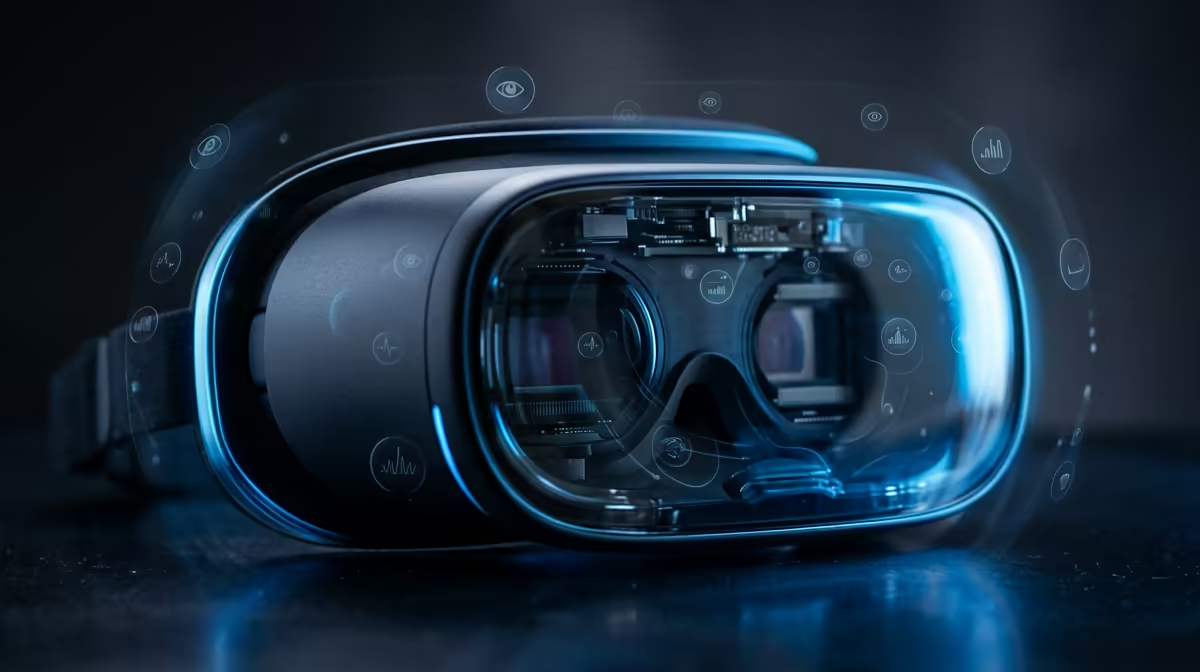
The headset carries several wide-angle cameras pointed outward. As you move, those cameras track fixed reference points in your environment, the edges of furniture, doorways, wall corners, and use the shifting position of those points to calculate how your head moves through space. This gives full six-degrees-of-freedom (6DoF) tracking: forward and back, left and right, up and down, plus pitch, yaw and roll. The same cameras watch the controllers, so the whole system is self-contained inside the headset. Current standalone and tethered headsets sit alongside other immersive gear in the AR and VR range at Evetech if you want to see which models use this approach.
Inside-out versus outside-in
Outside-in tracking, the older approach, relied on external sensors or base stations mounted around the room. These watched the headset and controllers from the outside, which gave extremely precise tracking but demanded permanent mounting points, careful placement and a dedicated space. Inside-out flips the arrangement: the sensors travel with you. The trade-off historically was a small accuracy gap and occasional loss of controller tracking when you moved a controller out of the cameras' view, such as drawing a bow behind your back. Modern systems have closed most of that gap with better cameras, more of them, and predictive software that fills brief blind spots.
Why it became the standard
The practical wins are hard to argue with. There is nothing to install on your walls, so the headset is portable and works in any reasonably lit room. Setup is a one-time boundary draw rather than a sensor-mounting project. It also makes fully standalone headsets possible, where the headset is the entire computer with no external hardware at all. For most buyers, that simplicity is exactly why inside-out tracking now dominates the consumer market.
What affects tracking quality
A few things help inside-out systems track cleanly. Decent, even lighting matters, since the cameras need to see reference points; a pitch-dark room degrades tracking. Some visual variety in the space helps too, as completely blank walls give the cameras fewer features to lock onto. Keeping the play area clear improves both tracking and safety. Accessories like spare controllers, head straps and face covers that improve the experience sit with other add-ons in the accessories best sellers.
Frequently Asked Questions
Is inside-out tracking as accurate as base stations?
For the vast majority of games and apps, yes. Outside-in still holds a slight edge for the most demanding competitive or simulation use, but modern inside-out tracking is precise enough that most users notice no practical difference in everyday play.
Do I need a dedicated room for inside-out tracking?
No. You define a play boundary once in whatever space you have, and the headset tracks within it. You can use the same headset in different rooms without remounting anything, which is one of the format's biggest advantages.
What happens if a controller leaves the cameras' view?
The headset uses motion sensors in the controller to estimate its position briefly, then re-acquires it visually when it comes back into view. For most movements this is seamless, with only fast behind-the-back motions occasionally causing a momentary glitch.
Does inside-out tracking work in the dark?
Not well. The cameras need enough light to see reference points in the room. Normal indoor lighting is fine, but a very dark room will cause tracking to drift or drop. Some headsets add infrared illumination to help in low light.
Curious which headset fits your space? Explore the VR and AR lineup at Evetech, check which models use inside-out tracking, and pick one that sets up in minutes with no wall sensors required.