The Raspberry Pi 5 gained something its predecessors never had: a real PCIe connector on the board. The official M.2 HAT+ is the accessory that turns that connector into a usable NVMe slot, letting you boot the Pi from a proper solid-state drive instead of a microSD card. For anyone running the Pi as an always-on server, that single change transforms its reliability.
Quick Answer
The official Raspberry Pi M.2 HAT+ adapts the Pi 5's single-lane PCIe 2.0 connector into an M.2 M-key slot for 2230 or 2242 NVMe SSDs. It lets the Pi boot and run from a fast, durable NVMe drive instead of microSD, which is the upgrade that makes a Pi reliable enough to leave running.
What the M.2 HAT+ is
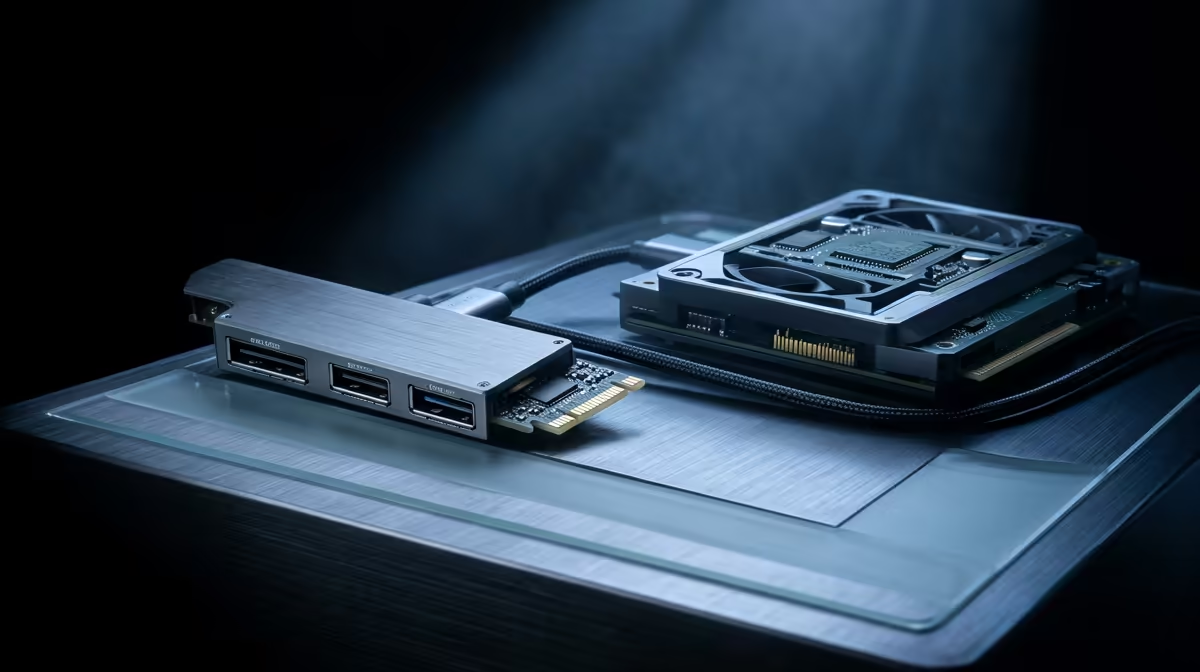
The Pi 5 exposes a small PCIe 2.0 connector on its board, but nothing plugs into it directly. The M.2 HAT+ is a daughterboard that sits on the Pi, connects to that PCIe port via a short flat cable, and presents a standard M.2 M-key slot. Into that slot goes an NVMe SSD in the 2230 or 2242 size, the shorter formats rather than the long 2280 sticks common in desktops.
Because it is a single PCIe 2.0 lane, you will not see desktop NVMe speeds. What you get instead is a drive that is dramatically faster and far more durable than a microSD card, which is exactly what matters for a board that runs around the clock. The official HAT+ is sized to match the Pi's footprint and is the safest path if you want guaranteed compatibility.
If a Pi feels like more tinkering than you want, a ready-built small machine covers many of the same always-on jobs, and the mini PC range at Evetech is a sensible alternative to compare. For a broader view of which compact systems buyers are choosing for home-lab and server duties, the PC best sellers at Evetech offers a useful reference point.
Why NVMe beats microSD
MicroSD cards are the weak point of long-running Pi projects. They are slow at the small random reads and writes an operating system generates constantly, and they wear out, often without warning, when used as a boot drive day and night. A corrupted card means a dead server and a rebuild from backup.
An NVMe SSD through the M.2 HAT+ fixes both problems. Boot and application loads are noticeably quicker, file operations stop being a bottleneck, and the endurance of a real SSD means it tolerates years of continuous writes that would kill a card. For a Pi running a home server, a Pi-hole, a small database or a media service, this is the upgrade that moves it from a hobby toy to something you can rely on.
Fitting it and booting from NVMe
Installation is straightforward. Power off the Pi, fit the NVMe drive into the HAT+ slot, secure it, then connect the HAT+ to the Pi's PCIe connector with the supplied cable and mount it with the standoffs. Take care with the small flat cable, since it seats in one orientation only.
On first boot you will still come up from microSD. To boot from NVMe you copy your OS to the SSD and adjust the Pi's boot order so the NVMe drive takes priority. Once that is set, you can remove the microSD card entirely and the Pi runs purely from the SSD. From then on it behaves like a tiny, quiet, solid-state server.
Frequently Asked Questions
What size NVMe drives fit the HAT+?
The official M.2 HAT+ takes 2230 and 2242 M-key NVMe drives, the shorter formats. The long 2280 sticks used in desktops do not fit, so check the size on the drive's label before buying.
Will I get full NVMe speeds?
No. The Pi 5 offers a single PCIe 2.0 lane, so throughput is capped well below desktop NVMe figures. It is still far faster and more reliable than microSD, which is the real reason to fit it.
Can I boot the Pi entirely from the SSD?
Yes. After copying your OS to the NVMe drive and setting the boot order to prefer it, you can remove the microSD card and run the Pi purely from the SSD.
Do I still need a microSD card?
Only for the initial setup and copying the OS across. Once the Pi boots from NVMe you can take the card out, though some keep one handy as a recovery option.
Is the official HAT+ better than third-party ones?
The official board guarantees fit and compatibility with the Pi 5's connector and power, which removes a lot of guesswork. Third-party boards can work well too, but the official HAT+ is the low-risk choice.
An NVMe drive is what turns a Raspberry Pi 5 into a dependable always-on machine. If you would rather skip the build entirely, compare ready-made options in the Evetech mini PC range and pick the small-footprint server that fits your project.