Quick Answer
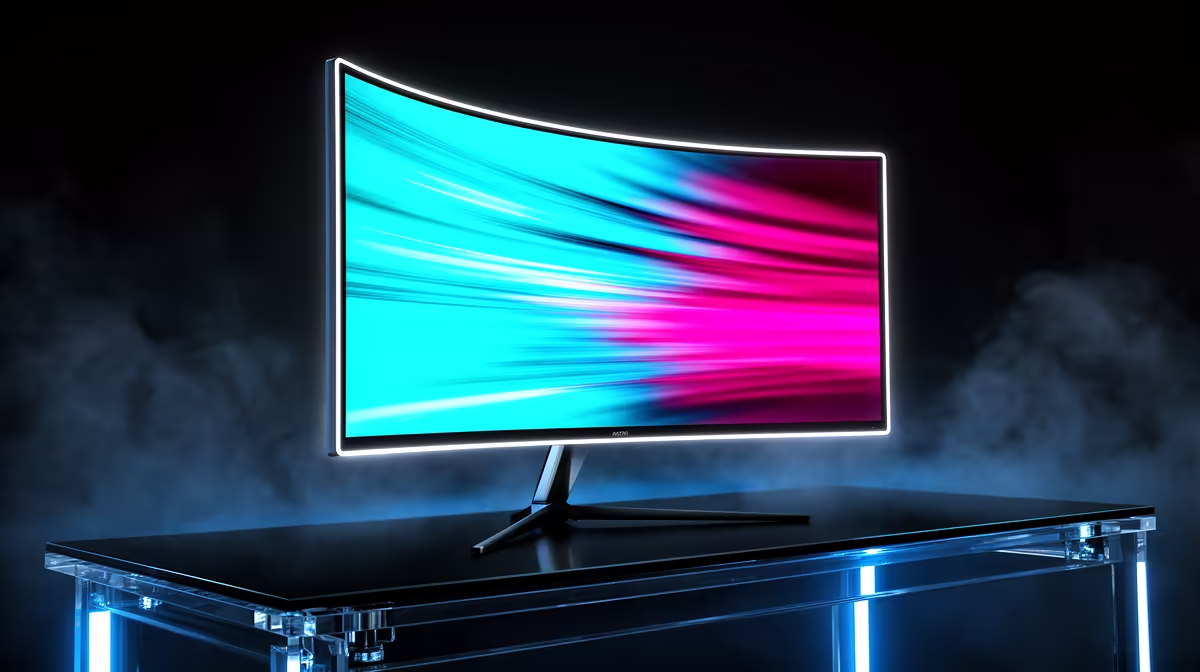
Motion blur persists on fast gaming monitors because pixel response time and panel persistence are two separate issues. Even a 240Hz IPS panel can smear fast-moving objects if the grey-to-grey (GtG) response time exceeds 1ms under real-world overdrive conditions. Enabling backlight strobing (marketed as ULMB, 1ms MPRT, or DyAc) eliminates sample-and-hold blur almost entirely.
Why Refresh Rate Alone Does Not Stop Blur 🔬
High refresh rate reduces the time each frame occupies the screen, but LCD panels hold each pixel lit for the full frame period. Your eye tracks a moving object across those held frames, producing the characteristic smear. This is called sample-and-hold motion blur and affects every LCD regardless of Hz rating. A 360Hz panel still produces visible blur in fast-paced titles like Apex Legends or Valorant if backlight strobing is off. OLED panels mitigate this more naturally because each pixel self-extinguishes between frames, delivering near-zero persistence without a strobe, which is one reason 27-inch OLED gaming monitors in the R8,000 to R14,000 range are popular with competitive players locally.
Response Time, Overdrive and What the Spec Sheet Hides 🖥️
Manufacturers quote the best-case GtG figure, typically measured at a specific voltage swing. Real-world pixel transitions, especially mid-tone greys, can take 3ms to 6ms on IPS panels, producing inverse ghosting when overdrive is pushed too high. Test your monitor by setting overdrive to its lowest level, then stepping up until ghosting halos appear behind fast objects. The sweet spot is one notch below that. For TN panels at 240Hz to 360Hz, GtG often lands under 1ms natively, so overdrive sensitivity is lower. VA panels require careful tuning because their slower transitions cause heavy smearing at default settings despite their contrast advantage.
How to Actually Reduce Motion Blur Right Now 🎮
Enable your monitor's backlight strobe mode through the OSD. On most gaming monitors this is labelled ULMB 2, ELMB Sync, or DyAc Plus. Note that strobing usually requires G-Sync or FreeSync to be disabled on many panels, so pick one or the other based on your priority. Frame rate matters too: strobing works best when your GPU pushes frames at or above the monitor's refresh rate consistently. On an RTX 5070 or RX 9070 XT, targeting 240 fps in esports titles at 1080p is realistic. In Windows display settings, confirm your refresh rate is locked to the panel's maximum, not defaulting to 60Hz after a driver update.
Strobeless Blur Reduction Tip ⚡
Check your in-game motion blur setting and disable it completely before adjusting monitor overdrive. In-game blur is a synthetic post-process effect layered on top of panel blur, so running both simultaneously makes diagnosing the root cause impossible and doubles the smearing effect you see.
FAQ
Does a higher refresh rate always mean less blur?
Not always. Refresh rate reduces the duration of each held frame, which helps, but backlight persistence is the dominant blur source above 144Hz. At 360Hz the frame period is under 3ms, so even moderate pixel response times become the bottleneck.
Can backlight strobing damage my monitor?
No, but it reduces peak brightness significantly, typically by 30% to 50%. Extended use in a bright room may feel dim. Most monitors limit strobing to specific refresh rate ranges, so check the OSD for supported Hz before enabling.
Is an OLED gaming monitor worth the premium in South Africa?
For competitive esports players who notice sample-and-hold blur, yes. OLED panels at 240Hz to 480Hz deliver near-zero persistence without needing strobing. Entry OLED gaming monitors are currently stocked at Evetech starting around R8,500 for 27-inch 1080p models.
Ready to eliminate blur from your gaming setup? Browse Evetech's range of fast gaming monitors, including high-Hz IPS and OLED options, all stocked locally and ready to ship across South Africa.