Quick Answer
PCIe 5.1 doubles the bandwidth per lane over PCIe 4.0 and provides 128 GB/s on a x16 slot, but current consumer GPUs including the RTX 5090 and RX 9070 XT do not saturate even PCIe 4.0 x16 bandwidth in games. PCIe 5.1 readiness matters more for NVMe SSD performance and future GPU generations than for current gaming.
PCIe 5.1 Bandwidth and What GPUs Actually Use 🖥️
PCIe 5.0 x16 delivers 128 GB/s of bidirectional bandwidth. The RTX 5090 in game benchmarks uses less than 20 GB/s of that in most titles, meaning even a PCIe 4.0 x16 slot (64 GB/s) provides ample headroom for current gaming. Frame time comparisons between PCIe 4.0 and PCIe 5.0 with an RTX 5090 at 4K show under 1% frame rate difference in virtually all game titles. For current gaming, PCIe version below the x16 slot does not meaningfully change your frame rates.
Where PCIe 5.1 Makes a Measurable Difference 🚀
PCIe 5.0 and 5.1 NVMe SSDs are where higher bandwidth is genuinely consumed today. PCIe 5.0 NVMe drives achieve 12,000 to 14,000 MB/s sequential read, versus 7,000 MB/s on PCIe 4.0. For content creators, video editors, and AI workloads transferring multi-gigabyte project files, the difference is real. In gaming, DirectStorage 1.2 leverages PCIe 5.0 NVMe bandwidth for GPU-direct asset decompression, which benefits open-world titles with large asset streaming needs. PCIe 5.1 (ratified in 2023) extends this with improved signal integrity and support for higher-speed x4 and x8 configurations.
Future-Proofing Your SA Build for PCIe 5.1 💡
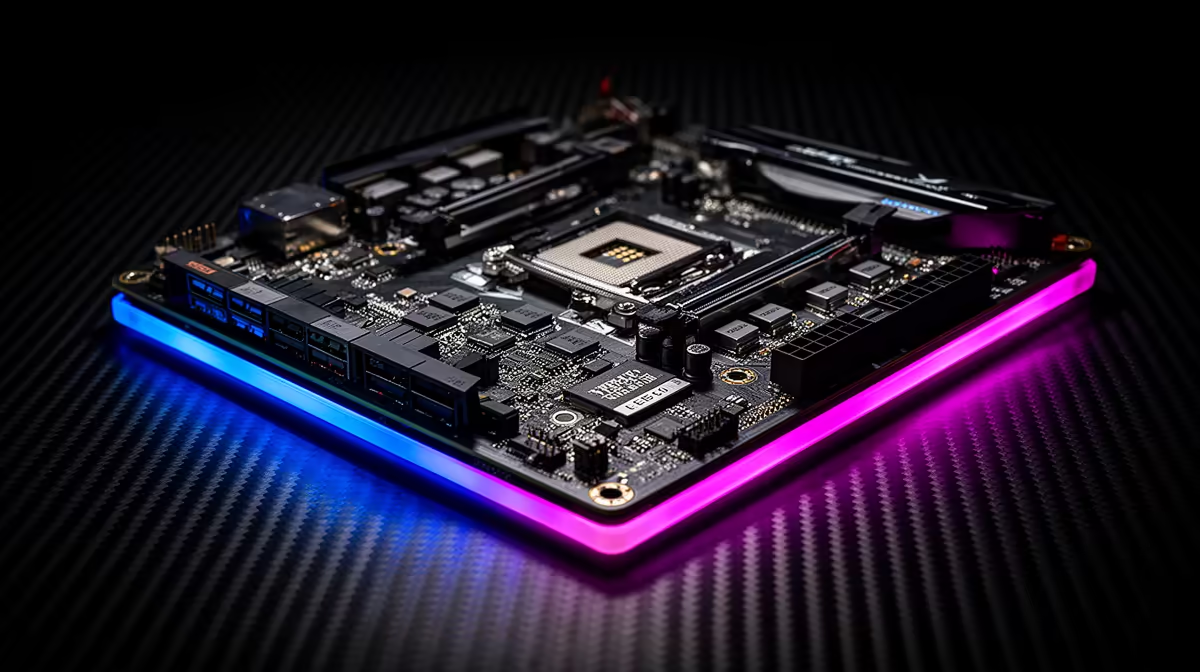
Motherboards on AMD AM5 (X670E, X870E) and Intel LGA1851 (Z890) support PCIe 5.0 x16 for the primary GPU slot and PCIe 5.0 x4 for NVMe. These platforms are PCIe 5.1-capable through firmware in most cases. For South African builders spending R20,000 to R40,000 on a gaming and creative workstation that will last three to five years, an AM5 or LGA1851 motherboard with PCIe 5.0 x16 already provides the foundation for the next two GPU generations without a platform change.
Slot Your GPU in the Primary x16 Slot Only ⚡
On Z890 and X870E boards, the primary M.2 slot nearest the GPU slot shares PCIe lanes in some configurations and may reduce the GPU slot to x8 when populated. Check your motherboard's slot sharing documentation before installing a PCIe 5.0 NVMe in the M.2_1 slot on the same lane group as your GPU to avoid unintended bandwidth reduction.
FAQ
Does it matter whether my GPU runs at PCIe 5.0 x16 or PCIe 4.0 x16 in gaming?
For current-generation games, no. The bandwidth available on PCIe 4.0 x16 exceeds what even the RTX 5090 uses in game rendering workloads. The difference only appears in synthetic bandwidth tests, not real frame rates.
Will future GPUs need PCIe 5.1?
Possibly in two or three generations. GPU designers are incrementally increasing reliance on system bandwidth for cache and texture streaming. PCIe 5.1 readiness on a current platform extends its relevance beyond 2028 for the GPU slot.
Does PCIe 5.1 require a new CPU as well as a new motherboard in South Africa?
PCIe 5.0 is available on current AM5 and LGA1851 CPUs in South Africa. PCIe 5.1 is supported by some AM5 and Z890 motherboard firmware updates; check your specific board's specification sheet for 5.1 support status.
Building a future-ready gaming or workstation PC? Browse PCIe 5.0-ready graphics cards and AM5 and LGA1851 components at Evetech for your next build.